Since the hon'ble PM Shri @narendramodi is personally handling the burning issue of paper leaks, I urge him to personally intervene on the ethanol blending policy as well.
Just because everyday working-class citizens aren't protesting on the streets doesn't mean this isn't a crisis. Most people can't afford to take leave from work to protest, but that doesn't lessen the severity of the issue.
The public is the biggest stakeholder in fuel policy. People save their hard-earned money for years to buy vehicles and pay taxes, only for officials to unilaterally introduce fuel blends that existing vehicle engines were never designed to handle.
Bringing E20 when most of the existing vehicle fleet was incompatible was already a misstep. Now, as people buy E20-compliant cars, there are talks of pushing to E27 by 2030. Where is the long-term clarity? Policies of such massive scale cannot be left to the whims and siloed decisions of one or two ministers and their teams.
The public deserves a logical, transparent, long-term roadmap with clear timelines so buyers can make informed decisions. Respectfully requesting intervention.
Honest feedback for the GoI to consider, offered as a well-wisher:
1. E20 is a massive issue. Just because people aren't protesting in the streets doesn't mean it isn't. There is a simmering anger everywhere.
2. The root cause of this mess is singular: someone decided it was acceptable to ignore the National Policy on Biofuels 2018's plan to introduce E20 in 2030, which would have allowed older, non-compliant vehicles to phase out naturally. Instead, E20 was rolled out despite the fact that most vehicles on the road are not calibrated to run on it.
3. There is no "lobby" behind this public frustration. If the govt believes there is, they should expose the nexus and let citizens decide for themselves. Otherwise, ministers and spokespersons are only making things worse by using "lobbies" and "deep states" as defensive arguments.
4. Vehicle performance is suffering. Drivers are experiencing a drop in mileage and damage to parts. After months of denial, even Nitin Gadkari and Hardeep Puri have acknowledged "some issues" with Ethanol.
5. If the goal is true energy security, the focus and push must shift toward EVs, alongside exploring nuclear energy as a primary power source. The govt should encourage and incentivize EV adoption through subsidies and a robust infrastructure network. Ethanol, in the way it is currently being implemented, is doing more harm than good.
6. The solution is to provide a choice between E0 and E20. If the current fuel infrastructure cannot support both, E20 should be rolled back to E10 until 2030. This will allow older cars and bikes to be phased out naturally before moving forward. And also, do not introduce E27 or whatever is next till the new fleet is E27 compliant and all E20 cars are phased out, unless there is an infrastructure in place to dispense both in future.
हित वचन तूने नहीं माना
मैत्री का मूल्य न पहचाना
तो ले, मैं भी अब जाता हूँ
बहुत-बहुत धन्यवाद @BJP4India! नमन रहेगा @narendramodi यह दिन दिखाने के लिए कि इस राष्ट्र में आतंकवादी सड़क घेर सकते हैं, दंगे कर सकते हैं, फिर वापस प्रदर्शन कर सकते हैं, पर आपकी कायर सरकार को समस्या मेरे जैसों से है।
आज मैं अपने घर में कैद हूँ। आज मेरा आना-जाना बंद है। न तो व्यक्ति अमर होता है, न सत्ता!
आप लोग कायरों का एक समूह मात्र हैं। आप समाज को बाँटने वाले, डरपोक हो जो ट्रोल बंदरों की एक सेना बिठा कर हमें कलंकित करना चाहते हो।
दिल्ली में आए मित्रों का आह्वान करता हूँ कि रामलीला मैदान की ‘मोदी छावनी’ तक पहुँचिए। मोदी ने छावनी बनवाई है तो आप उसी मोदी तक अपने नारों को पहुँचाइए।
ये आपके बच्चों को जन्मजात अपराधी बना चुके हैं और आपको आतंकवादी की तरह देखते हैं। आप सवर्ण हैं तो इसका प्रतिकार कीजिए।
#March8DelhiChalo
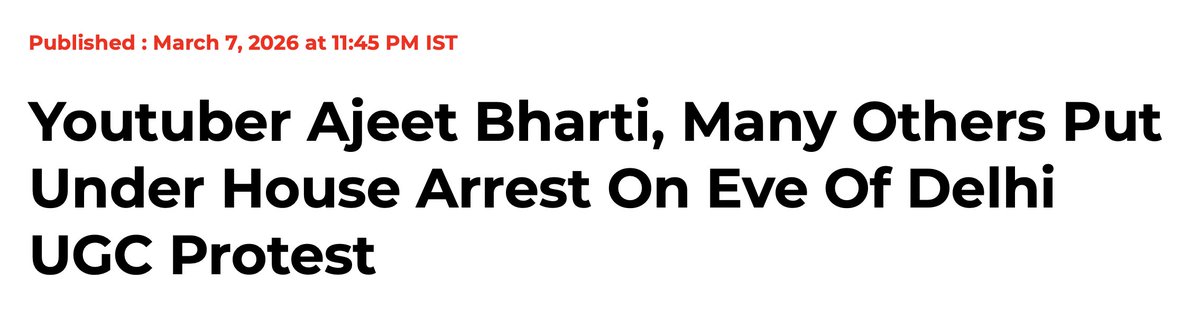
In this country tens of thousands can attend funerals of terrorists, congregate to call for the breakup of India, block an arterial road for six months, lay siege to a highway for a year, but if @ajeetbharti wants to protest, legally and peacefully, he is put under house arrest.
Dear @narendramodi. The @ugc_india Equity Regulations are unjust and must be revised:
1 Caste discrimination victim definition excludes general category
2 Equity committee composition excludes mention of general category
3 There is no provision for punishing false complaints
Until now, the minimum qualifying criterion for PG medical seats for SC, ST, and OBC candidates was the 40th percentile, about 235 marks out of 800.
As per an order of the Ministry of Health, this has been reduced to the 0th percentile, meaning even a score of –40 out of 800 is now eligible, subject to seat availability.
The one profession that directly deals with life and death, where competence should be sacred and non-negotiable,has been dragged down to this level. Perhaps this is the only country in the world where such a dangerous dilution of standards is not just tolerated, but actively encouraged.
Whosoever is affected by IndiGo’s delays or cancellations should form an alliance, and drag the airline to court to make an example out of it.
Screaming at ground staff achieves nothing except giving IndiGo a convenient escape while ordinary employees absorb the public’s anger for decisions made by a dysfunctional management. The people at the counter have no authority over the mess operations creates; they can’t summon an aircraft or override safety and scheduling rules.
All that rage only slows things further because staff must handle confrontations instead of trying whatever limited fixes they can offer. Aim at the airline’s leadership, not at the people forced to stand between you and IndiGo’s mismanagement, unless venting is all you wanted.
AI वैज्ञानिक Santosh Yadav को पीटा, Cab driver के सिर पर बोतल फोड़ी, 6 साल की बच्ची के प्राइवेट पार्ट पर हमला — सिर्फ़ इसलिए कि ये भारतीय थे!
Ireland में क्यों बढ़ रहे हैं Indians के खिलाफ हमले?
@india_expert
Maharashtra has banned pigeon feeding spots, a welcome step.
Pigeons are harmful. They spread histoplasmosis, cryptococcosis and over 50 other diseases. They breed rapidly, overpopulate, and become a nuisance. Their droppings are acidic and corrosive, damaging buildings, vehicles, and public spaces.
Growing pigeon dominance has coincided with a sharp decline in sparrow populations. Once a dominant species in Indian cities, sparrows are now rarely seen in urban India, a stark example of survival of the fittest. As cities modernized, architecture evolved, eliminating the small holes and ledges sparrows relied on for nesting. Pigeons, on the other hand, adapted with ease, nesting on flat surfaces, cramped balconies, rooftops, and even ACs.
Sparrows also suffered from vanishing green spaces and kitchen gardens, which cut off their supply of insects and grains. Meanwhile, pigeons thrived on food scraps and showed remarkable resilience to urban life.
Unlike pigeons, sparrows played a gentler, more beneficial role, controlling insects, keeping cleaner nests, and adding soft chirps to the urban soundscape. Pigeons, by contrast, overwhelm spaces with their aggressive presence and loud, repetitive cooing.
मुगलों के आगमन से पूर्व, भारत में विवाह दिन में ही संपन्न होते थे। @DrKumarVishwas जी की सुपुत्री का विवाह भी दिन में ही संपन्न हुआ।
दक्षिण भारत में यह परंपरा आज भी है।
अपने घर-परिवार में पावन कार्यों का आयोजन दिन में ही करें, यही हमारी संस्कृति है।