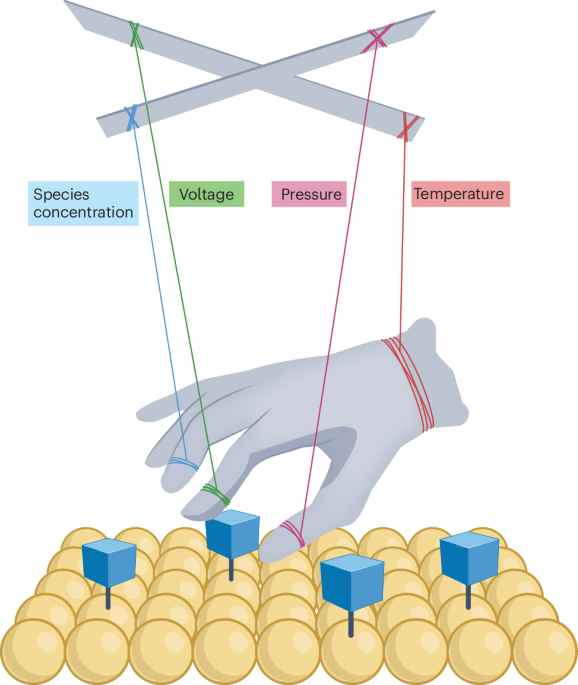
Our piece "The overlooked role of adsorption isotherms in electrocatalysis" is online @NatureCatalysis. We highlight the challenges and opportunities in understanding echem isotherms, and hope it will stimulate rich dialogue in the community! (1/2)
Link: https://t.co/6mMuo295Ph
Excited to share an updated preprint from our OC25 release last summer! We demonstrate how OC25-trained models enable large-scale, explicit-solvent simulations of electrocatalytic interfaces! Lots of exciting insights on CO dimerization on Cu!
Preprint: https://t.co/Jebq9fLHzy
Excited that OC25 dataset and models for solid-liquid interfaces is out! It was great fun working on this project with FAIR Chemistry @AIatMeta! We hope OC25 will accelerate the modeling of interfaces and are looking forward to feedback from the community!
See details below!
This month we welcome a new DELI Lab member - Zacc Koh who is joining us as a PhD student and will work on temperature effects in electrocatalysis! Zacc obtained his BS from NTU. Looking forward to working together!
Neil Razdan (UC Berkeley) and I are organizing a symposium on "Thermal and Electrocatalytic Processes in Nonlegacy Reaction Media" (description below) at #ACSFall2026 in Chicago. If you work in these areas, consider submitting an abstract by March 30!
https://t.co/iYRg4dsf4J
Neil Razdan (UC Berkeley) and I are organizing a symposium on "Thermal and Electrocatalytic Processes in Nonlegacy Reaction Media" (description below) at #ACSFall2026 in Chicago. If you work in these areas, consider submitting an abstract by March 30!
https://t.co/iYRg4dsf4J
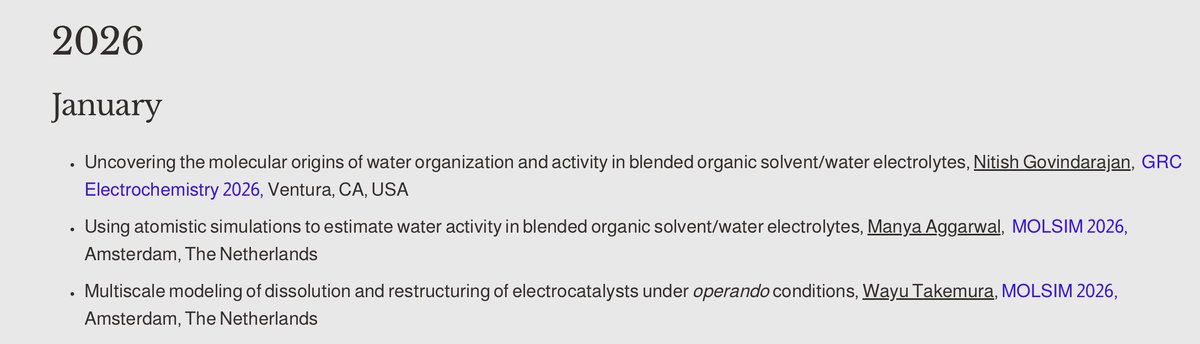
New year - new conferences:
Manya and Wayu will attend MOLSIM in Amsterdam to learn from the best and present work on electrolytes/dissolution: https://t.co/TbVQjeLY9y
I will attend Electrochem GRC in Ventura and present work on blended electrolytes: https://t.co/NuLZHx4nZQ
Year one in the books for DELI Lab 🎉From launching the lab to building our first projects and collaborations, it’s been an exciting start! Grateful for an amazing team and looking forward to exciting science in 2026!
Checkout 2025 highlights & more:
https://t.co/ippGVTknmg
Our piece "The overlooked role of adsorption isotherms in electrocatalysis" is online @NatureCatalysis. We highlight the challenges and opportunities in understanding echem isotherms, and hope it will stimulate rich dialogue in the community! (1/2)
Link: https://t.co/6mMuo295Ph
Our piece "The overlooked role of adsorption isotherms in electrocatalysis" is online @NatureCatalysis. We highlight the challenges and opportunities in understanding echem isotherms, and hope it will stimulate rich dialogue in the community! (1/2)
Link: https://t.co/6mMuo295Ph
We are looking for candidates interested in applying to a joint PhD program between NTU and Sorbonne University starting Aug 2026!
The project involves atomistic simulations of water in salt electrolytes. More details on the project can be found here: https://t.co/cGwJXCwfdS
My (not so random) musings after reading recent literature and reviewing papers on this topic: Many (electro)catalytic reactions produce multiple products. As a result, predicting product selectivity as a function of catalyst material/reaction environment is of interest. Always nice to remind ourselves of how sensitive are predictions in product selectivity to the calculated (DFT) energetics, and if predicting small increases in selectivity is really feasible!
In this example (taken from our @ChemicalScience perspective https://t.co/wEdTo5EmUj) we see how in the region from −0.05 eV to 0.05 eV, the selectivity towards product (P1) already changes from 12% to 87%! So think before attributing small changes in selectivity to things like active site identity.
Our article is on the front cover of this month's issue @ACSEnergyLett!
About the Cover:
The development of multiscale modeling approaches can act as a lens to visualize and understand electrochemical processes. To evolve towards a mature field, strengths and limitations of various methods need to be thoroughly understood, and clear guidelines established.
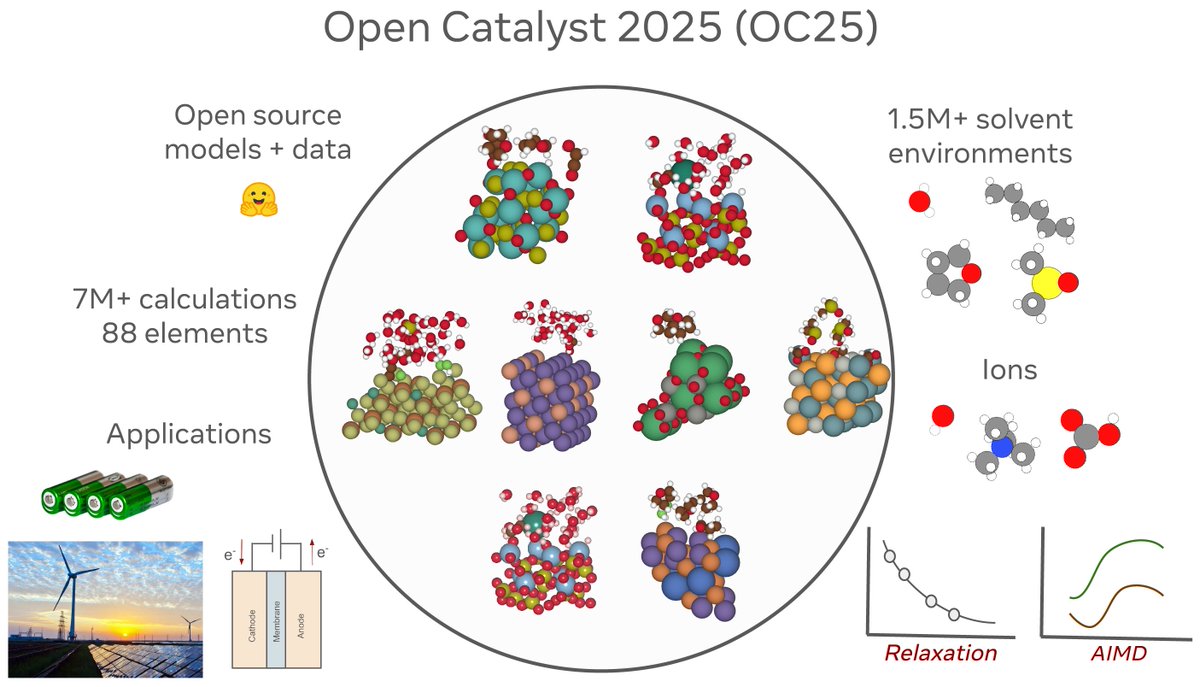
Key aspects of OC25:
1. ~7 million DFT evaluations across 1.5 million unique structures
2. 8 solvents: Water, THF, Benzene, Diethyl ether, DMSO, CCl4, methanol, hexane
3. Several cations and anions
4. Wide range of surface charge densities of metal/electrolyte interfaces
Excited that OC25 dataset and models for solid-liquid interfaces is out! It was great fun working on this project with FAIR Chemistry @AIatMeta! We hope OC25 will accelerate the modeling of interfaces and are looking forward to feedback from the community!
See details below!
🚀With Climate Week NYC going on now, I’m excited to announce the @Meta FAIR Chemistry team's latest release - The Open Catalyst 2025 (OC25) Dataset and Models for Solid-Liquid Interfaces!
Paper: https://t.co/BqQN2Qrw8u
Dataset+Models: https://t.co/cCXuSFMF8I
1/n
Key aspects of OC25:
1. ~7 million DFT evaluations across 1.5 million unique structures
2. 8 solvents: Water, THF, Benzene, Diethyl ether, DMSO, CCl4, methanol, hexane
3. Several cations and anions
4. Wide range of surface charge densities of metal/electrolyte interfaces