life hack: do the work. stop looking for the shortcut, and do the work. stop overthinking, and do the work. stop listening to people tell you why you'll fail, and do the work.
Your gut might be the real culprit.
Scientists discovered a fascinating circuit connecting your brain directly to Brunner's glands in your small intestine.
These glands secrete mucin—a crucial protein that feeds gut bacteria.
When this system is disrupted, brain fog follows.
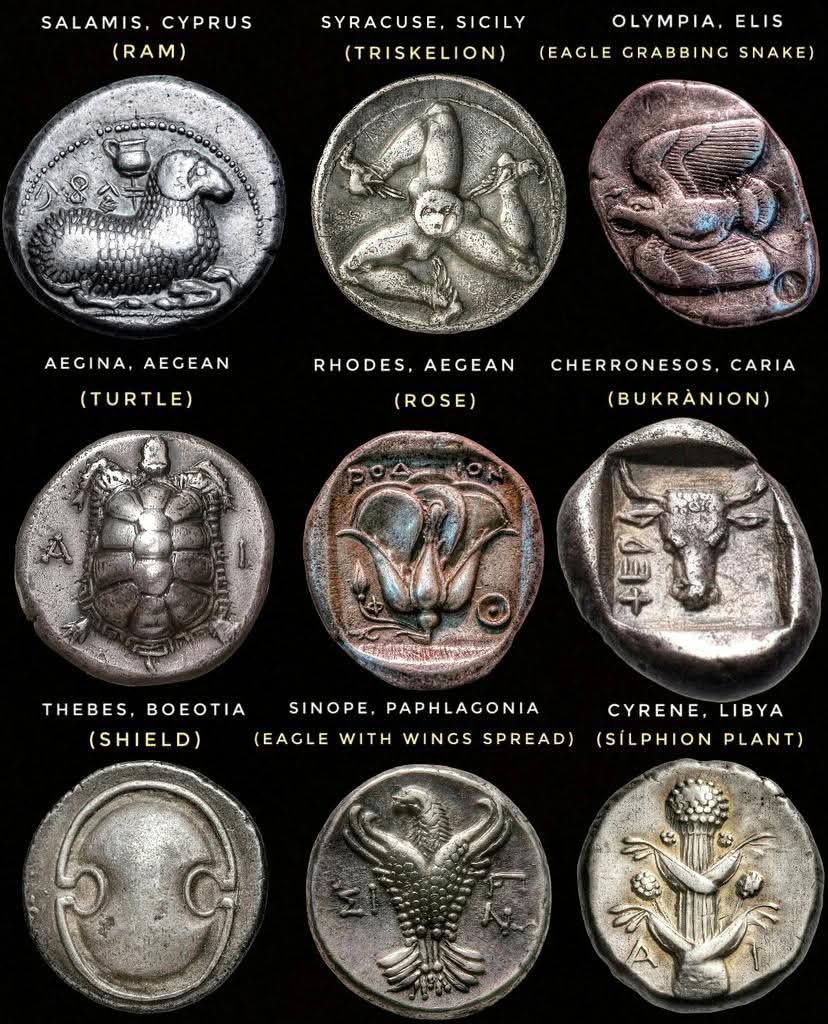
History of Ancient Greek Coins:
The history of ancient Greek coins is a fascinating tale of innovation, politics, art, and culture. Coinage played a pivotal role in shaping the economic and political landscapes of the Greek world, serving not only as a medium of exchange but also as a means of propaganda, artistry, and religious expression.
• The Beginnings of Coinage (7th Century BC) :
The first known Greek coins were minted in the region of Lydia, located in modern-day Turkey, around 600 BC. These early coins were made of electrum, a naturally occurring alloy of gold and silver. King Croesus of Lydia (reigning from 595-546 BC) is often credited with introducing the first pure gold and silver coins, which became highly influential in the ancient world.
However, the idea of coinage soon spread to the Greek city-states, and by the 7th Century BC, the Greek world began producing their own coins. The city-state of Aegina (located in the Saronic Gulf) is thought to have been one of the first to mint coins. The Aeginetan stater, featuring a turtle symbol, became a widely circulated and recognized coin throughout the Mediterranean.
2. The Rise of City-State Coinage (6th-5th Century BC) :
By the 6th Century BC, many Greek city-states began minting their own coins. This was a revolutionary development, as it gave city-states greater control over their economies and allowed them to express their unique identity through the symbols depicted on the coins. Athens was one of the most famous early coin producers, with the Athenian owl coin (featuring the goddess Athena and an owl) becoming an iconic symbol of the city and widely circulated across the Greek world.
Each city-state had its own minting system, with designs that often featured local gods, heroes, or symbols of power. For instance:
Corinth minted coins featuring the Pegasus, the winged horse, which was a symbol of the city.
Syracuse on the island of Sicily, under the rule of Dionysius I, minted magnificent coins featuring images of Arethusa, the nymph, along with dolphins.
Ephesus featured the goddess Artemis on its coins, showcasing her importance in the city's religious life.
The stater (a gold or silver coin) became the standard unit of currency in many city-states. Coins helped facilitate trade, as they provided a standardized form of money that could be used across regions, contributing to the expansion of commerce and exchange between Greek city-states and foreign powers, such as the Persians, Egyptians, and Phoenicians.
• The Classical Period and Expansion of Coinage (5th-4th Century BC) :
The 5th Century BC marked a golden age for Greek coinage, especially with the rise of Athens after its victory in the Persian Wars (490–479 BC). Athens, with its rich silver mines at Laurion, began minting massive quantities of coins, notably the Athenian tetradrachm, which became one of the most important and widely circulated coins of the ancient world. These coins depicted the head of Athena on the obverse and the owl on the reverse, symbolizing wisdom and the city’s power.
Coinage during this period was also a reflection of the political and cultural power of the city-states. Coins were used not only in trade but also as propaganda, reinforcing the authority of rulers and the prestige of the cities. The designs often depicted deities, heroes, and events related to the city’s triumphs or divine patronage.
During this time, the use of coins in warfare became more significant. Armies began paying soldiers in coinage, and mercenaries were often compensated with coins rather than land or goods. This facilitated the expansion of Greek influence, particularly through the use of mercenary forces in campaigns across the Mediterranean and beyond.
#archaeohistories
If you're smart, wealth can buy you the lightness of absence of schedule & the ability to modulate your day to surprises as they come.
If you're stupid (like most rich pple), wealth buys you the prison of a rigid schedule, metastatic obligations, & self-feeding complications.
be bored more often. take a walk without phone, exercise without music, do the dishes without watching tv. let your mind be blank. ideas will pop up organically.
It is only those who are in constant revolt that discover what is true, not the man who conforms, who follows some tradition. It is only when you are constantly inquiring, constantly observing, constantly learning, that you find truth, God, or love.
- Jiddu Krishnamurti
1. “The only way to deal with an unfree world is to become so absolutely free that your very existence is an act of rebellion.”
The goal in life should be to reach personal freedom as fast as possible.
Being free is how you say F U to a corrupt system designed to enslave people.
Get wealthy then get free asap.
The desire to be "good" at the arts often stifles the very passion we were meant to nurture. Humans evolved artistic abilities as a means of self-expression, not as a measure of proficiency. When the goal shifts from creative freedom to “mastery”, the joy of expression is lost.
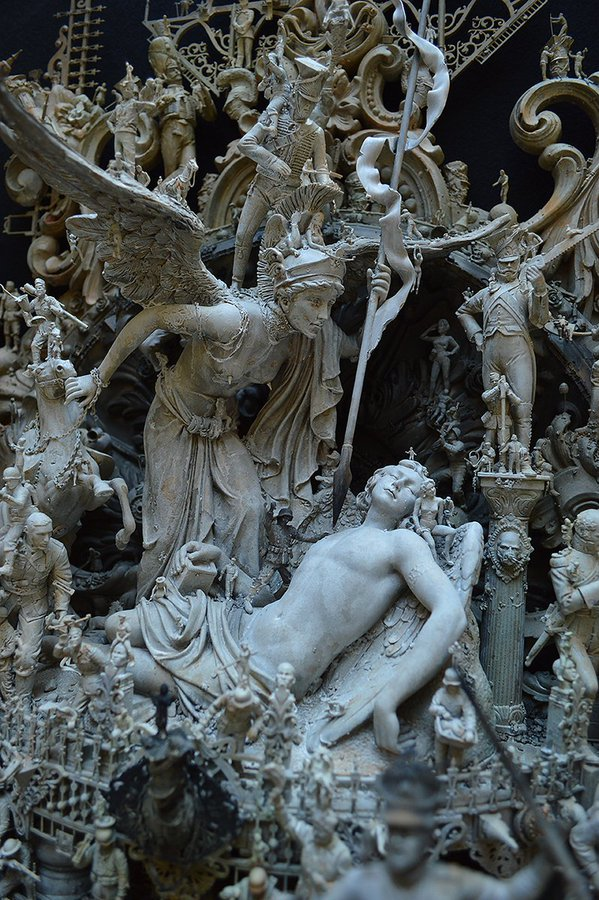
Some masterpieces aren’t just art—they’re acts of rebellion, daring the world to confront beauty, power, and the raw edge of human emotion.
Kris Kuksi's Tribulation (25) is a breathtakingly intricate sculpture that feels like a dystopian cathedral come to life.
Everyone knows Botticelli's Birth of Venus — one of the most iconic paintings of all time.
But what exactly is going on here? Scholars have wrestled with its meaning (and mystery) for 500 years.
And it isn't what you think... (thread) 🧵