Sri Lanka's greatest export isn't tea.
It's talent.
Every year we lose highly skilled professionals, entrepreneurs, and young graduates.
The real question is:
How do we make Sri Lanka a place where talent chooses to stay?
#BrainDrain#SriLanka
Most organizations don't need more leadership training.
They need leaders who actually apply what they've already learned.
The problem isn't lack of knowledge.
The problem is lack of accountability.
Agree or disagree?
Leadership isn't tested in a training room.
It's tested:
• During conflict
• During pressure
• During uncertainty
• During difficult decisions
Anyone can sound like a leader in a workshop.
Reality is the real assessment.
After reading one of my good friend’s post @MalithiTissera something hit me. I want to give job opportunities for talented, capable people. Today I realized that this is my purpose!
If the same workplace problems exist after every training program...
Maybe the employees aren't the problem.
Maybe leadership is.
Or perhaps the organisation expects a one-day workshop to fix a one-year culture problem?
🚨 Most leadership lessons I learned weren't in a boardroom.
They were at 35,000 feet.
After a decade in aviation, one thing became clear:
Many corporate leaders would struggle in a cockpit.
Not because they lack intelligence.
Because aviation demands:
✈️ Accountability
✈️ Communication
✈️ Decision-making under pressure
✈️ The courage to challenge authority
The question is:
Would your team feel safe enough to tell you that you're wrong?
https://t.co/s38SutPTkM
#Leadership #AviationLeadership #CRM #ExecutiveLeadership
Customer complaints are often leadership complaints in disguise.
Poor service.
Poor communication.
Poor accountability.
These rarely start with frontline employees.
They start with leadership.
Do you agree?
Many corporate leaders would fail Crew Resource Management (CRM).
And that’s a problem.
For those outside aviation, CRM was developed after investigators discovered something alarming.
Many aviation accidents weren’t caused by a lack of technical skill.
They were caused by:
• Poor communication
• Ego
• Assumptions
• Hierarchy
• Failure to speak up
• Failure to listen
Sound familiar?
In aviation, a First Officer must be able to challenge a Captain.
A cabin crew member must be able to question a decision.
Why?
Because safety is more important than status.
Yet in many organizations, employees stay silent.
Not because they don’t see the problem.
Because they don’t feel safe enough to speak.
The result?
Bad decisions travel all the way to the top unchecked.
I’ve spent over a decade in aviation and leadership environments, and one lesson stands out above all others:
The smartest person in the room is not always right.
The safest and most successful teams are the ones where people feel confident enough to challenge, contribute, and communicate openly.
CRM teaches us that leadership is not about having all the answers.
It’s about creating an environment where critical information reaches decision-makers before it’s too late.
Perhaps the biggest risk facing organizations today isn’t a lack of talent.
It’s a culture where people stop speaking up.
My question to leaders:
If one of your employees noticed a serious mistake in your decision today, would they feel safe enough to tell you?
Or would they stay silent because of your title?
Here's what nobody wants to hear:
Your top performer won't automatically become your best leader.
Technical expertise and leadership capability are completely different skills.
Yet organizations make this mistake every day.
The biggest lie in corporate training:
"We conducted the training."
Training is an event.
Development is a process.
The two are not the same.
Do you agree?
A strong economy should be measured not only by growth figures but by the quality of life experienced by ordinary citizens. If these allocations genuinely reach vulnerable families, create opportunities, and reduce the cost of living, it will make a meaningful difference to many Sri Lankans. The real success will be in effective implementation and measurable outcomes.
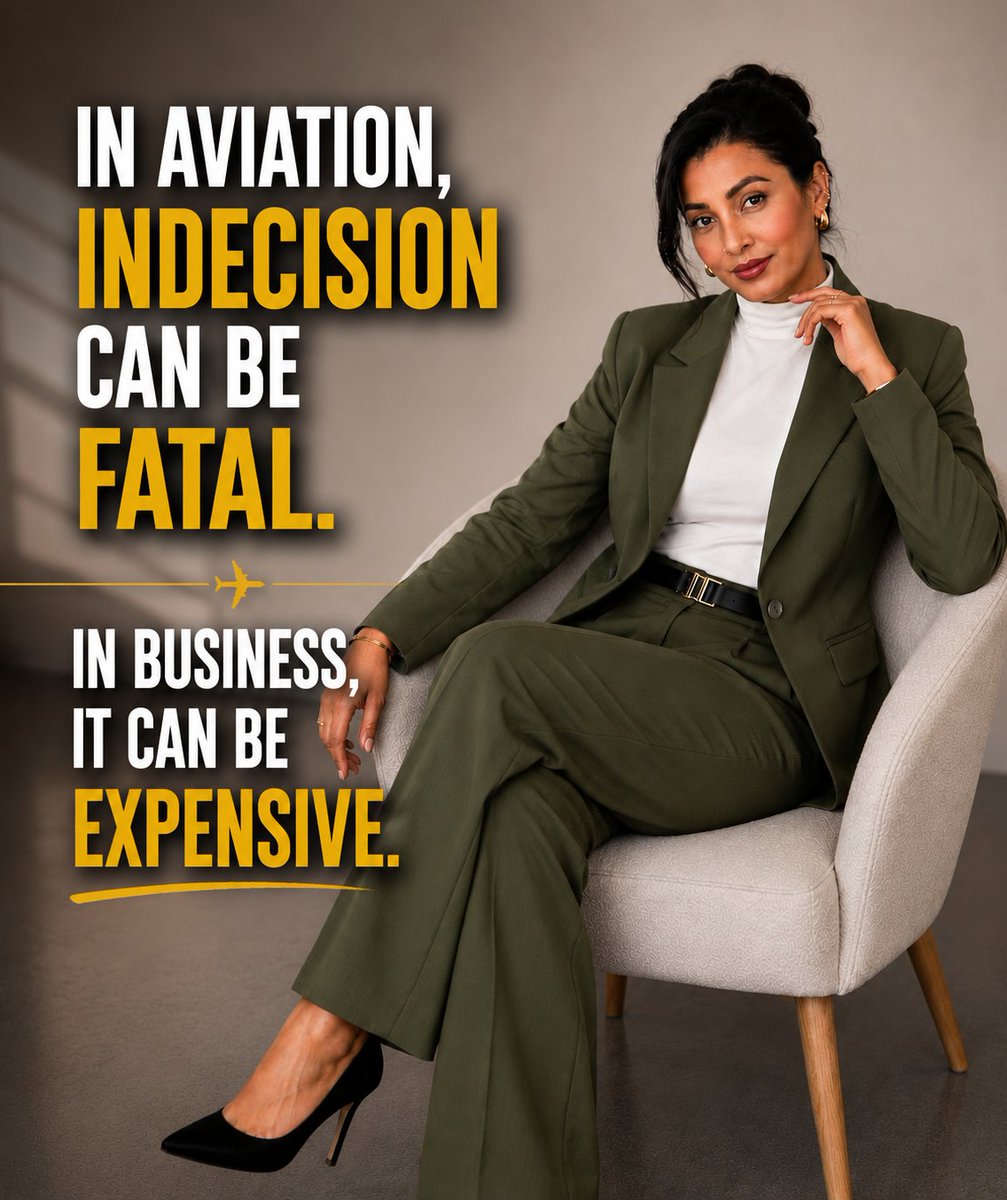
One thing aviation taught me is that delayed decisions can be just as dangerous as bad decisions.
As a former aviation professional as a cabin crew over a decade, student pilot, PPL holder, and ATPL holder, I've spent years observing how decisions are made when the stakes are high.
At 35,000 feet, uncertainty is normal.
Weather changes.
Equipment fails.
Situations evolve.
Yet the crew cannot sit around debating endlessly.
A decision must be made.
And it must be made quickly, using the best information available at that moment.
What surprises me is how different decision-making can be in the corporate world.
I've seen organisations spend weeks discussing issues everyone already understands.
Meetings about meetings.
Committees discussing what another committee should decide.
Endless analysis.
But minimal action.
Meanwhile, opportunities disappear.
Customers leave.
Employees become frustrated.
Competitors move ahead.
In aviation, indecision is a decision.
And often the most dangerous one.
In cockpit, the best pilots are the ones who gather the available information, assess the risks, make a decision, and continuously adjust as new information emerges.
Many leaders are waiting for 100% certainty.
The problem is that certainty rarely exists.
Leadership is not about waiting for perfect conditions.
Leadership is about making responsible decisions when conditions are imperfect.
Perhaps that's why some organisations move faster, adapt faster, and outperform their competitors.
Not because they have better people.
But because they have leaders who are willing to decide.
My question to leaders:
Are you making decisions based on the information you have today?
Or are you waiting for certainty that may never come?
#Leadership #CEO #ExecutiveLeadership #BusinessTransformation #LeadershipDevelopment #OrganizationalCulture #PeopleAndCulture #Management
Most CEOs would never survive in a cockpit.
Before you get offended, keep reading.
As a former aviation professional and pilot, I’ve spent years studying an industry where mistakes can have catastrophic consequences.
In aviation, there is no room for ego.
No room for assumptions.
No room for “I know better.”
Yet in the corporate world, I often see leaders making decisions based on rank rather than reality.
Here’s the difference.
When a Captain enters a cockpit, the goal is not to prove they are the smartest person on board.
The goal is to get everyone safely to the destination.
A great Captain actively encourages challenges from the First Officer.
A great Captain listens.
A great Captain invites different perspectives.
A great Captain knows that being in charge doesn’t mean having all the answers.
Yet many leaders do the opposite.
They surround themselves with people who agree with them.
They discourage disagreement.
They confuse authority with leadership.
And then wonder why problems weren’t identified sooner.
One of the most powerful concepts in aviation is Crew Resource Management (CRM).
CRM teaches us that safety is not the responsibility of one person.
It is the responsibility of the entire crew.
Every voice matters.
Every observation matters.
Every concern matters.
Imagine if more organizations operated this way.
Imagine if employees felt safe enough to challenge poor decisions.
Imagine if managers listened before reacting.
Imagine if leaders viewed feedback as protection rather than criticism.
The truth is:
Many corporate failures are not caused by a lack of intelligence.
They are caused by a lack of communication.
In aviation, silence can be dangerous.
In business, it can be equally costly.
The best leaders are not the ones who speak the most.
They are the ones who create environments where others feel safe to speak.
So here’s my question:
Would your team feel comfortable challenging your decision if they genuinely believed you were wrong?
Because if the answer is no, you’re not leading a team.
You’re leading a room full of passengers.
What’s your view?
Sri Lanka produces graduates.
But does Sri Lanka reward competence?
Why are talented young people struggling to find jobs while some people in powerful positions can’t effectively lead a meeting, communicate clearly, or manage basic operations?
The uncomfortable question:
Are we hiring the best people, or the most connected people?
#SriLanka #Jobs #Youth #Leadership
Dengue is once again emerging as a serious threat to our people. While health authorities continue their efforts, local councils must take the lead in maintaining clean public spaces, clearing drains, managing waste, and eliminating mosquito breeding grounds.
Protecting communities is not a seasonal responsibility, it is a duty. Every local authority must act with urgency and accountability before more lives are put at risk.
Every preventable dengue case is a reminder that inaction has consequences. The time to act is now.
#DenguePrevention