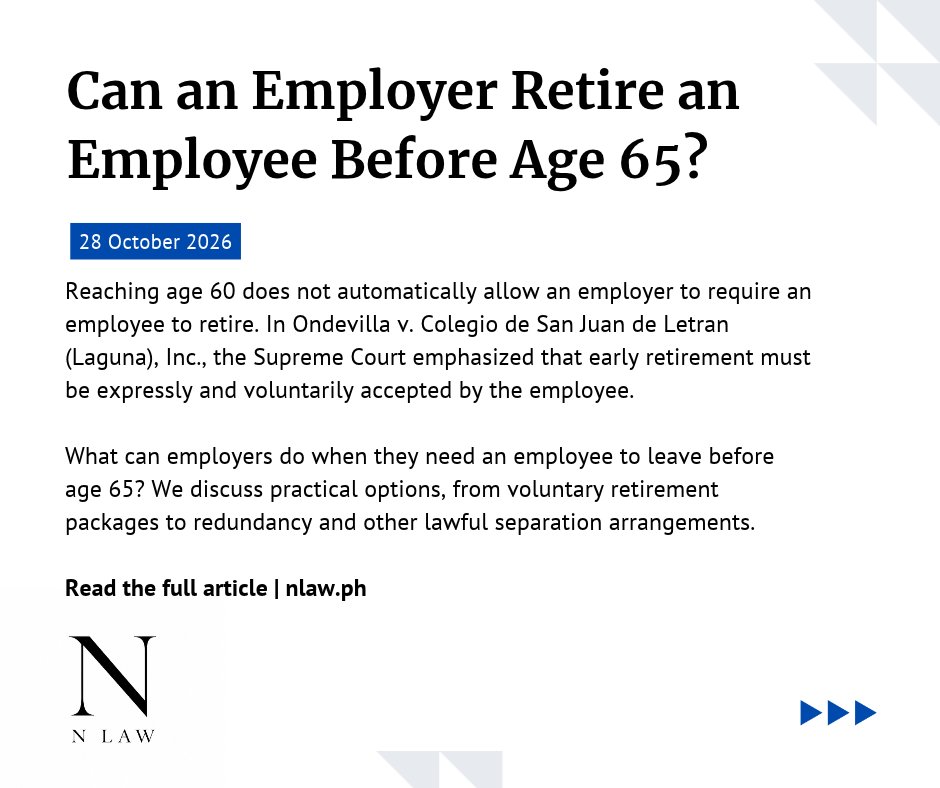
Can an employer require retirement at 60? In Ondevilla, the Supreme Court stressed that early retirement requires the employee’s genuine, voluntary consent.
N Law explains: https://t.co/xW4nKTk4Jf
Atty. Kristoffer Monico S. Ng | N Law
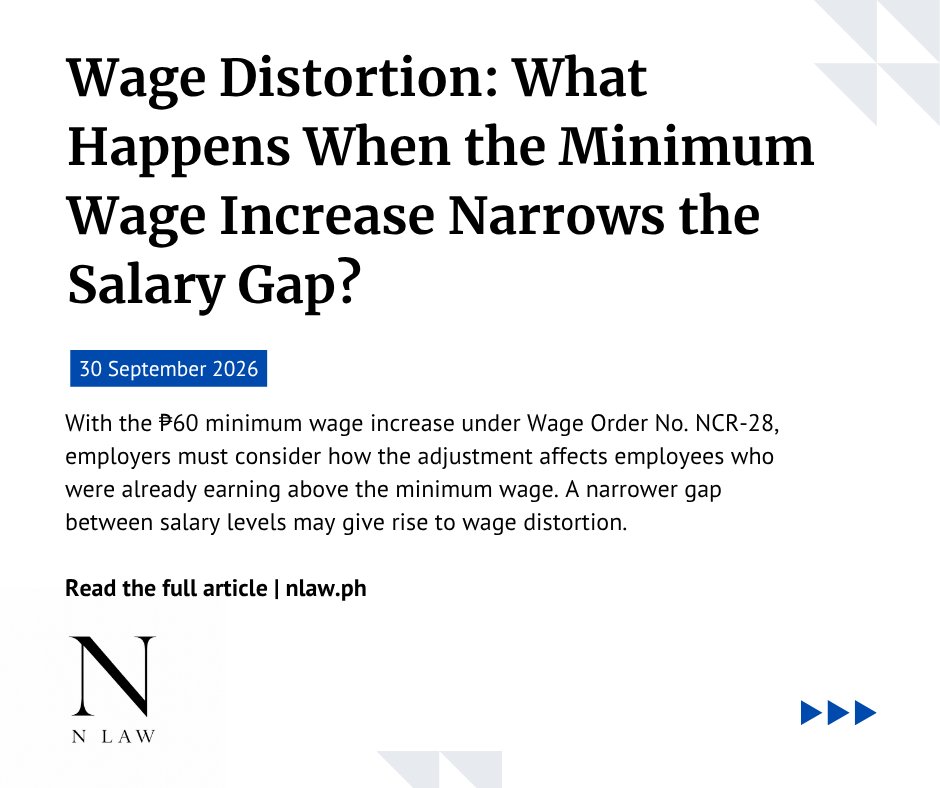
The ₱60 NCR wage increase mainly benefits minimum wage earners, but it may also lead to wage distortion.
N Law explains: https://t.co/i0qVoA7tZC
Atty. Kristoffer Monico Ng | N Law
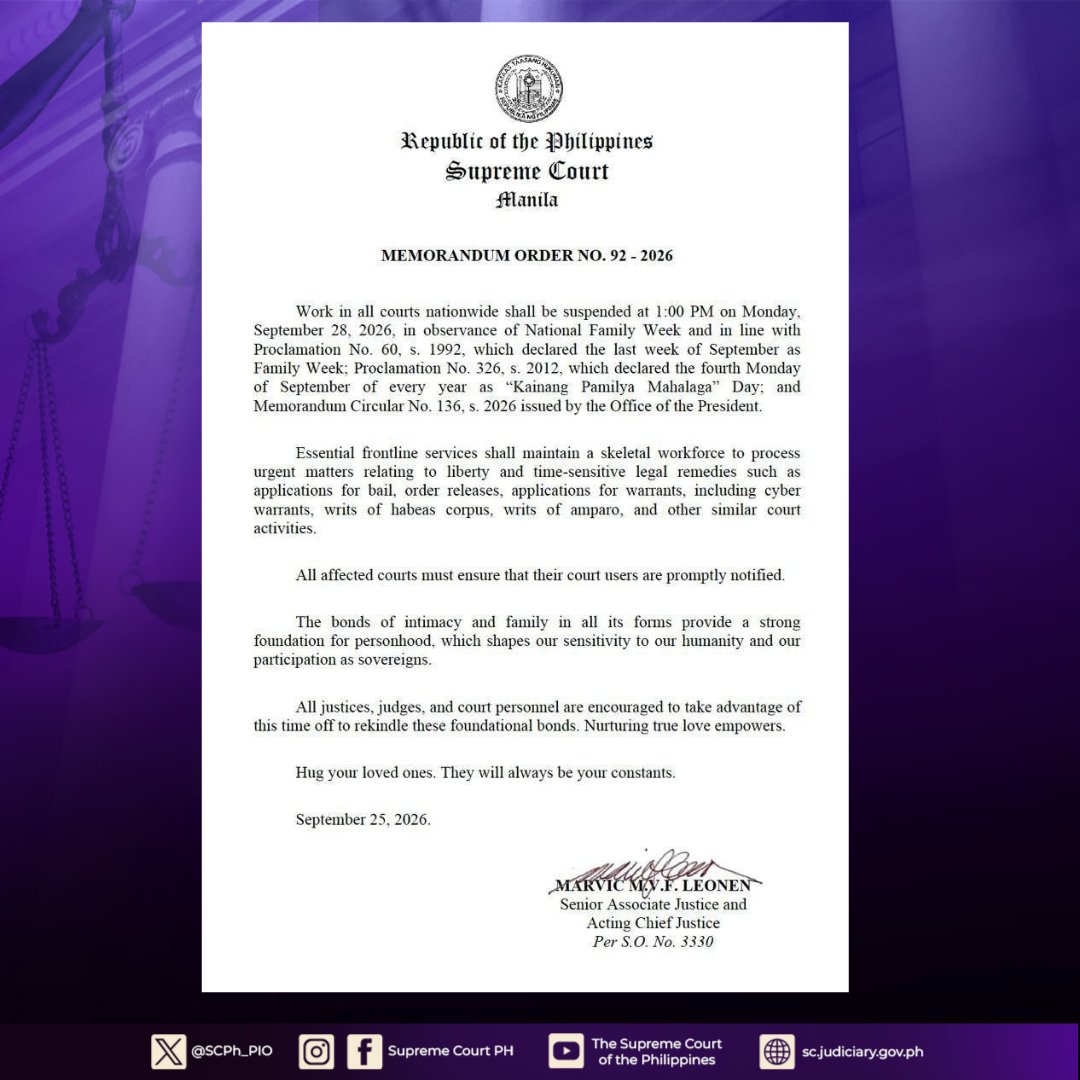
WORK SUSPENSION: All courts nationwide suspend work starting at 1:00 P.M. on Monday, September 28, 2026, in view of Proclamation No. 326, s. 2012 declaring the last week of September every year as Family Week and Memorandum Circular No. 136, s. 2026, declaring the fourth Monday of September of every year as “Kainang Pamilya Mahalaga” Day.
Essential frontline services shall maintain a skeleton workforce.
READ Memorandum Order No. 92-2026 issued by Acting Chief Justice Marvic M.V.F. Leonen at https://t.co/4gAMzFyKrW
#SCPhWalangPasok #SupremeCourtPH
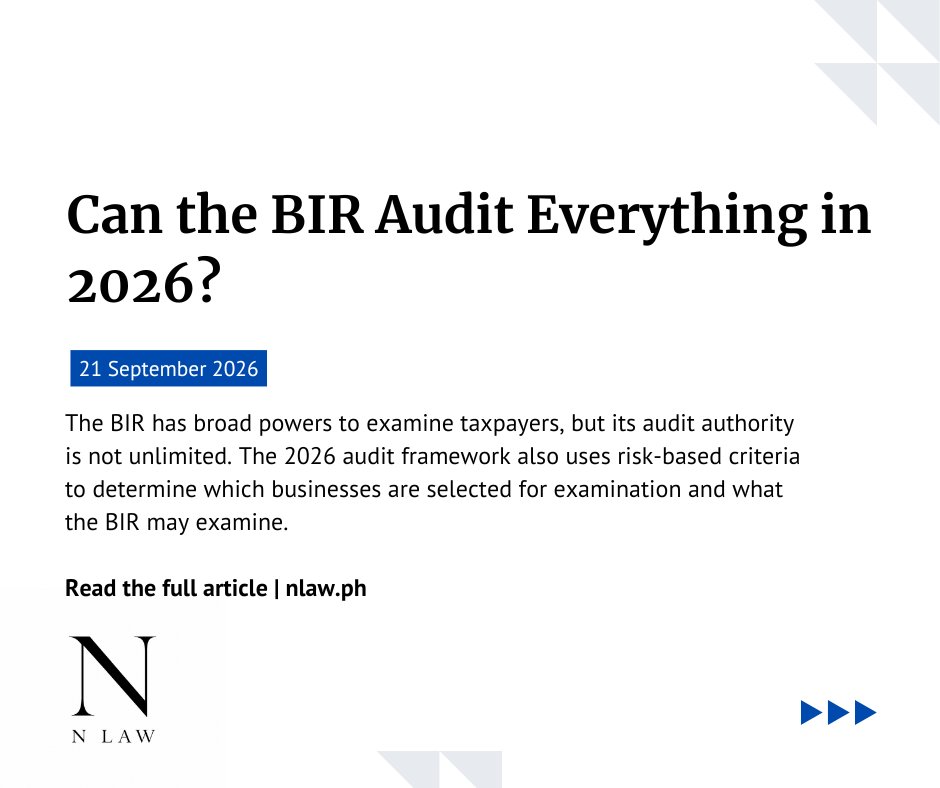
Can the BIR Audit Everything in 2026? RMO No. 22-2026 limits audits to the authority issued and introduces risk-based taxpayer selection.
N Law explains: https://t.co/AAZLE0BTQV
#NLaw
Power shortages have prompted discussions on NAPOCOR joining the competitive generation market. What would its participation mean for WESM price signals and private generation investment?
N Law explains: https://t.co/ZOBlknX7pz
#NLaw
What is “grave threats” under Philippine law? The Sara Duterte case puts this crime in focus. In this article, we explain what makes a threat criminal and what must be proven.
N Law explains: https://t.co/Z5rMDlyPTu
#NLaw
The bank made the mistake. Can it still demand the money back?
The Supreme Court recently clarified when solutio indebiti and unjust enrichment may apply when a bank’s own negligence caused an erroneous credit.
Read the Supreme Court’s ruling >
The Supreme Court (SC) has ruled that a bank cannot require a depositor to return money they already withdrew on the ground of unjust enrichment when the loss was caused by the bank’s own gross negligence.
In a Decision written by Associate Justice Japar B. Dimaampao, the SC’s Third Division denied the petition filed by BDO Unibank, Inc. (BDO), holding that the bank’s disregard of its own banking policy amounted to gross negligence.
The case stemmed from Cristina Barcellano’s (Barcellano) deposit of a regional check worth PHP 151,200 from an Albay branch of Landbank into her savings account at BDO’s Lucena City branch.
The BDO teller mistakenly validated the check as local instead of regional, allowing the amount to be credited after only three banking days instead of the required seven.
Believing the funds were available, Barcellano withdrew PHP 76,000. Shortly after, BDO received a stop payment order on the check and demanded that she return the money. Although Barcellano initially agreed, she never repaid the amount. BDO later refused to release the remaining balance and filed a criminal complaint for estafa.
Both the Regional Trial Court and the Court of Appeals acquitted Barcellano, finding no fraud, deceit, or abuse of confidence on her part and blamed BDO’s own negligence.
Before the SC, BDO asked for a review of the civil aspect of the case, arguing that despite Barcellano's acquittal, she should still be required to return the money. BDO argued that her refusal amounted to unjust enrichment and that since the funds were released due to its error in processing the check, Barcellano was required to return them based on the principle of solutio indebiti, which requires the repayment of money received by mistake.
The SC disagreed, ruling that there was no unjust enrichment because BDO failed to prove that Barcellano knowingly received and retained a benefit to which she was not entitled.
SC declared that the bank did not explain why the stop payment order was issued or show that Barcellano knew the check would not be honored. Instead, the evidence showed that she withdrew the money in good faith after BDO itself made the funds available in her account.
The SC also ruled that BDO’s own gross negligence caused its loss. It found that the bank credited the check before it had properly cleared it, incorrectly treated a regional check as a local check, and failed to detect the error until after receiving the stop payment order. These lapses showed a failure to observe basic safeguards meant to protect the bank from the risks of invalid checks.
The SC also rejected BDO’s reliance on solutio indebiti. Although the doctrine generally requires the return of money received by mistake, it does not apply when the mistake resulted from the payor’s own gross negligence. Here, BDO’s error stemmed from its failure to exercise the extraordinary diligence and reasonable prudence required of banks.
Read the full text of the press release at https://t.co/hf6l4z3ksW
Read the full text of the Decision at https://t.co/d3D4KppV52
Copying of this content is subject to the SC PIO’s Credit Attribution Policy: https://t.co/6W5N1BfHld
Working from home does not give employers unrestricted access to an employee’s work laptop. A look at the rules on screenshots, keystroke logging, and webcam monitoring under the Data Privacy Act.
N Law explains:
https://t.co/5gdKBstxqj
Ninoy Aquino Day was observed two days ago. A timely refresher on holiday pay rules, especially for those who worked on the holiday or their rest day.
N Law explains:
https://t.co/Piz7zA4ugW
AWOL does not automatically mean abandonment. An absence may be unauthorized, but is that enough to justify dismissal?
N Law explains:
https://t.co/FWvQvYff9i
The ₱85 NCR wage increase is under judicial restraint. But what about wages already paid? What should employers do next?
N Law explains:
https://t.co/xuCrTw9frN