On Saturday we unveiled a new war memorial at St Mary’s Westmill to remember PO Peter Mildren and were delighted that so many people could join us. The weather was the perfect backdrop to a thrilling flypast by PT462 from the Aircraft Restoration Company. Photos: Alan Millard
Remembering the Polish Army’s Role in the Normandy Campaign and Operation Overlord.
While Polish naval and air forces supported the initial D-Day landings on 6 June 1944, the Polish Army’s major ground contribution to Operation Overlord came in the subsequent Battle of Normandy.
The 1st Polish Armoured Division, commanded by General Stanisław Maczek, landed in Normandy in late July and early August 1944 as part of the First Canadian Army. Comprising around 16,000–18,000 soldiers and equipped with approximately 380–400 tanks and supporting artillery, the division entered combat on 8 August during Operation Totalize.
The division played a decisive role in the closing stages of the Battle of Normandy, particularly in the Falaise Pocket (August 1944). Tasked with helping to seal the escape route of the encircled German Seventh Army and Panzer divisions, Polish forces advanced toward Chambois and secured critical high ground at Hill 262 (known to the Poles as “Maczuga” – The Mace) on Mont Ormel. From 19–21 August, they endured intense counterattacks from multiple German units while short on ammunition and supplies.
Their heroic stand helped trap and destroy large numbers of German forces, contributing significantly to the Allied victory in Normandy and accelerating the liberation of France. 
The fighting was costly: in the Normandy campaign, the 1st Polish Armoured Division suffered approximately 446 killed, 1,501 wounded, and 150 missing, along with heavy losses in tanks. Despite these sacrifices, the division’s professionalism and determination earned them respect from Allied comrades and helped pave the way for the rapid Allied advance across Western Europe. 
The Polish Army’s efforts in Normandy exemplified the unyielding spirit of Polish forces fighting in exile for the liberation of their occupied homeland and the defeat of Nazi Germany. Their actions remain a proud chapter in the broader history of Operation Overlord and the Allied victory in Europe.
We fly to remember, and are inspired by the soldiers of the 1st Polish Armoured Division, and all Polish & Allied forces who served with distinction.
https://t.co/nNLcFK5vTE
📷 (Photo1) Polish 1st Armoured Cromwell Tank. Note the unit motif.
📷 (Photo 2) General Maciek.
📷 (Photo 3) Polish 1st Armoured enroute to Falaise - ready and highly motivated to deliver the final knockout blow to rid France of the German Occupiers.
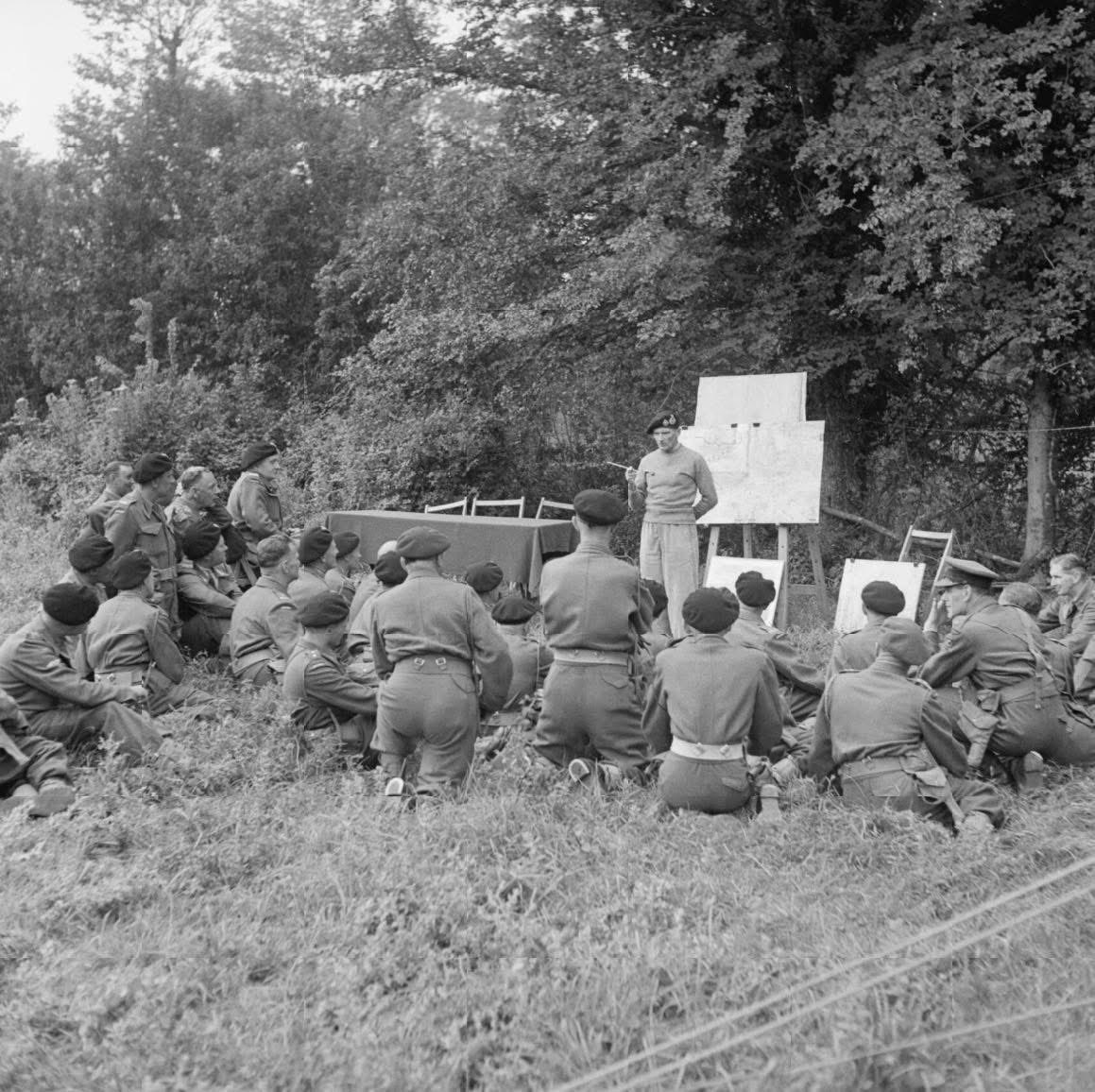
📷 (Phpto 4) Field Marshal Bernard Montgomery briefing Staff Officers of the 1st Polish Armoured Division about the plan of the Battle of the Falaise Gap in Sommervieu, France. General Stanisław Maczek, the CO of the Division, is seated on his right.
#DDay #OperationOverlord #BattleOfNormandy #1stPolishArmouredDivision #FalaisePocket #PolishArmy #WorldWarII #Normandy1944
Volunteering Week 🎉
At the Battle of Britain Bunker, and across Hillingdon’s heritage sites, everything we do is made possible by our incredible volunteers.
Interested in volunteering? Check out the Hillingdon Council website for more information 👉️ https://t.co/jLtwxsoyVn
@SeaSpitfires Although the photograph, as I’m sure you know (and according to IWM) was taken earlier in the year and one of a couple of photos taken of it. Roy was at the stern. The hi res version of the image might just show him…
@SeaSpitfires I have this photo as LCF 32 (my Uncles). The same photo is referenced as LCF 32 in The Royal Marines a Pictorial History as per my uncle’s annotation
Some of the PHF team are in Normandy this week on what is turning into an annual trip of Gratitude & Remembrance.
Our Hawker Hurricane Flight to Poland in August sets about to do the same thing. A Flight to remember ALL who served.
The Fundraising is just £220 away from 75% and we hope we can make this total on D-DAY!
Please spare what you can or swap a coffee, beer or your take-away for a donation. Your name, message or dedication will be hand written into the Pilots Log Book - Then flown to Poland onboard the Hurricane to be presented to the Polish Air Force
https://t.co/nNLcFK5vTE
Polish Air Force on D-Day – 6 June 1944
🇬🇧🇺🇸🇫🇷🇵🇱
On D-Day 11 of 16 Polish Squadrons flew in support of the Normandy landings.
• 131 (Polish) Wing (Spitfire IXs): 302, 308 & 317 Squadrons provided low cover over Sword & Juno beaches, fighter sweeps, and ground attack.
• 133 Wing (Mustangs): 306 & 315 Squadrons escorted gliders for US 82nd & 101st Airborne.
• 303 Squadron (Spitfire) flew multiple beachhead sorties.
Bomber squadrons also took part: Lancasters of 300 Sqn deceived the Germans, Mosquitos of 305 struck targets, Wellingtons of 304 hunted U-boats, and 301 (1586 Flt) delivered agents to the Resistance.
We know from first hand accounts that many Polish Airmen believed that the Invasion of France was a step closer to going home… this alas, despite Allied Victory in Europe was not to be.
Please help us fly them home this August.
https://t.co/nNLcFK5vTE
#DDay80 #PolishAirForce #Normandy1944 #Spitfire #RAF #OperationOverlord #ww2
@jamesjhistory@james_2904@HistoryPegg@barkofthebirch Was the Halifax really more difficult to bale from than the Lancaster? Having been in Friday 13th at Elvington and the Lancaster at Duxford, the Halifax seemed easier to move around in.
(Albeit it wasn’t dark and we weren’t being shot at / in a steep dive towards the ground).
Honoring the Polish Navy’s Vital Role in Operation Overlord and D-Day – 6 June 1944
Allied forces launched the largest amphibious invasion in history — Operation Overlord, with its naval component known as Operation Neptune.
While the contribution of Polish ground and air forces is well documented, the significant role of the Polish Navy in the D-Day landings is often less highlighted.
Although Poland had been occupied since 1939, the Polish Navy continued to fight as part of the Allied coalition under British operational command.
Several Polish warships and their crews participated directly in the Normandy landings, providing critical naval gunfire support, convoy protection, minesweeping, and escort duties.
Key Polish contributions included:
• ORP Dragon (light cruiser): The largest Polish vessel involved. It delivered effective bombardment of German coastal defenses in support of Sword Beach. On 8 July 1944, she was severely damaged by a German Neger manned torpedo, resulting in the loss of 37 crew members. The ship was later scuttled to form part of the artificial harbor breakwater.
• ORP Ślązak (escort destroyer): Played a prominent role by leading elements of the invasion fleet through cleared minefield channels on the night of 5–6 June. She provided close fire support for Sword Beach, suppressed enemy positions, and assisted Royal Marine Commandos under fire.
• ORP Krakowiak (escort destroyer): Supported operations at Gold Beach and subsequent actions around Port-en-Bessin, engaging German defenses and helping secure the beachhead linkage.
• ORP Piorun and ORP Błyskawica (destroyers of the 10th Destroyer Flotilla): Conducted screening patrols to protect the invasion fleet from German surface threats and participated in follow-on operations along the French coast.
Polish merchant vessels, including the liners MS Batory and MS Sobieski, also supported the massive logistical effort by transporting troops and supplies.
The Polish ships operated primarily in the British and Canadian sectors. Their crews earned a reputation for professionalism, courage, and determination under intense conditions. These actions were part of a broader Polish military contribution in the West, which included the 1st Polish Armoured Division fighting later in the Normandy campaign and Polish squadrons providing air support.
The Polish Navy’s involvement in D-Day stands as a powerful example of continued resistance by a nation that refused to surrender, fighting across multiple theaters until the end of the war in Europe.
We remember and fly in honor of the Polish sailors who served with distinction on that historic day.
Theirs and the bravery, skill & sacrifice of all Allied Sailors helped secure the beaches and ultimately contributed to the liberation of Europe.
The stunning colourised pictures are just a few from a fascinating collection on the Facebook Page:
The Polish Navy in colour by Mateusz Prociak
#DDay #OperationOverlord #PolishNavy #PolishArmedForces #History #NormandyLandings #WorldWarII #ww2
1 #Polish🇵🇱 Fighter Wing entered offensive operations in June 1941, and was the first Polish Air Force wing of #WW2 since the 1939 invasion of #Poland. The 1 Fighter Wing was composed of the veteran Polish 302 and 303 Squadrons, along with the newly formed 308 Squadron. #History