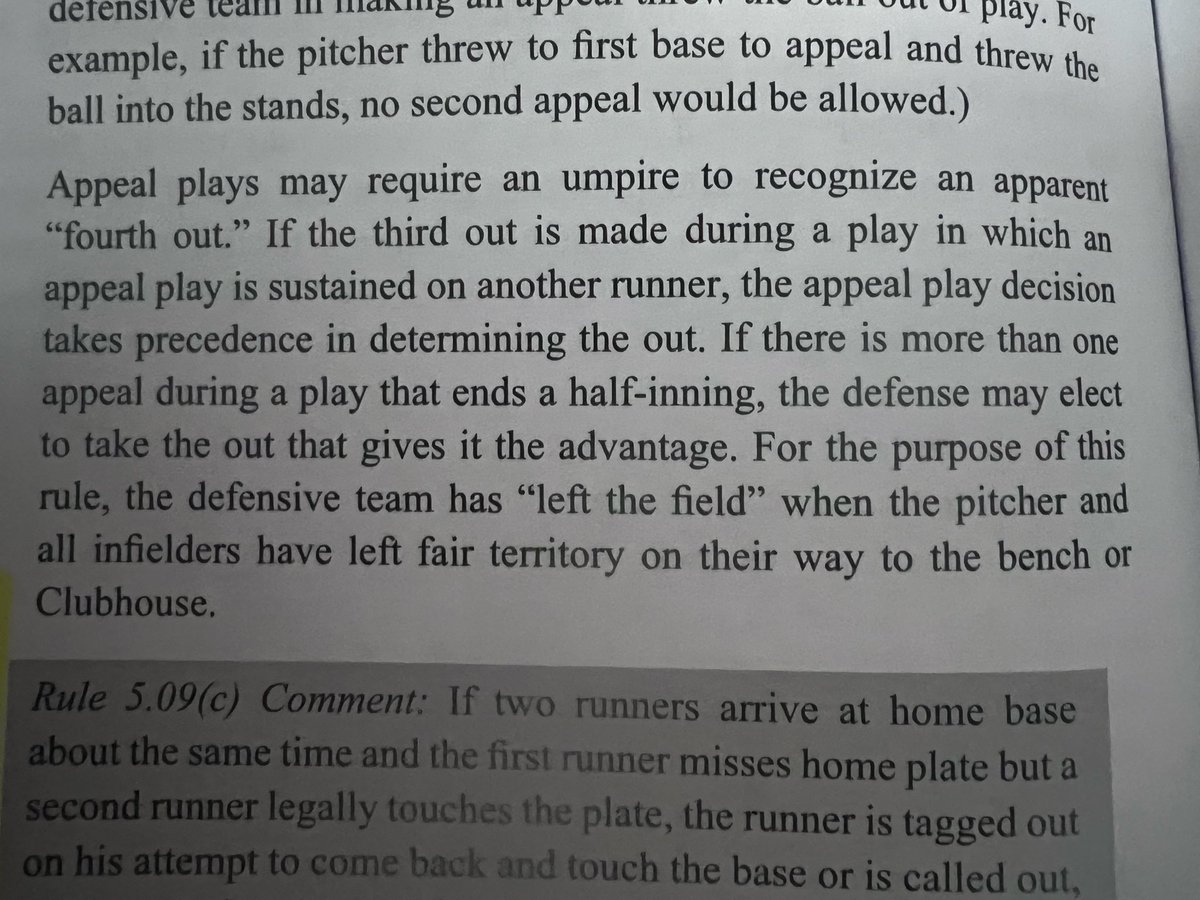
@PhilTribble@PitchingNinja Good job sharing your knowledge!Technically a 4th out situation is when a 3rd out happens normally on the field and then an appeal is necessary to prevent a run. This is a double appeal situation. But it’s absolutely the same idea, and both are discussed together in the rulebook.
@BobRitchie2@PitchingNinja Assuming that waving motion from the PU was indeed him waving off the run, then yeah, I believe it was incorrect. Not sure what he would be thinking there. I saw that Schneider referenced this in his post-game conference.
@ctkatz8086@PitchingNinja Yep, that’s all correct. Only thing to add is that Rule 5.09(c)(4) covers this very situation where there are two possible appeal plays to end a half-inning. The defense gets to pick the appeal that’s most advantageous. But by leaving the field they lost the right to 2nd appeal.
@BobRitchie2@PitchingNinja At pro school we were trained to signal “That run scores” on a close timing play, but if it’s obviously to everyone that the run crossed the plate before the third out, we didn’t need to signal it. I think in this case the official scorer would know it counts until appealed.
@PlancksLaw@PitchingNinja I dunno, at least they took the time to get it right even if they had to go to NY. This is one of those highly technical rule applications that you might see once in a career. So tough to remember with 100% certainty in the moment, even at the pro level.
@PhilTribble@PitchingNinja Phil, umpire here. Are you as well? This sent me to my rule book,and interestingly it wouldn’t be a 4th out situation. In this case where there are two potential appeals, the defense gets to pick the one that’s most advantageous. If they hadn’t left the field, that is.
@Jomboy_ I think the crew chief could have been clearer in his announcement by saying, "After review, the catcher was set up in a position to obstruct the plate....however, any occurrence of obstruction is overriden by malicious contact, which we have here on the runner, etc. etc."