Assistant Professor of Philosophy, U Lethbridge / author of ‘The MAiD Question: Understanding Canada's Assisted Dying Debate' (forthcoming, McGill-Queen's UP)
Registration is free - and now open. Attend virtually or in-person.
For more information, including the conference program, visit https://t.co/7jCN5eV10M.
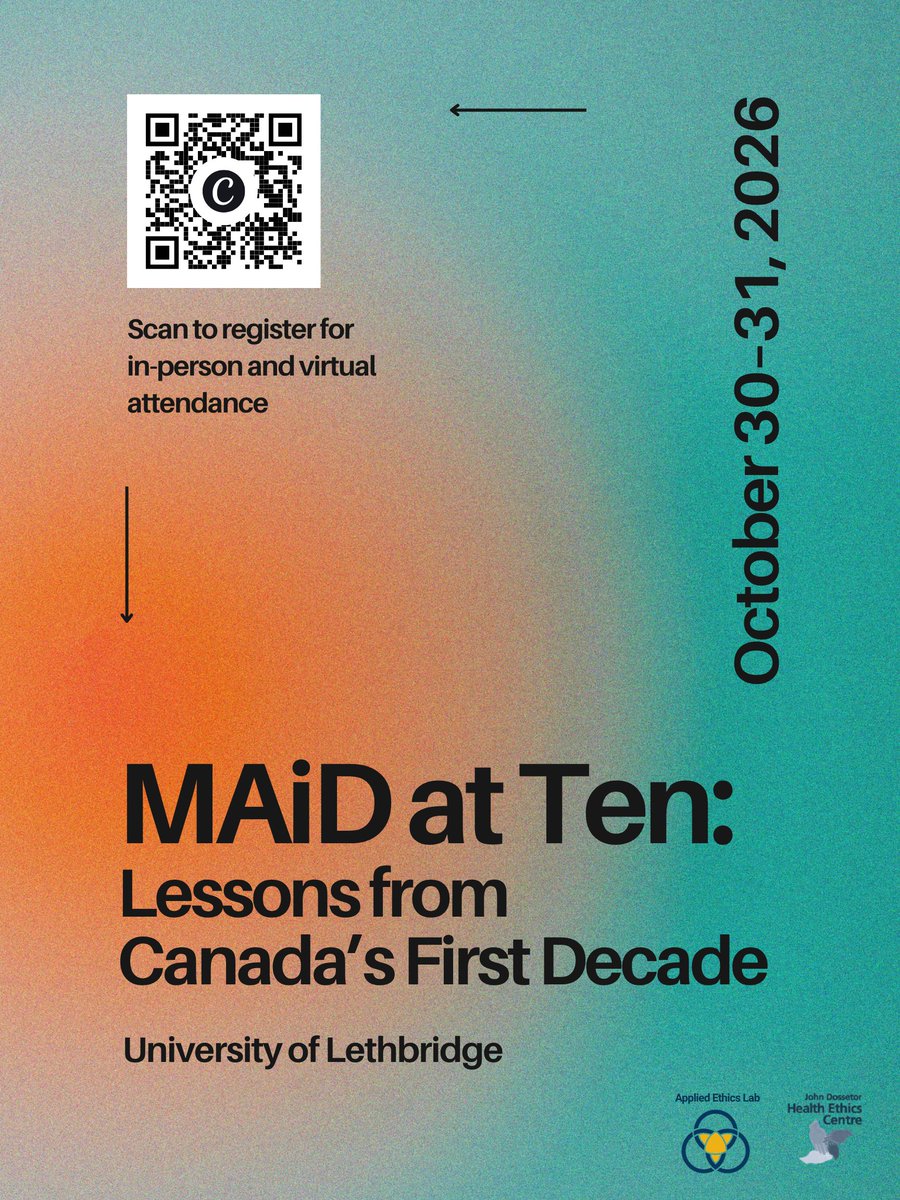
What have we learned from Canada's first decade of Medical Assistance in Dying (MAiD)?
Join us - virtually or in-person - at the University of Lethbridge next month.
Registration is free and now open: https://t.co/s2iy1YL8X2
Featuring keynotes from
Madeline Li
“Beyond the Request to Die: Avoiding the Collapse of Complexity Through Therapeutic Conversations”
Timothy Christie
“Legal Eligibility Is Not Ethical Oversight: The Role of Professional Discretion in the Provision of MAiD”
What have we learned from Canada's first decade of Medical Assistance in Dying (MAiD)?
Join us - virtually or in-person - at the University of Lethbridge next month.
Registration is free and now open: https://t.co/s2iy1YL8X2
I bring this into dialogue with structural injustice to develop the concept of *structurally embedded suffering*. I argue that this has implications for how irremediability for mental disorder is assessed and the state’s responsibility to remediate injustice in mental healthcare.
If you're in Montreal - and interested in ethics, the philosophy of psychiatry, and/or structural injustice:
I'll be giving a talk this coming Wednesday on MAiD and mental illness [abstract below].
In this talk, I consider how the ontology of mental disorder bears on the ethics of MAiD MI-SUMC. I look at externalist approaches in the philosophy of psychiatry, according to which mental disorders are partly constituted by a person's relationship to their wider environment.
This isn't an isolated phenomenon. At a recent talk, I was asked by a prominent MAiD advocate why I am opposed to MI-SUMC "even with" additional safeguards? This same person had, a moment before, defended Downie's 'nothing unique' about mental illness claim.
They say "the assessment process for Track 2...is already rigorous, and will be more so for MAID MD-SUMC."
But why do we need *extra* safeguards for MAID for mental illness if "there's nothing unique about mental illness" (Jocelyn Downie)?
"[This] should be the start, not the end, of a rethinking of the rules around medically assisted death, as well as a reconsideration of how Canada funds treatment for mental illness."
https://t.co/KqkRlW2ACy
Granted, 'choice' talk is a lot more compelling. It's a bit more of a hard sell to say there's a Charter right that entitles *me* to force *you* to help me end my life.
What 'rights' are we talking about, exactly? And please don't say bodily autonomy.
Of course, what we're *actually* talking about is a supposed 'right' to demand that others - doctors, no less - cooperate with one's wish to die.
"What this committee is saying very clearly is that people with mental disorders are not Canadians on the same footing as other Canadians, that their rights can be dispensed with." - Mona Gupta
I agree.
This committee was stacked from the onset and basically carves out discriminatory exclusions for mental illnesses.
A sham. But likely, MAiD for mental illness becomes law in 2027.
Somewhere between less than half (43%) and "a slight majority" (57%) - neither of which constitute 'clear support'. But this is the same guy who said that the committee was 'biased' because expert consensus told him what he didn't want to hear.