Got a monograph, article, or other project in need of some figures? Got a passage of music you need engraved, annotated, or even animated? I'm looking to take on new projects! More info here: https://t.co/PjZw5jkMzy
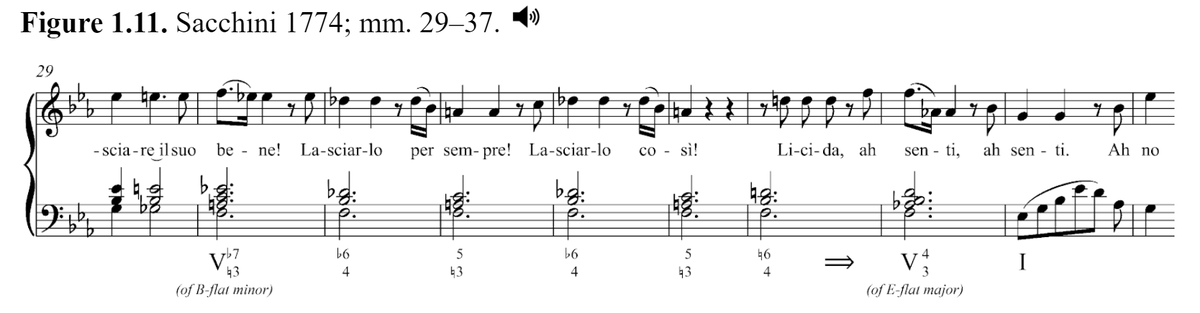
I feel like if the bass in m. 35 was a Bb, it would make total sense: HC in V followed by I in V, reinterpreted as V of I. But the fact that the F pedal continues through makes it feel like the HC effect isn't over, which makes the pivot back to Eb major feel way more dramatic.
Thinking about this passage today and wondering if ppl know of similar harmonic progressions elsewhere. Essentially: a modulation down a fifth accomplished through a bass line like (key 1:) b6-5 = (key 2:) 2-1.
@doctaj Reminds me of the way that Bolsonaro appropriated Bailes funk in his campaign (Cibele Burke at Cornell gave a wonderful paper at IASPM about that a few years ago)
#DisneySongsRanked
1. Mother Knows Best (Tangled)
Score: 500/500
Rapunzel asks her “mother” if she can leave her tower. Mother Gothel responds.
–
Have you ever had somebody in your life who is supposed to love you, but can’t stop critiquing you? Somebody who seems almost excited by your inadequacies? And when you criticize them, they immediately wither and ask how you could be so mean, weaponizing their own fragility.
Mother Gothel is not Disney’s scariest villain. She’s not the most evil. She’s not even the most realistic. And yet, she finds herself at the top of this ranking, above juggernauts like “Part of Your World,” “Colors of the Wind,” “When You Wish Upon a Star,” and every other song by any other villain.
I’m well aware that my opinion on this number is an outlier: “Mother Knows Best” doesn’t typically rank in the top 30 of most folk’s favorite Disney songs, and even in villain song rankings, it’s consistently placed below famous works like “Poor Unfortunate Souls” and “Be Prepared.” I’ll do my best to justify why, for weeks now, I have been 100% confident in my placing of “Mother Knows Best” at the top of this ranking.
Donna Murphy is a revelation as the haughty, saccharine, critical, and defensive Mother Gothel. Her entire performance is done with a sublime Transatlantic accent, which gives her character the appearance of something from a time capsule, belonging to an era much, much earlier than the one the rest of the characters inhabit. That’s perfect, given the plot of the movie, which involves Mother Gothel using Rapunzel’s magical hair to artificially extend her lifespan and preserve her youthful beauty. This woman really is from a different time.
For the first iteration of “Mother Knows Best” (I’ll get to the reprise), Murphy is perfect down to the syllable in her delivery, expertly balancing interspersions of comedic quasi-spoken delivery with a conventional singing style. Her voice, lightly nasal and haughty, is perfect for the character: beautiful, pleasant, but with just the slightest bit of edge. Her vibrato and expression are to die for. As she croons to Rapunzel, you feel as if you’re witnessing a live theater performance–and that’s because, diegetically, Gothel is giving a performance of sorts in order to keep her captive “daughter” hidden.
Menken’s music, and the orchestration, are perfect: restrained, with comedic interjections from muted trumpets and an excellent bass clarinetist, the number hums along perfectly as Murphy delivers some truly fantastic lyrics, like this triple-feature rhyme:
"Mother knows best
Take it from your mumsy
On your own, you won't survive
Sloppy, under-dressed
Immature, clumsy
Please, they'll eat you up alive!"
The first iteration of “Mother Knows Best” is really quite silly in its delivery: Gothel is listing all the reasons why Rapunzel can never leave the tower, including things like “men with sharp teeth” and “the plague.” It isn’t until the final moments of the number that the mask slips, ever so briefly, as Gothel tells Rapunzel through gritted teeth: “Don’t ever ask to leave this tower again.” Then, the moment’s gone: A quick smooch on the head and an “I love you,” and it’s like it never happened.
The reprise of “Mother Knows Best” is a different beast entirely: Mother Gothel tracks down a recently escaped Rapunzel, and begs her to come back to her tower. Their dialogue gradually becomes verse, so subtly that you don’t realize it’s happening until it’s done:
--
Rapunzel:
But Mother, I -
Mother Gothel:
This is why you never should have left!
Dear, this whole romance that you've invented,
Just proves, you're too naive to be here
Why would he like you?
Come on now really!
Look at you! You think that he's impressed?
Don't be a dummy
Come with Mummy
Mother...
Rapunzel:
No!
Mother Gothel:
No? Oh.
--
After that rhymed “No? Oh” moment, the real Mother Gothel shows herself: Vindictive and cruel, willing to exploit any insecurity of her “daughter” if it’s in her own best interest, even if it grinds Rapunzel’s spirit into dust. The reprise of “Mother Knows Best” is hardly the same song as the first, as it’s set in a grinding minor mode with shuddering, low orchestral accompaniment. Murphy’s delivery makes a glorious shift in the reprise, as she contemptuously spits the lyrics out, still sublimely rhymed by lyricist Glenn Slater:
"Rapunzel knows best
Rapunzel's so mature now
Such a clever grown up miss
Rapunzel knows best
Fine, if you're so sure now
Go ahead, then give him this!"
Murphy’s performance reaches an apex when she shouts “I won’t say I told you so,” and delivers the line with such theatrical hatred that my blood runs cold. The final cadence, in which Mother Gothel sings “Mother knows best” a final time, is perfect in every sense, but her borderline operatic vibrato in this moment is organic and incredible.
In Disney animated musicals, there have been a few perfect songs. There have been a few perfectly-acted villains. There have been incredible lyrics, gorgeous orchestrations, sublime recording and production. There have been songs that tie in perfectly with the story being told, moving the plot forward in a meaningful way. And, of course, Disney has been lucky enough to hire several singers who I would consider perfect.
In my opinion, though, there is no song that more exemplifies the convergence of all of these features as “Mother Knows Best.” It’s an exemplary number that is an astonishing demonstration of craft at the highest level, with no flaws on a technical or expressive level. It is the song that I view to be most well-executed on every level, and for that reason, it’s at the top of my list. Thanks for reading!
–
Endnotes on controversy surrounding Gothel character:
I should end by acknowledging that the character Mother Gothel has appeared to some folks to be an antisemitic stereotype. The olive-skinned, curly-haired Gothel steals the blonde baby Rapunzel away from her family. Some have said that this character, and others like her, is connected all the way back to the concept of “blood libel.” And it’s true that historically, many Disney villains have been marked by having some features that have been historically associated with Jewishness.
It doesn’t really matter that Mother Gothel never came off as an antisemitic stereotype to me. It doesn’t really matter that her appearance was based on actress Donna Murphy and Cher, neither of whom were Jewish. It also doesn’t necessarily matter that a number of Jews were involved in the creation of the character and of Tangled–because if that’s how this character came across to you, my own experience doesn’t invalidate yours. But I’m here talking about my own experience, and when I watch Mother Gothel, I see a stereotype of a critical German mother, from the unwarranted mocking, to the “oh stop being so sensitive, I was only joking,” to the dramatic talk of “you’ll be sorry when I’m dead!”
@MusicOfLee It's about how musicians construct "common ground" (common understandings of the musical situation), and how that ropes not only instrument competencies and song knowledge, but also ideas about how musicians should relate (e.g., musical hazing as a test of bluegrass masculinity)
A little bit ago, I posted some advice about writing conference proposals. Since there was some interest, I thought I'd just batch upload all conference proposals I've ever written since entering the field in 2013. Hope it's useful to someone! :) https://t.co/zM8aWF8yTx
My favorite bit is at :24, where a circle of fifths sequence starts and is an absolute jam, and then fizzles out a few seconds later.
I have no clue at all what is going on in the lore of this game. But I love this music!
I always get ads for Hokai: Star Rail, even though I'm not a mobile gamer. Usually they're annoying. But man, the composer pops OFF in this one I just got. https://t.co/rk40KLYhO6
@Komaniecki_R It's not exactly the same, but it's the closest explanation of how I feel. Anyways, otherwise, I love the song! Firmly in the fan rather than hater camp.
@Komaniecki_R I'm reminded of Sondheim's reasons for not liking the lyrics he wrote for "I Feel Pretty," good poetry, but not right for the character in this moment https://t.co/RHpFcmNdcu
@Komaniecki_R One thing I like about this song is that it establishes a pecking order of the kittens. Like who is soloist vs. who is accompanist, and the various ways that they lean into or are annoyed at / resist those roles is pretty charming.
@Komaniecki_R It seems to me that if you threw caution at a warning sign, you'd BE CAUTIOUS. Throwing caution to the wind implies that the wind blows the caution away so that it isn't there anymore.
@vcmusictheory @oharatheorem And if you're on a program committee reading a ton of abstracts, it's way less taxing to go "oooo shiny! *stamps approval*" than to engage everything on equal footing. That's to say, so long as figures are an option, I think there will be a cognitive bias toward them.
@vcmusictheory @oharatheorem I wanna make clear that I totally agree with this. I happen to be an extremely visually oriented person, so I often work from a "figures first" perspective. But not all (or even most) theory needs to work like this, yet SMT clearly favors scholarship with a strong visual emphasis
I'm less successful at AMS proposals (I apply every year, this is my second acceptance there), but I hitched my wagon to the amazing Jessica Peritz and Carlo Lanfossi for a session on 18th century opera seria. So the advice there is "become friends with smart people"
10 years ago, I gave my first SMT talk as an MM student. I've given 33 talks since. But this year will be the first time I present at both SMT and AMS! See me explore a cognitive theory of opera composition in "Markedness Correlations and the Constraints of Operatic Multimedia"
I don't think I have much prof. advise generally (still grinding for a TT), but you can game SMT conference proposals by investing in aesthetics: SMT proposals allow figures, make pretty ones, and I genuinely think you are 70% of the way to acceptance.