Highly Cited Paper in Web of Science!
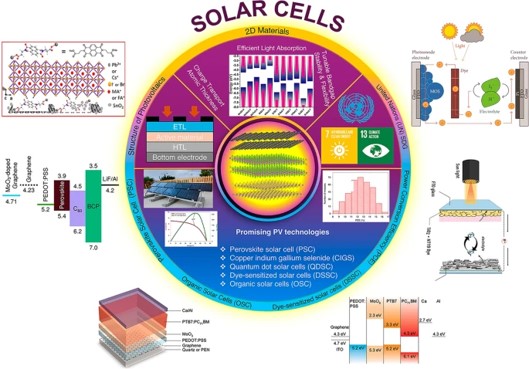
Emerging Role of 2D Materials in Photovoltaics: Efficiency Enhancement and Future Perspectives
Ghulam Dastgeer*, Muhammad Wajid Zulfiqar, Sobia Nisar, Rimsha Zulfiqar, Muhammad Imran, Swagata Panchanan, Subhajit Dutta, Kamran Akbar*, Alberto Vomiero*, Zhiming Wang*
Nano-Micro Lett. (2026) 18:32
https://t.co/xYjiG0cHJ5
This review systematically examines two-dimensional materials in perovskite, organic, and dye-sensitized solar cells, focusing on their roles as electron transport layers, hole transport layers, and counter electrodes. It highlights how energy-level alignment, work function tuning, defect passivation, and interfacial engineering enhance charge extraction, suppress recombination, and improve device efficiency and stability. It further discusses challenges in material quality, interfacial stability, and large-scale fabrication, outlining strategies involving doping, surface modification, and scalable synthesis to advance next-generation photovoltaic technologies.
#2DMaterials #Photovoltaics #InterfaceEngineering
HOT PAPER in Web of Science!
Integrating Overall Water Splitting with Advanced Oxidation for Wastewater Treatment Using a Bifunctional Medium-Entropy Amorphous Alloy
Yifan Cui, Yonghui Wang, Bo Li, Jiaqi Huang, Le Bo, Hengqi Liu, Mahlanyane Kenneth Mathe, Murodjon Samadiy, Shengfeng Guo, Hongxian Shen, Jianfei Sun, Sida Jiang*
Nano-Micro Lett. (2026) 18:333
https://t.co/DSU3lAuh17
This work develops melt-extracted (FeCoNi)₈₀B₂₀ medium-entropy amorphous alloy fibers to integrate overall water splitting with advanced oxidation for wastewater treatment. The crystalline–amorphous heterostructure and multielement synergy regulate OH* adsorption, balancing electrocatalytic activity and pollutant degradation. In simulated reclaimed water, the coupled process achieves complete decolorization within 60 min and 63.24% total organic carbon removal, while an anion-exchange membrane electrolyzer operates at 200 mA cm⁻² for approximately 100 h. Production in approximately 100 g batches further highlights its potential for coupling hydrogen production with water remediation.
#WaterSplitting #WastewaterTreatment #AmorphousAlloys
HOT PAPER in Web of Science
Absorption, Photothermal, Anti-Corrosion, and Antimicrobial Properties
Qiqin Liang, Mukun He, Beibei Zhan, Hua Guo, Xiaosi Qi*, Yunpeng Qu, Yali Zhang, Wei Zhong, Junwei Gu*
Nano-Micro Lett. (2025) 17:167
https://t.co/hTc8E7xsyj
This work constructs hierarchical sea urchin-like yolk–shell CoNi@N-doped carbon-CoNi@CNTs nanocomposites using Prussian blue analogue precursors and catalytic chemical vapor deposition. Integrating CoNi nanoparticles, carbon nanocubes, and CNTs creates abundant polarization interfaces and conductive pathways, improving impedance matching and microwave attenuation. The composites achieve a minimum reflection loss of −71.70 dB at a thickness of 2.78 mm and an antibacterial rate of 84.03% against E. coli at 1 mg mL⁻¹. Their additional photothermal conversion, hydrophobicity, and corrosion resistance highlight a strategy for multifunctional microwave absorbers suited to complex environments.
#MicrowaveAbsorption #YolkShellStructure #MultifunctionalMaterials
HOT PAPER in Web of Science
Functionalized Separators Boosting Electrochemical Performances for Lithium Batteries
Zixin Fan, Xiaoyu Chen, Jingjing Shi, Hui Nie*, Xiaoming Zhang, Xingping Zhou*, Xiaolin Xie, Zhigang Xue*
Nano-Micro Lett. (2025) 17:128
https://t.co/SSOzp5uoMo
This review systematically compares three major separator functionalization strategies for lithium batteries: surface coating, in situ modification, and grafting modification. It examines inorganic, organic, and hybrid modification materials, emphasizing how electrolyte wettability and coating–substrate adhesion influence ion transport and cycling stability. It further outlines future directions in cost-effective functional materials, manufacturing processes, coating thickness control, and quantitative adhesion assessment, alongside multifunctional designs for dendrite suppression and interphase stabilization, to advance safer and more durable lithium batteries.
#FunctionalSeparators #LithiumBatteries #InterfaceEngineering
HOT PAPER in Web of Science
Comprehensive Understanding of Closed Pores in Hard Carbon Anode for High-Energy Sodium-Ion Batteries
Siyang Gan, Yujie Huang, Ningyun Hong, Yinghao Zhang, Bo Xiong, Zhi Zheng, Zidong He, Shengrui Gao, Wentao Deng, Guoqiang Zou, Hongshuai Hou*, Xiaobo Ji
Nano-Micro Lett. (2025) 17:325
https://t.co/mc6AhWWfGZ
This review systematically examines closed pores in hard carbon anodes for high-energy sodium-ion batteries, proposing a classification of quasi-closed, closed, and fully closed pores. It analyzes their formation mechanisms and establishes relationships between pore structural characteristics, sodium-ion desolvation, pore filling, and low-voltage plateau capacity. It further summarizes pore engineering strategies involving precursor cross-linking, pore-forming agents, and carbonization control, and emphasizes molecular-level design integrating kinetic and thermodynamic analyses to guide rational pore regulation and improve sodium storage performance.
#HardCarbon #ClosedPores #SodiumIonBatteries
HOT PAPER in Web of Science!
Boosting Oxygen Evolution Reaction Performance on NiFe-Based Catalysts Through d-Orbital Hybridization
Xing Wang, Wei Pi, Sheng Hu, Haifeng Bao*, Na Yao*, Wei Luo*
Nano-Micro Lett. (2025) 17:11
https://t.co/2SnNKu5C2o
This work develops La-modified NiFe catalysts with 3d–5d orbital coupling to enhance oxygen evolution reaction activity and stability. Experimental and theoretical analyses reveal that La incorporation breaks the symmetry of Ni–Fe units, optimizes metal–oxygen orbital hybridization, strengthens oxygen-intermediate adsorption, and lowers the rate-determining step energy barrier. The NiFeLa catalyst requires an overpotential of only 190 mV at 10 mA cm⁻² in 1 M KOH. An anion-exchange membrane water electrolyzer achieves 1.58 V at 1 A cm⁻² at 80 °C, with durability demonstrated for over 600 h at 1 A cm⁻².
#OxygenEvolution #OrbitalHybridization #WaterElectrolysis
HOT PAPER in Web of Science!
Advancements and Challenges in Organic–Inorganic Composite Solid Electrolytes for All-Solid-State Lithium Batteries
Xueyan Zhang, Shichao Cheng, Chuankai Fu*, Geping Yin, Liguang Wang*, Yongmin Wu*, Hua Huo*
Nano-Micro Lett. (2025) 17:2
https://t.co/ebI4fCyrJt
This review systematically examines organic–inorganic composite solid electrolytes for all-solid-state lithium batteries, analyzing key performance parameters and microscopic lithium-ion transport mechanisms. It compares inert and active inorganic fillers, highlighting how filler composition, content, morphology, and structural design influence ionic conductivity, lithium-ion transference number, mechanical strength, and electrochemical stability. It further summarizes advanced characterization techniques and outlines challenges and future directions in ion transport optimization, interfacial engineering, and scalable manufacturing to advance practical solid-state batteries.
#SolidStateBattery #CompositeElectrolyte #IonTransport
Call For Papers:
Special issue on Highly Safe and Sustainable Batteries
Guest editor: Prof. Guanjie He, Ivan P. Parkin, Jiang Zhou
https://t.co/fzUbBxdGV0
Architecting Anode Current Collectors for Practical Anode‑Free Alkali Metal Batteries
Kai Tang, Zihan Shen, Wen Xie, Pengfei Song, Longcheng Zhang, Dongshuang Wu, Zhichuan J. Xu* Nano‑Micro Lett. (2027) 19:53
https://t.co/8cF6tdtxIo
This review systematically compares lithium, sodium, and potassium anode‑free alkali metal battery systems, analyzes core performance metrics including Coulombic efficiency, depth of discharge and cell‑level energy density. It summarizes cutting‑edge anode current‑collector engineering strategies and identifies four key design parameters: electronic conductivity, alkali metal affinity, collector morphology, and interphase stability. It further puts forward practical considerations covering genuine anode‑free configuration, stack pressure, manufacturability and machine‑learning‑guided design for advancing real‑world implementation.
#AnodeFreeBattery #CurrentCollector #AlkaliMetalBattery
Call for Papers for a Special Issue on
AI for catalysis towards a low-carbon and sustainable future
Article Types: Original research articles, Reviews, etc.
Guest Editors: Sai Chen, Xiaoguang Duan, Roger Ruan, Xiaonan Wang, Xiangzhou Yuan
https://t.co/c5eS4H1X7Q
New Cover Paper
Bi-Polar Bioenergetic Intervention via a Pathology Self-Adaptive Single-Atom Nanocatalyst for Diabetic Tumor Postoperative Management.
Jiajie Chen, Jimin Huang, Zhibo Yang, Kai Tang, Chengtie Wu, Huamao Ye, Jianlin Shi & Yufang Zhu
Nano-Micro Lett. 18, 346 (2026).
https://t.co/RXA0xfz1N8
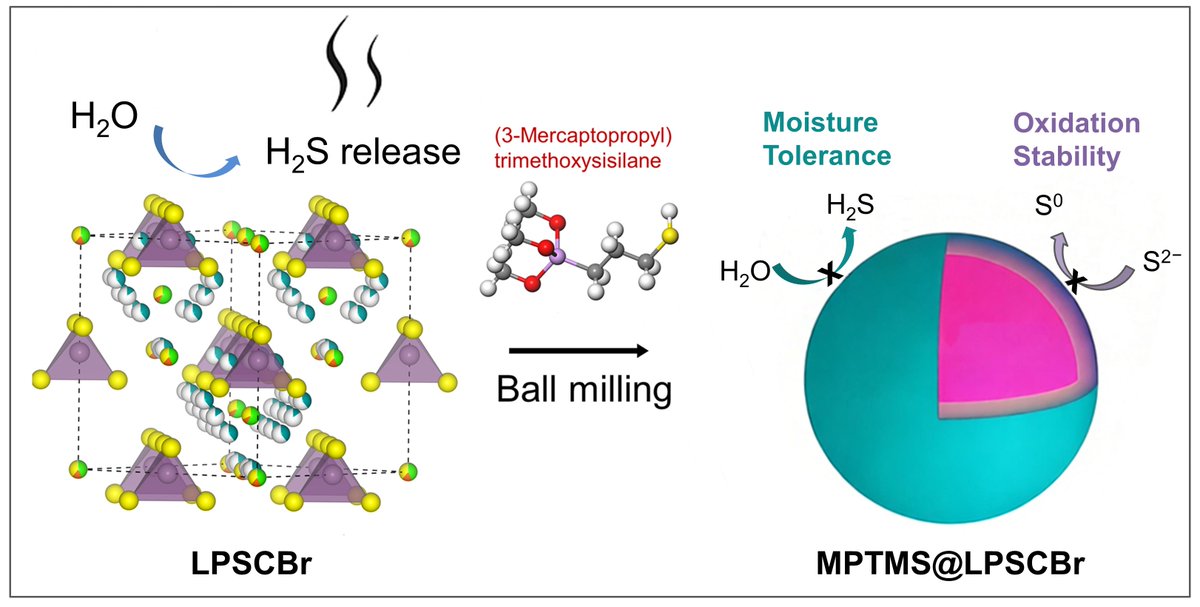
High‑Conductivity and Moisture‑Tolerant Sulfide Electrolyte Enabled by Bifunctional Coating for Practical All‑Solid‑State Lithium Batteries
Dabing Li, Hongjie Xu, Guoqin Cao, Fanfan Liu, Jinjin Ban, Shilin Zhang, Li‑Zhen Fan*, Junhua Hu*
Nano‑Micro Lett. (2026) 19:51
https://t.co/E1mUjVyctg
The authors propose a bifunctional MPTMS coating strategy via mechanochemical ball‑milling to address the notorious moisture‑sensitivity issue of argyrodite‑type sulfide solid electrolytes. The synergy of covalent S‑S bonding and hydrophobic siloxane network greatly suppresses toxic H₂S release while retaining high ionic conductivity. Systematic characterizations verify improved air stability, inhibited hydrolysis‑oxidation degradation and enhanced cathode interfacial compatibility. Assembled all‑solid‑state cells and pouch cells deliver outstanding long‑cycle performance. This scalable surface‑modification approach is also applicable to other thiophosphate electrolytes, paving the way for ambient‑atmosphere manufacturing of practical all‑solid‑state lithium batteries.
#SolidStateBattery #SulfideElectrolyte #SurfaceModification #MoistureStability #AllSolidStateBattery #InterfaceEngineering
Strategies for Boosting Performance of Perovskite Photodetectors: Synergistic Material and Device Optimization for Advanced Applications
Ying Li, Xinmiao Li, Yancheng Chen*, Guozhen Shen*
Nano‑Micro Lett. (2027) 19:50
https://t.co/ttn0HS0H9E
This review summarizes the research evolution of perovskite photodetectors. It discusses four key optimization routes: material preparation, optical management, interface engineering and stability enhancement. Typical applications including imaging, optical communication, wearable electronics and X‑ray detection are introduced. The authors analyze major challenges such as lead‑free development, large‑area fabrication and standardized evaluation, and propose a developmental roadmap toward practical optoelectronic systems. It provides valuable references for advancing perovskite photodetectors from lab research to real‑world applications.
#Perovskite #Photodetector #InterfaceEngineering #Optoelectronics #WearableDevices #XRayDetection