“This is the kind of finding you hope you’re going to make on a mission.” – Tim McCoy, curator of meteorites and lead author on a new paper out today.
Find the paper here: https://t.co/EFJygRlbeC
The discovery suggests that extraterrestrial brines provide a crucial setting for the development of organic compounds. “We now know from Bennu that the raw ingredients of life were combining in really interesting and complex ways on Bennu’s parent body,” said McCoy.
Interested in writing about meteorites and mammoths, squids and sloths, diamonds and dinosaurs?
Apply now for our paid Summer 2025 #SciComm internship!
This 12-week, part-time internship may be virtual.
Apply here by Feb 21: https://t.co/dXljFzEHOS
Congrats to curators Dr. Andrea Quattrini and Dr. Sabrina Sholts for receiving the Presidential Early Career Award for Scientists and Engineers (PECASE). PECASE is the highest honor bestowed by the U.S. government on outstanding scientists and engineers early in their careers.
The National Museum of Natural History will be closed to the public on Tuesday, January 7 due to street closures as part of ceremonies honoring former President Jimmy Carter. All other Smithsonian museums on the National Mall will be open as usual.
In the event of a government shutdown, our museums, research centers, and the National Zoo will remain OPEN through at least Thursday, Dec. 26. Please note that we are closed on Dec. 25. Visit https://t.co/JIkab2wlwE for updates.
Image: Richard Lippold’s “Ad Astra” on view outside our @airandspace.
This included recently partnering with his friend and colleague Bruce Collette to endow a permanent curatorial position in the Fish Division.
We’re going to miss Dave a lot.
Today we mourn the loss of our friend and colleague Dave Johnson, Curator of Fishes.
Dave was a world-renowned comparative morphologist and ichthyologist who joined our Fish Division's curatorial staff in 1983. He was by nature a collaborator and had many co-authors worldwide.
He served as a mentor to staff – long-time and new, young and old – and took particular interest in ensuring that future generations had the support they needed to be successful.
In Aug 2023, a shark seemingly appeared out of nowhere and the three female epaulette sharks at the Brookfield Zoo in Illinois had a new roommate: a teeny-tiny baby shark.
Where'd it come from? Short answer: parthenogenesis
Find the long answer here: https://t.co/MBR4VdqFgM
In late 1872, Captain Charles Hall lay dying on the U.S.S. Polaris, off the coast of Greenland. Before his death, Hall accused his chief scientist of wanting to poison him.
Could a specimen in the museum's collection help solve this mystery?
Read more: https://t.co/8lE2tXZD0k
Eighty-four years, six months and seven days.
That's how long it took for an octopus collected by John Steinbeck in the Gulf of California to be correctly identified. Read more here: https://t.co/JAEb5Rjl57
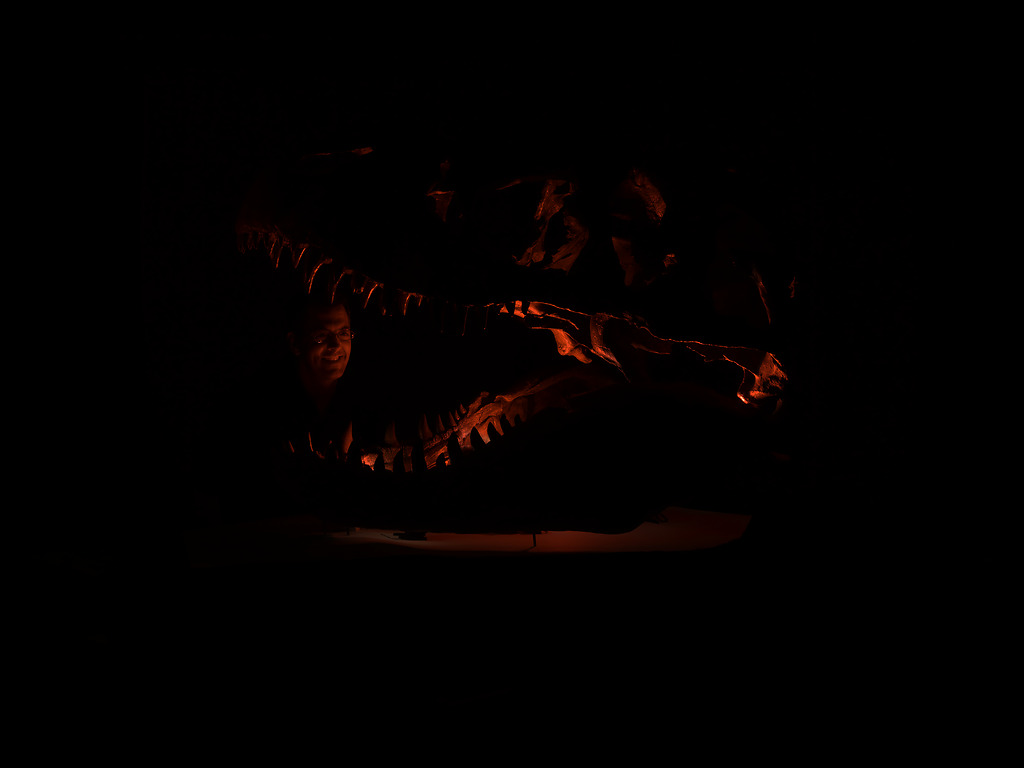
This T. rex skull is ready for Halloween!
Standing about 15 feet tall with large, serrated teeth, a Tyrannosaurus wouldn't need much help striking fear. The largest meat eater in western North America, it feasted on dinosaurs large and small.