Helios is becoming a multichain light client for Ethereum.
It has become clear that light clients are fundamental to Ethereum scaling. A future with thousands of rollups doesn’t feel far away, and the closer we get, the more critical rollup interoperability will become.
🧵👇
What happens when intelligence becomes a line item?
For the first time, companies can treat AI token spending almost like headcount: allocate more money, deploy more intelligence, and potentially get more work done.
That changes the economics of building a company. It could reshape how companies form, how teams are managed, how businesses are financed, and who is best positioned to build them.
a16z crypto General Partner @guywuolletjr and Head of Engineering @NoahCitron join @rhackett to explore why engineering leaders may soon manage token budgets like P&Ls, the emergence of software-engineering “pod shops”; and whether the future belongs to smaller, leaner businesses run by people who are unusually good at directing agents.
They also ask why AI agents may naturally transact using stablecoins, and confront a larger question: If AI has created so much new intelligence, why hasn’t it produced an obvious jump in economic growth? And in a world where everyone can access powerful models, will intelligence matter less than grit, judgment, and agency?
0:00 Intro
4:01 Why token spending is starting to resemble headcount
4:51 Deciding how much spend is too much spend
9:04 The agentic A/B test: How to quantify "return on tokens"
12:05 The software-engineering "pod shop"
25:13 Paying deference to the Machine God
26:06 The rise (or not) of lean, AI-native microbusinesses
28:05 Everyone's a manager? The new style of thinking for engineers
30:48 Why AI agents may naturally use stablecoins
34:33 When AI productivity will appear in GDP
47:49 Why grit and agency may matter more than IQ
51:38 How AI could create new paths for startups
54:53 Innovation, commoditization, and creative destruction
We've been exploring whether AI security agents can replace human experts.
Our takeaway so far: not yet.
For price manipulation, one of the most complex DeFi attacks, generating exploit PoCs is still a bottleneck.
Would love your thoughts.
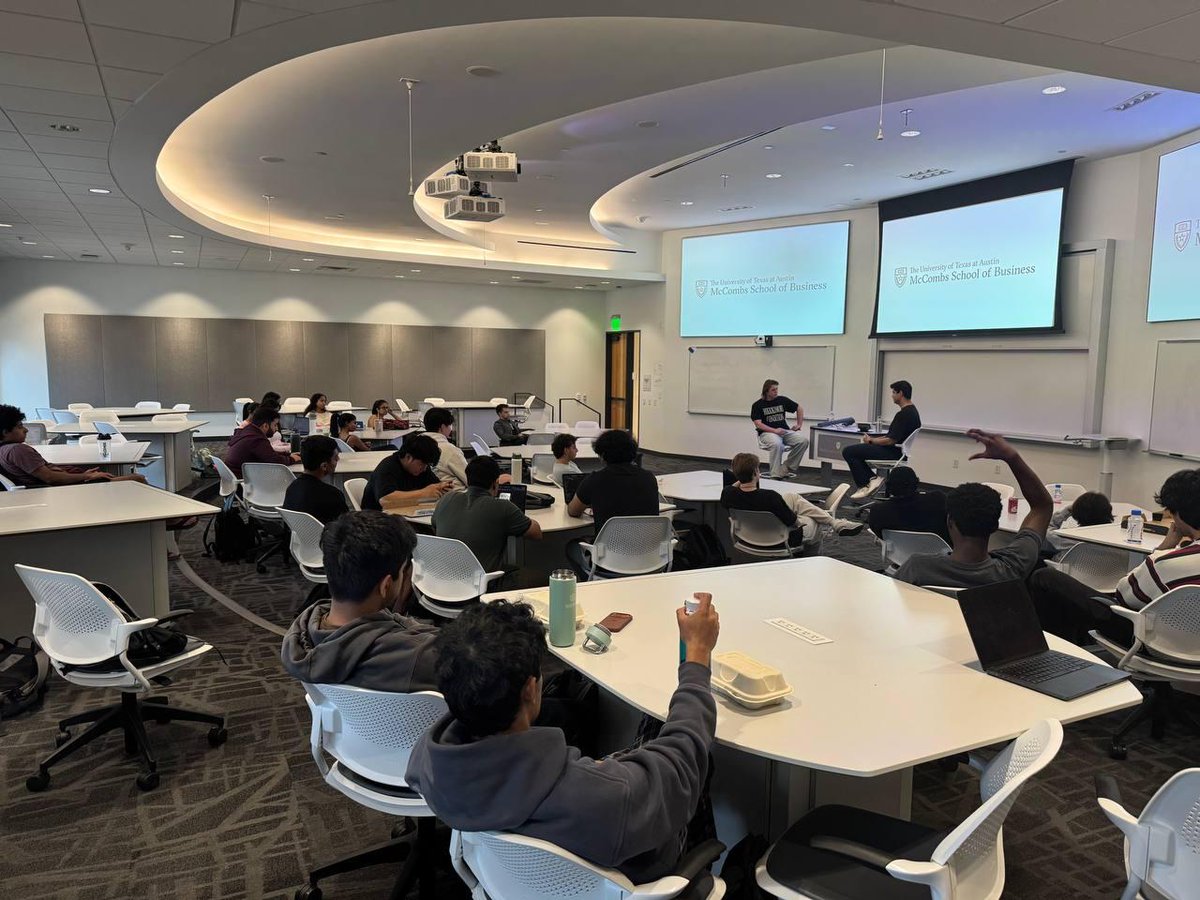
This week, students at UT Austin through Texas Blockchain had a great conversation on privacy, ai, investing, and how young professionals can orient their careers in crypto. A huge thank you to @Windscar1001 from @a16zcrypto for the discussion!
Counterclaim: the existence of Bitcoin makes either time travel or a cryptographically relevant quantum computer impossible (or both).
If both could exist at some future point, then future humans would build the computer, extract the keys, and steal all Bitcoin.
Today @joshgans and I investigated a critical question of our time – and along the way discovered what may provide the first actual and distinctive use case for Bitcoin over traditional money 💸⏳⌛️⏳
Jolt WASM prover demo is now supports blindfold.
Full ZK proving in browser: https://t.co/N1vKhPpe34
Next on the roadmap is to optimize Jolt for small statements to get 10x on prover time!
Big Jolt announcement today: Jolt now has native privacy (a zk zkVM!)
Why does this matter? Arguably the main blocker for privacy app innovation is ease of experimentation. The time and effort required to make (particularly zk-based) privacy products is astronomical.
How many developers are there in the world that you would trust to build the fancy cryptography required for privacy apps? I think it's around 50. Even if LLMs speed up the implementation, there are only 50 people in the world that can certify / give you confidence that the implementation is faithful. Coupled with the fact that you need difficult audits for every new change, the pace of progress is very underwhelming.
With Jolt, developers can just do things. Developers write rust, and the Jolt proving backend will increasingly harden over time, bringing the cost and time for audits for the app layer down tremendously.
2026 is the year of privacy apps and we are excited for Jolt to play a big part in that!
See reply for the full article :)
[1/2] Jolt is now a "zkzkVM" 🤫.
A somewhat subtle point that differentiates our approach from most other zkVMs:
Jolt proofs are "directly" ZK, while others rely on "wrapping" their zkVM proof with a different proof system (often Groth16) to achieve ZK.
1/ Jolt now supports zero-knowledge 🧵
This makes Jolt suitable for privacy applications — no SNARK recursion, no "wrapping", no sacrifice of transparency. Marginal increase in proof size (~3 KB). Prover time is essentially unchanged.
https://t.co/zZew9iMu7I




![moodlezoup's tweet photo. [1/2] Jolt is now a "zkzkVM" 🤫.
A somewhat subtle point that differentiates our approach from most other zkVMs:
Jolt proofs are "directly" ZK, while others rely on "wrapping" their zkVM proof with a different proof system (often Groth16) to achieve ZK. https://t.co/3xx5UyqYmo](https://pbs.twimg.com/media/HCgliXQawAMkTGd.jpg)



