I'm excited we at Prism ML are releasing 1-bit and ternary image generation models! Bonsai Image 4B models are small enough to fit on your iphone and maintain 88-95% of their parent model's quality, FLUX.2 Klein 4B. Try them out locally on your iphone, macbook, or small GPU 🌳🌳🌳
Today we’re releasing 1-bit and Ternary Bonsai Image 4B.
A new family of image-generation models designed to run high-quality diffusion inference on local hardware: from laptops to phones.
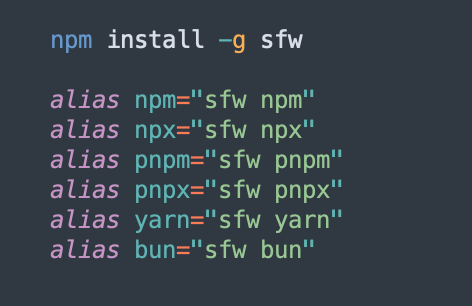
npm user?
➡️ One small change to stay safe, FREE
Add these aliases
➡️ pkg installs forbid using known malware
I run this:
- locally, to stay safe
- in my CI to detect compromised transitive dependencies early for my lib consumers
Excited to share that @GoogleChrome will soon be coming to ARM64 Linux devices!
Thanks to @nvidia for the awesome product & engineering partnership to bring one of the fastest and safest browsers to some of the most powerful computers in the world! 🛠️🕸️🤝
More at https://t.co/QDCRiDiktN
🚨BREAKING: MIT hooked people up to brain scanners while they used ChatGPT.
What they found should concern every single person reading this.
ChatGPT users showed 55% weaker brain connectivity than people who didn't use it. Not after years. After just four months.
Here's how they tested it. 54 people were split into three groups: one used ChatGPT to write essays, one used Google, and one used nothing but their own brain. They wore EEG monitors that tracked their brain activity in real time across four sessions over four months.
The brain-only group built the strongest, most widespread neural networks. Google users were in the middle. ChatGPT users had the weakest brains in the room. Every time.
Then the memory test hit. Participants were asked to recall what they'd just written minutes earlier. 83% of ChatGPT users couldn't quote a single line from their own essay. They wrote it. They couldn't remember it. The words passed through them like they were never there.
It gets worse. In the final session, ChatGPT users were told to write without AI. Their brains were measurably weaker than people who never used AI at all. 78% still couldn't recall their own writing. The damage didn't go away when the tool was removed.
Meanwhile, brain-only users who tried ChatGPT for the first time? Their brains lit up. They wrote better prompts. They retained more. Their brains were already strong enough to use AI as a tool instead of a crutch.
The researchers also found that every ChatGPT essay on the same topic looked almost identical. More facts, more dates, more names. But less original thinking. Everyone using ChatGPT produced the same generic output while believing it was their own.
MIT gave this a name: cognitive debt. Like financial debt, you borrow convenience now and pay with your thinking ability later. Except there's no way to pay it back.
The question isn't whether ChatGPT is useful. It's whether the price is your ability to think without it.
The goroutine leak profile in the upcoming Go 1.26 is a big deal.
But the synctest package, available since 1.24, can also catch leaks just fine. I don't know why no one talks about this.
Anyway, it's time to cover both of them!
https://t.co/iUrAa7ShdI