Awesome work from @noctrog and @YoussefMMSaied working in my lab at @unige_en.
After all those years I still cannot comprehend the amount of information packed in a few tokens [if you do your job well].
📄 Paper: https://t.co/MssTaiCe61
🌐 Project: https://t.co/SXNJvPkO8B
💻 Code: https://t.co/iqnhraLVUJ
🤗 Checkpoints: https://t.co/E3eTrHLsT7
Work in collaboration with @YoussefMMSaied and @francoisfleuret
Your RAE does not need all of those tokens.
Meet PoolDINO: 4x-16x fewer tokens, similar generation quality, and both cheaper training and sampling.
Here's RAE vs. 8x compression on an M1 Pro CPU (no accelerator).
🧵
Good for generation doesn’t mean best for every task.
Learned pooling gives lower classification accuracy and worse performance on dense tasks (depth, segmentation) compared to simple baselines.
❌Diffusion planners are missing a fundamental ingredient of classical control: an explicit model of the system dynamics.
📍We address this gap by introducing Model Predictive Diffuser, a new diffusion planning framework with a novel sampling strategy alternating between a planner and a dynamics model.
✅Achieving better performance, greater adaptability, improved sample efficiency and more!
We released Sonic-3.5 and Ink-2, the #1 streaming models for text to speech and speech to text you can use in your voice agents today.
New architectures enable new frontiers for speed and quality.
We're now the only provider to have #1 models for both speaking and listening.
Cartesia Ink-2 debuts as #1 for accuracy on the brand-new streaming speech-to-text leaderboard from @ArtificialAnlys! We designed Ink-2 from the ground up for voice agents - with low latency, eager transcripts, and semantic endpointing.
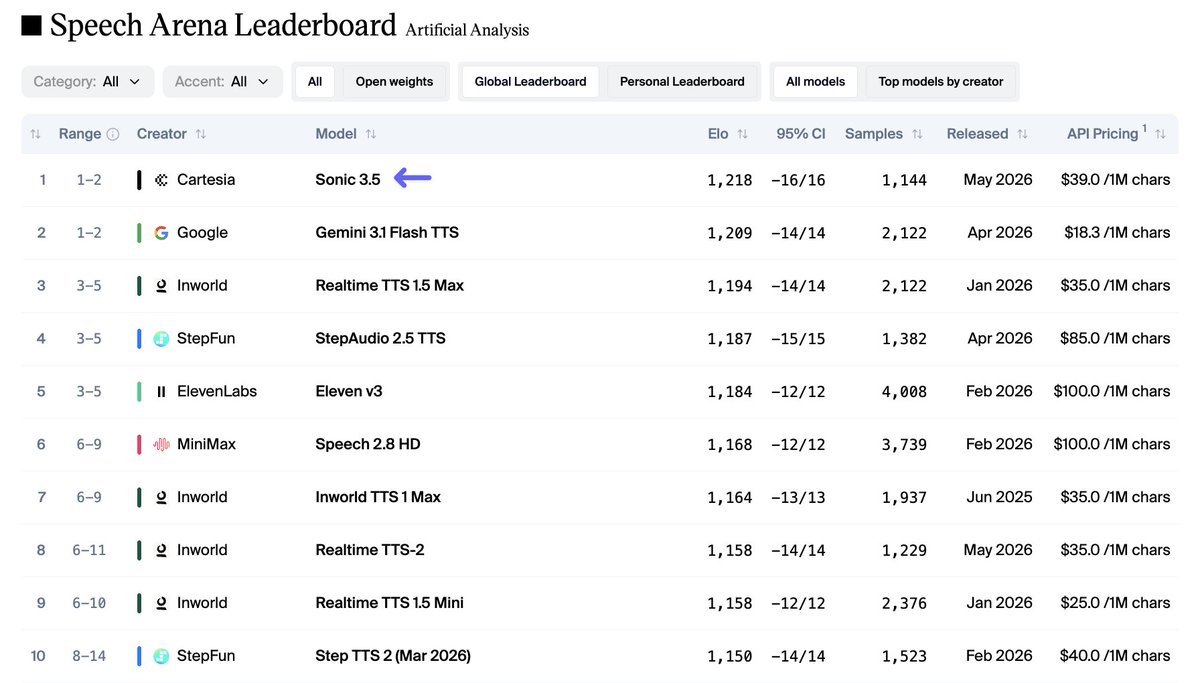
Sonic 3.5 is now the #1 text to speech model on the @ArtificialAnlys leaderboard!
You no longer have to trade off quality and latency - Sonic 3.5 also has the fastest time to first audio at 82ms end to end.
See full benchmark results 👇
Cartesia’s Sonic-3.5 takes the #1 spot on the Artificial Analysis Speech Arena Leaderboard, surpassing Inworld Realtime TTS 1.5 Max and Google’s Gemini 3.1 Flash TTS
Sonic-3.5 is the latest TTS model from @cartesia . It supports 42 languages, including 9 Indian languages, with 500+ voices available out of the box. The model has been highly preferred among voters in the TTS Arena, with its demonstrated naturalness and accurate transcript following.
Key takeaways:
➤ Quality: Sonic-3.5 has an Elo score of 1,218 (+16/-16) based on 1,144 arena appearances, placing it ahead of Inworld Realtime TTS 1.5 Max at 1,194 and Gemini 3.1 Flash TTS at 1,209
➤ Pricing: Sonic-3.5 is priced at $39/1M characters, a premium compared to Gemini 3.1 Flash TTS at $18.3/1M characters, and Inworld Realtime TTS 1.5 Max at $35/1M characters
➤ Speed: 105.5 characters per second, compared to 205 characters per second for Inworld Realtime TTS 1.5 Max and 26.3 characters per second for Gemini 3.1 Flash TTS
See more details and listen to samples below 🧵
1/
What happens when a denoiser trained at one noise level is reused inside an iterative sampler?
We trained SwinIR with Noise2Noise at σ=10, then dropped it unchanged into the constrained sampler of @ZKadkhodaie & @EeroSimoncelli (NeurIPS ’21) for 10% random inpainting.
Baseline SwinIR: 6.08 dB on Set12.
SwinIR-WNE: 23.87 dB.
Same backbone. Same N2N pairs. Same sampler.
With François Fleuret @francoisfleuret. ICML 2026. 🧵
If you go through the code and think something can be further optimized, please let me know!
(I'm sure there's a better way of doing context parallelism...)
I'm open sourcing a reimplementation of DINO (v1) in Jax/Flax/NNX. It trains a ViT-S on imagenet-1k in ~10h with x8 RTX 4090 to 68.8% K-NN top-1 accuracy.
First time doing Jax. I was really amazed at how simple it was to implement Data Parallelism. I also appreciate that everything in the ecosystem (grain, orbax, ...) is built around distributed training from the ground up.