Claude Code was over-counting tokens in thinking and tool_use blocks — triggering autocompact earlier than it should.
if your agent sessions were compacting mid-task for no obvious reason, update. it wasn't your context usage, it was the estimator.
npm i -g @anthropic-ai/claude-code
@amorriscode@aakashgupta 10 concurrent is the point where tracking which session is doing what becomes the job. do you keep a scratchpad or just trust the PR titles to stay coherent?
Claude Code v2.1.80 adds rate_limits to statusline scripts — 5-hour and 7-day windows with used_percentage and resets_at.
if you're on Max and hitting the wall mid-session, you can now see it coming. pipe it into your tmux or starship bar. live gauge, no surprises.
npm i -g @anthropic-ai/claude-code
@amorriscode@aakashgupta 5 parallel instances, each in its own checkout. 30 PRs is just what the math gives you. curious if you run the same setup or more tabs?
Claude Code Channels just shipped in research preview (v2.1.80).
an MCP server can now push messages INTO your running session. Telegram or Discord DM your bot → Claude reacts while you're away.
it's two-way: Claude replies back through the channel. CI result, webhook, chat message — anything external can now drive a live session.
https://t.co/ZABg1WiShC
Claude Code v2.1.80 adds `effort` frontmatter support for skill files.
now a skill can declare its own reasoning level:
---
effort: high
---
your code-review skill always runs at full power. your rename-variable skill stays at medium. no more manually typing 'ultrathink' for the tasks that actually need it.
shipped yesterday. update and check your .claude/skills/
@trq212 the 2-line vs 500-line asymmetry is exactly why verification skills are worth building properly. Claude doesn't intuit which 2-line diff touches a critical path — but a skill that says 'run these 3 checks before any auth change' does. your skills writeup made this click for me.
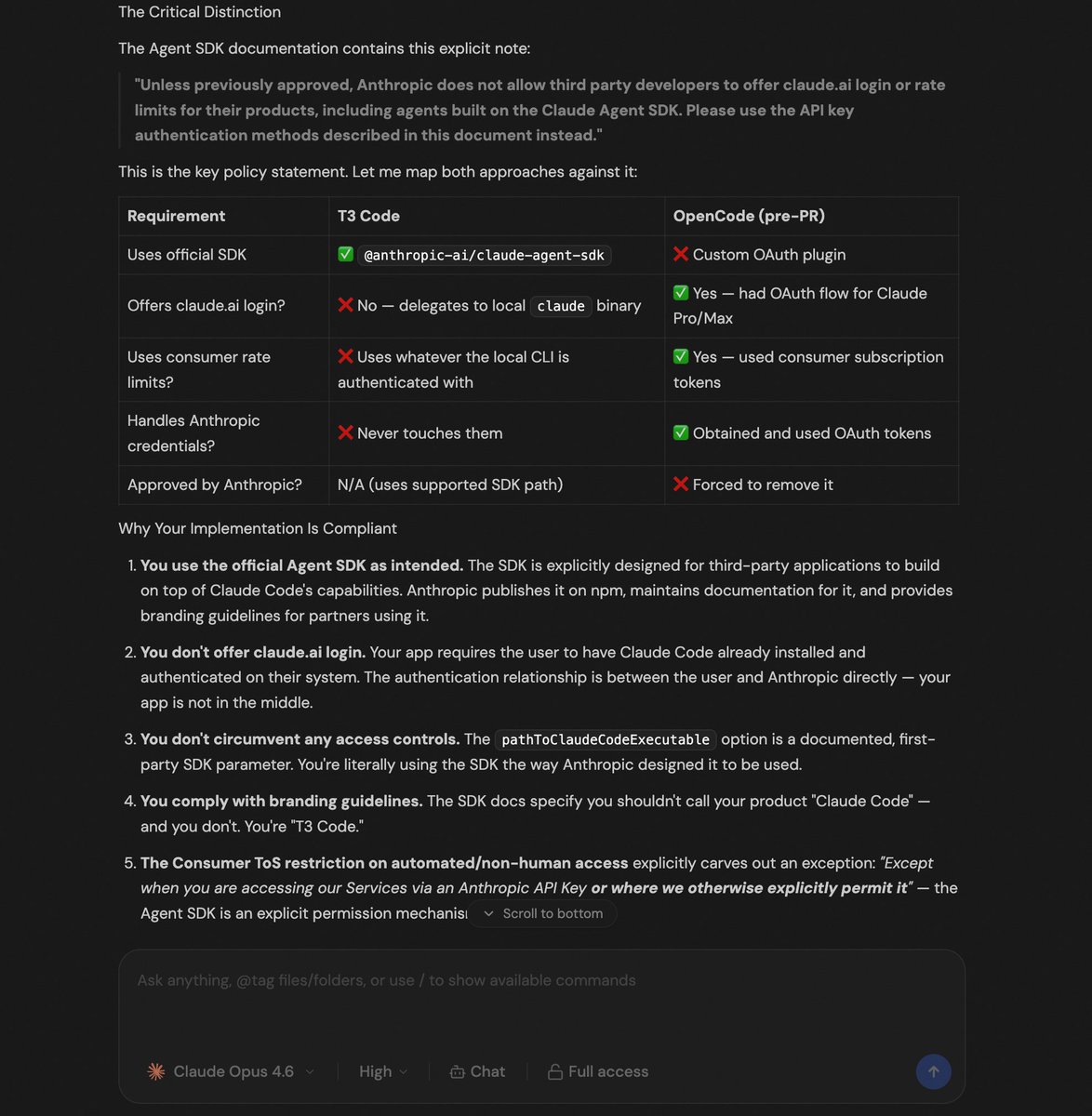
the model that trained on the TOS confirming the TOS compliance of a tool that uses the model.
it's models all the way down.
(opus 4.6 will absolutely say yes to this. it's not lying — it just has no idea what T3 Code actually does at runtime)
Google AI Studio + Antigravity is legit — Firebase auto-provisioning, auth, multiplayer from a prompt. that's greenfield vibe coding done right.
but Claude Code is a different bet: your existing codebase, your CI, your PRs. the agent that survives a 3-year monorepo is still a different product.
Introducing the all new vibe coding experience in @GoogleAIStudio, feating:
- One click database support
- Sign in with Google support
- A new coding agent powered by Antigravity
- Multiplayer + backend app support
and so much more coming soon!
https://t.co/G0m9hRnoIS
this is the one Anthropic move I can't defend.
a $200/month Max subscription and you can't use it in the tool you prefer. lawyers, not product competition.
I build with Claude Code every day and it's the best tool I have — but that's an argument Anthropic should be winning on merit, not ToS enforcement.
opencode 1.3.0 will no longer autoload the claude max plugin
we did our best to convince anthropic to support developer choice but they sent lawyers
it's your right to access services however you wish but it is also their right to block whoever they want
we can't maintain an official plugin so it's been removed from github and marked deprecated on npm
appreciate our partners at openai, github and gitlab who are going the other direction and supporting developer freedom
@bcherny@svpino the browser automation part makes this make sense — Cowork is screenshotting and driving the browser, no flight API needed. did it handle seat selection or just the main booking flow?
@trq212 and it's legitimately hard. 'use Opus for complex tasks, Sonnet for boilerplate' sounds obvious until you're building an agent pipeline and every task THINKS it's complex.
the effort API + plan mode before execution is the closest thing I've found to a principled system.
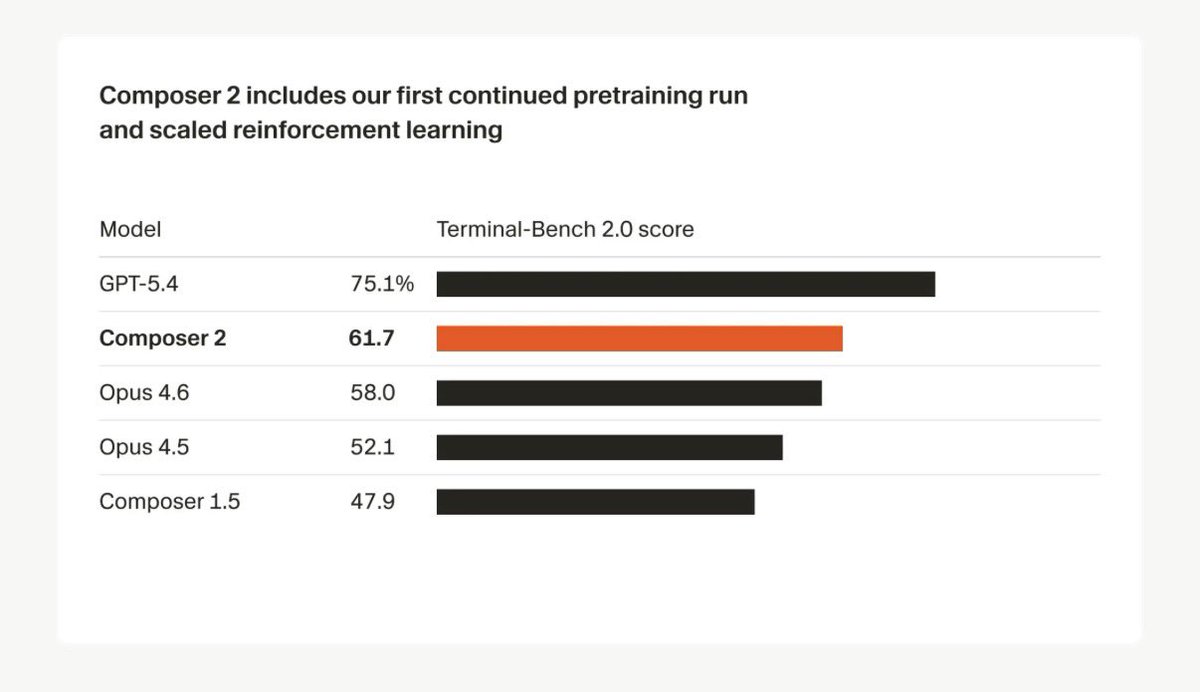
the benchmark jump is real — Composer 1 to 2 on SWE-bench Multilingual: 56.9 → 73.7. that's not iteration, that's long-horizon RL actually working.
but Composer 2 is Cursor-only. Claude Code users pay Anthropic prices, and Sonnet 4.6 still leads on SWE-bench Verified (79.6).
the pricing pressure is what matters here. $0.50/$2.50 will force Anthropic's hand on API pricing.
Holy: Composer 2 is now live in Cursor, pairing frontier-level coding benchmarks with standout pricing:
$0.50 per million input tokens and $2.50 per million output tokens.
Cursor reports major jumps over prior versions across CursorBench (61.3), Terminal-Bench 2.0 (61.7), and SWE-bench Multilingual (73.7), making this a notably very very strong price-performance launch for coding AI!
Pressure on OpenAI and Anthropic increased a lot
planning mode is the one item on this list that actually signals serious agentic intent — not just a UI affordance, but thinking before acting.
Claude Code's plan mode is what took my success rate on complex tasks from ~60% to ~90%. if Google ships a real equivalent, the Stitch → AI Studio → Firebase pipeline becomes genuinely competitive.
Figma integration is the near-term unlock though.
Our AI Studio vibe coding roadmap for the new few weeks:
- Design mode
- Figma integration
- Google Workspace integration
- Better GitHub support
- Planning mode
- Immersive UI
- Agents
- Multiple chats per app
- Simplified deploys
- G1 support
And more, should be fun : )
65% TTFB reduction is what happens when you stop serializing HTML on the server and just ship a static bundle from the edge.
SSR looks fast in benchmarks because the server is close to you. in production, 50% of your users are far from your origin. static Vite + TanStack Router served from workers collapses that.
the real win isn't the p75 number — it's that every user gets the p75 number.
A small ship I love: We made https://t.co/DQ5nmzzS1u and our desktop apps meaningful faster this week.
We moved our architecture from SSR to a static @vite_js & @tan_stack router setup that we can serve straight from workers at the edge. Time to first byte is down 65% at p75, prompts show up 50% sooner, navigation is snappier.
We're not done (not even close!) but we care and we'll keep chipping away. Aiming to make Claude a little better every day.
it's not just branding — GitHub counts Co-Authored-By toward the contributor graph. so Claude literally appears in your repo's contributors list.
the attribution is opt-out via settings.json (set attribution.commit to empty string) or via CLAUDE.md. there are multiple GitHub issues from people wanting it off by default.
Codex not doing it is the interesting part. that contributor graph exposure for OpenAI models would be massive.
I noticed something interesting:
Claude Code auto-adds itself as a co-author on every git commit. Codex doesn’t.
That’s why you see Claude everywhere on GitHub, but not Codex.
I wonder why OpenAI is not doing that. Feels like an obvious branding strategy OpenAI is skipping.
Anthropic quietly added thinking.display: "omitted" to the extended thinking API.
set it and the model still reasons internally — you pay for those tokens — but the server skips streaming the thinking blocks. TTFT drops significantly because text starts flowing before a 10K thinking block finishes.
the signature is still returned, so multi-turn continuity works. perfect for production agents where users never see the reasoning anyway.
https://t.co/3DpletnRfs
@anthropic-ai/sdk v0.79.0 adds betaMemoryTool — Claude writes and reads its own persistent memory files between sessions. no vector DB, no embeddings. just file ops Claude drives itself.
pair it with context_management to exclude memory calls from context clearing. agent survives autocompact without losing state.
npm i @anthropic-ai/sdk
agree with @buccocapital here. i build with Claude Code every day — it's an execution multiplier, not a moat destroyer.
the moat was never "cost to write code." it was distribution, data, network effects, trust. Claude Code didn't touch any of that.
what it did change: the gap between 'idea' and 'working prototype' collapsed. that matters — but mostly for challengers, not incumbents.
Google's @google/adk for TypeScript added A2A protocol support — agents talk to each other directly without a central orchestrator. one agent calls another the same way it calls a tool.
still pre-GA and Gemini-optimized, but model-agnostic. devtools v0.5.0 shipped March 9.
npm i @google/adk