sizing breaks it before the theory does. there are 7 long end ops from sept 9 to nov 4, so even if you double the cap you’re talking maybe $14bn of buying vs ~$148bn of nominal 10y+ auctions in the same window. it’s basically a wrench that’s way smaller than the pipe it’s trying to fix.
oracle put it in writing in september. 455 billion of backlog and only a tenth of it turning into actual cash inside a year, so nine tenths of the order book is a promise about 2029.
the bond market read that, and two weeks later oracle borrowed 18 billion and paid one tenth of one percent more than its last deal. a tenth. that's what learning nine tenths of your customer book is a rain cheque was worth.
then february. nothing new. same backlog, same ladder, no fresh filing, oracle just asks for 24.5 billion instead of 18. and now it's another four tenths on top. so the disclosure cost 0.1 and the extra 6.5 billion of size cost 0.4, which tells me nobody was ever pricing the backlog. they were pricing how badly oracle needed money that morning.
and it's every name on the chart. alphabet was paying a third of a percent over the government and now pays four fifths. amazon half a percent to three quarters. meta 0.75 to 0.86. not one of them came back cheaper than its own last deal. the grey line is every other american company borrowing and it barely moved, so nobody got scared of corporate debt in general, it got expensive for these four in particular.
the bit i can't get past is they all came back bigger anyway. oracle asked for more at a worse price. normally you wait a few weeks for a friendlier market. these guys can't. the leases are signed, the chips are on order, the power contracts have dates on them, the money has to be there on the builder's calendar and not the bond desk's. and the bond desk can see that. once you know somebody has to borrow you take another sliver off him every time he walks in and he pays it, because what's he going to do, stop building?
oracle put it in writing in september. 455 billion of backlog and only a tenth of it turning into actual cash inside a year, so nine tenths of the order book is a promise about 2029.
the bond market read that, and two weeks later oracle borrowed 18 billion and paid one tenth of one percent more than its last deal. a tenth. that's what learning nine tenths of your customer book is a rain cheque was worth.
then february. nothing new. same backlog, same ladder, no fresh filing, oracle just asks for 24.5 billion instead of 18. and now it's another four tenths on top. so the disclosure cost 0.1 and the extra 6.5 billion of size cost 0.4, which tells me nobody was ever pricing the backlog. they were pricing how badly oracle needed money that morning.
and it's every name on the chart. alphabet was paying a third of a percent over the government and now pays four fifths. amazon half a percent to three quarters. meta 0.75 to 0.86. not one of them came back cheaper than its own last deal. the grey line is every other american company borrowing and it barely moved, so nobody got scared of corporate debt in general, it got expensive for these four in particular.
the bit i can't get past is they all came back bigger anyway. oracle asked for more at a worse price. normally you wait a few weeks for a friendlier market. these guys can't. the leases are signed, the chips are on order, the power contracts have dates on them, the money has to be there on the builder's calendar and not the bond desk's. and the bond desk can see that. once you know somebody has to borrow you take another sliver off him every time he walks in and he pays it, because what's he going to do, stop building?
the last few days i've seen an extraordinary amount of gold and commodities deal closing worth hundreds of millions.
feels like institutions in GCC & asia are bracing up for something.
another thing that i noticed is that $SNDK has $11.4bn of flash orders it has to fill over the next twelve months.
it sold $20.2bn of flash in the whole year that just ended. those orders were signed before this price spike.
so if flash prices keep going up, sandisk does not get the upside on that part of the book. the customer already has the price.
and this is only the near term piece. another $48.4bn comes after the next twelve months, plus $31.3bn more that got signed after year end.
its gonna be a really fun next few quarters.
sandisk $SNDK put 25 dollars into its own stock for every dollar it put into a factory this year.
bought back nothing at all in either of the two years before, so it started the same year they got $59.8bn of flash reservations on the books.
and they don't even own the fabs, kioxia's JVs do.
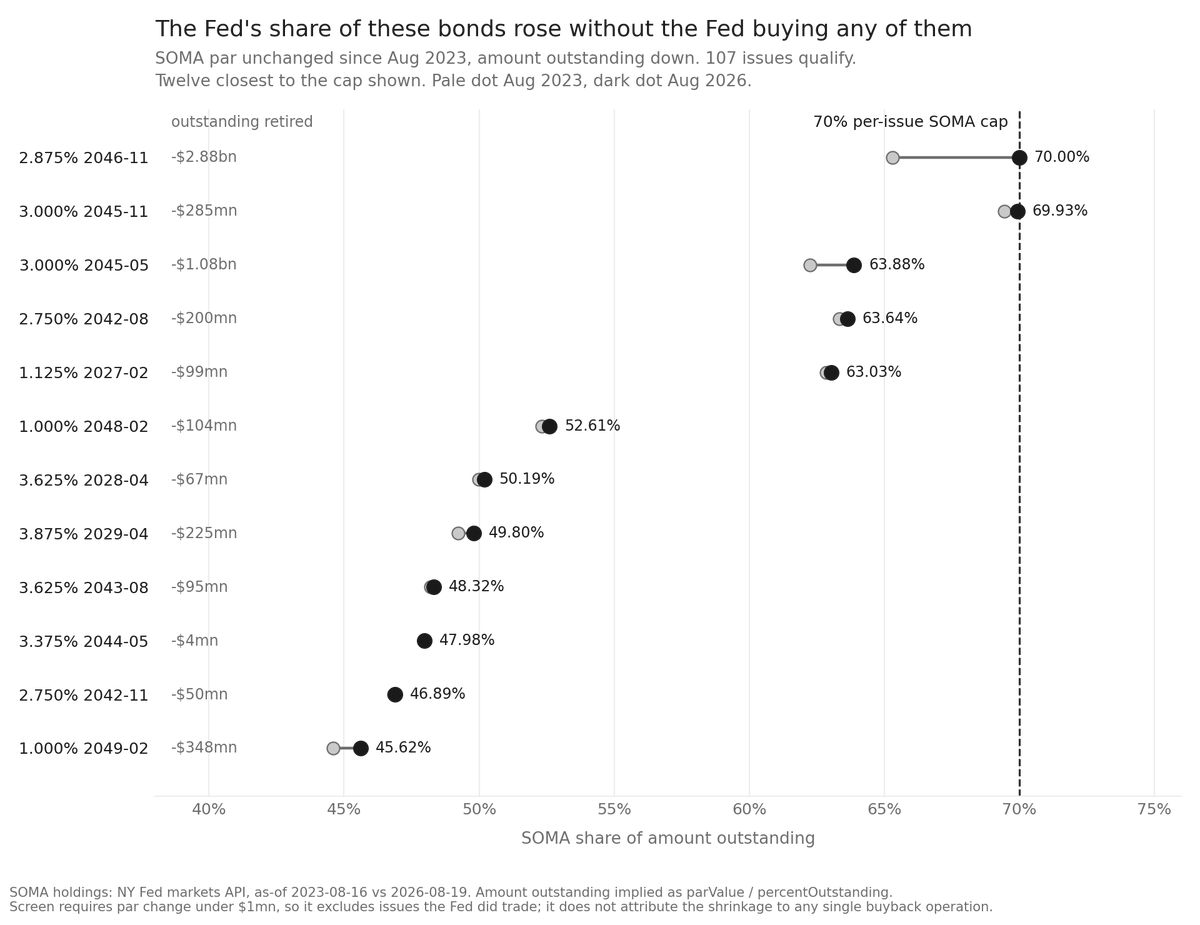
the fed's ownership share of 107 treasury issues has gone up without the fed buying a single one of them.
SOMA par on these lines has not moved since august 2023. what moved is the denominator. treasury bought the bonds back, the issue got smaller, and the fed's slice of it got bigger by sitting still.
the 2.875% of november 2046 is now at 70% of the issue, which is the fed's own per-issue cap, and it got there on $2.88bn of retirement it had no part in.
buybacks were sold as liquidity maintenance. on these lines they are a slow squeeze on somebody else's balance sheet.
@younweb3 this popped up on my instagram yesterday and i thought about it much more than i should have
"a day doesn't teach you anything while you're inside it."
sandisk $SNDK put 25 dollars into its own stock for every dollar it put into a factory this year.
bought back nothing at all in either of the two years before, so it started the same year they got $59.8bn of flash reservations on the books.
and they don't even own the fabs, kioxia's JVs do.
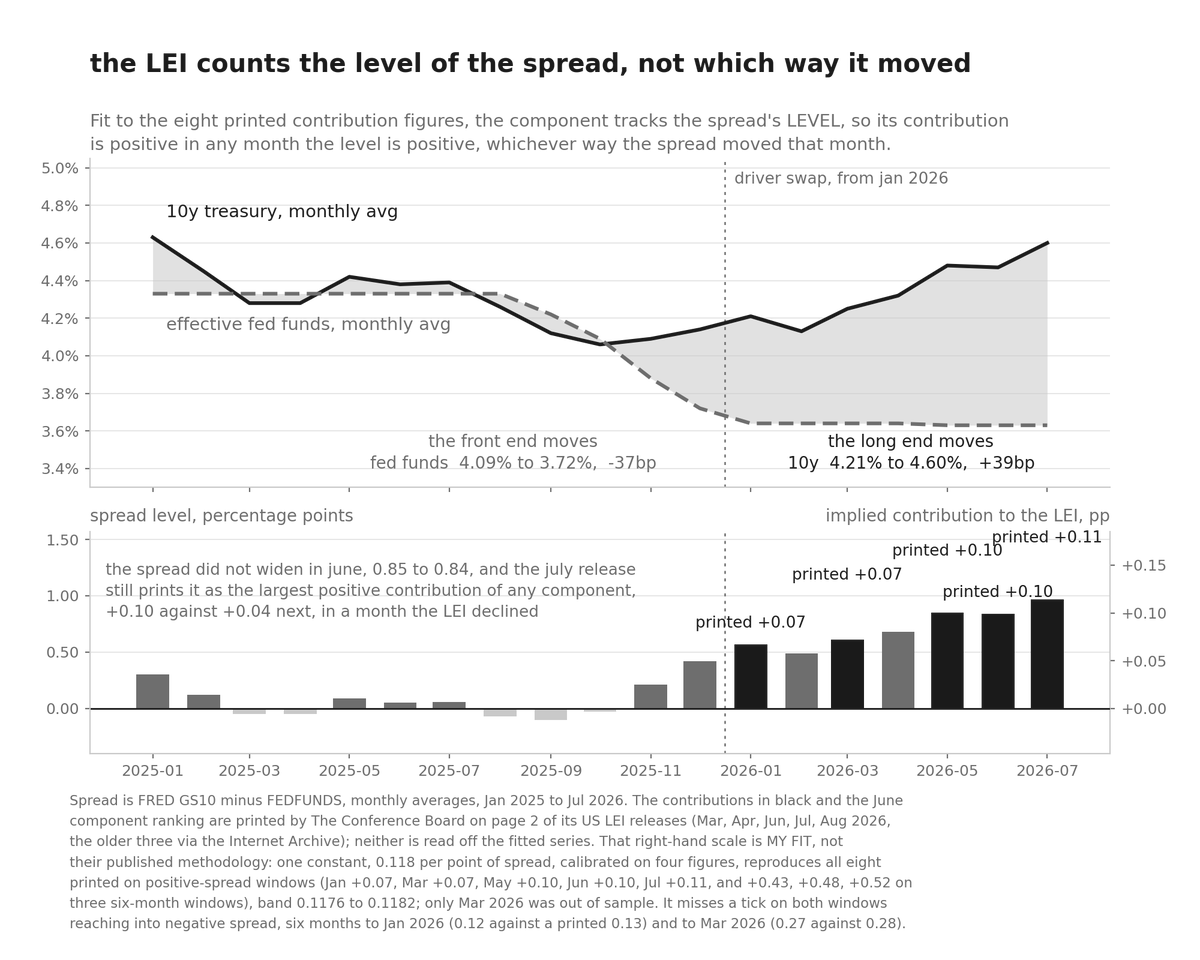
the LEI’s yield-curve contribution does not care which way the spread moved that month. it counts the level.
june 2026 the spread went 0.85 to 0.84, so it flattened, and the july release still printed that component as the largest positive contribution of anything in the index, +0.10 against +0.04 next, in a month the index fell.
fit one constant to the eight contribution figures they actually print and it reproduces all of them: 0.118 per point of spread. every month the curve is positive, the component adds. every month.
so the thing people read as 'the curve is telling you growth is coming' is arithmetic on a level, not a signal about a change.
the fed's ownership share of 107 treasury issues has gone up without the fed buying a single one of them.
SOMA par on these lines has not moved since august 2023. what moved is the denominator. treasury bought the bonds back, the issue got smaller, and the fed's slice of it got bigger by sitting still.
the 2.875% of november 2046 is now at 70% of the issue, which is the fed's own per-issue cap, and it got there on $2.88bn of retirement it had no part in.
buybacks were sold as liquidity maintenance. on these lines they are a slow squeeze on somebody else's balance sheet.
i asked some people around me on what they think about the results of the poll and i realised that scarcity and bad returns can coexist. that’s probably the part i missed earlier.
ai infra can stay tight while a lot of the capital going into it still gets wrecked.
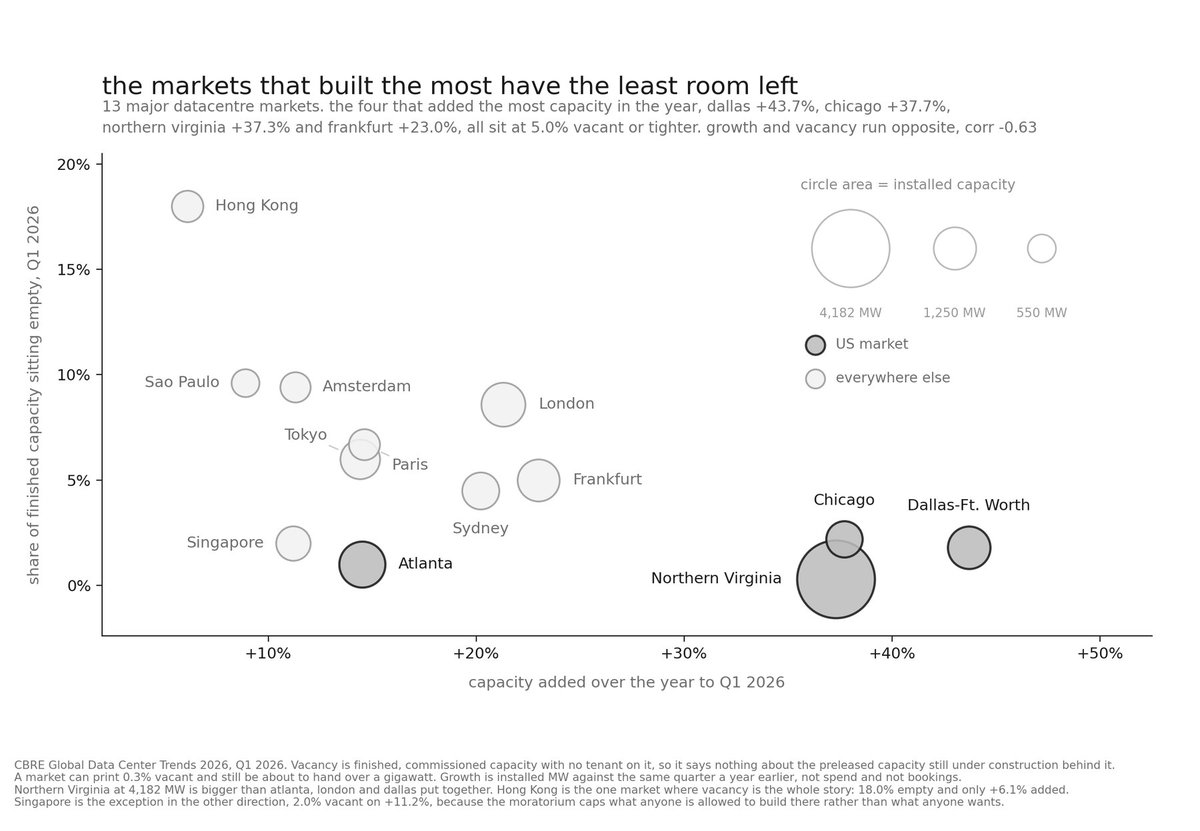
the strongest evidence against current overcapacity is not simply low vacancy. it is that some of the markets adding capacity fastest are still ending up with the least available capacity.
hyperscalers can tolerate mediocre standalone returns because compute feeds everything else they own. neoclouds can’t. the machines have to pay for themselves.
so i’m not really watching for empty data centers. i’m watching renewal pricing, debt terms and gpu residuals.
if enterprise demand explodes a few years from now, great. but that demand may want blackwell, rubin or whatever comes next, not the hardware financed at scarcity-era economics today.
i’m more interested in who’s still making money by the time all that demand actually shows up.
its a small dataset but i'm glad it went somewhere.
there’s something pretty interesting buried in this gpu pricing table.
the market is starting to put very different prices on the compute itself and on the certainty of actually having that compute when you need it.
aws is charging $19.47/hr on-demand for b300 and $3.84 on spot. b200 is $15.89 vs $4.38.
that kind of spread tells you the market is no longer just pricing the gpu. it’s pricing certainty, availability, cluster quality and the ability to actually get the compute when you need it.
and yet most of the newer gpu spot prices here were still moving up month-on-month.
so this doesn’t look like a broad compute glut to me. it looks more like the market is starting to separate cheap, interruptible compute from genuinely scarce, dependable capacity.
i believe the more interesting part of this is what this does to depreciation.
an h100 doesn’t need to become useless for its economics to deteriorate. it just needs a newer chip to give you far more useful compute for roughly the same merchant rental price.
that means physical useful life and economic useful life can be very different things.
which is why i think the ai capex debate is slowly moving away from “are we building too many gpus?”
and now i’m back to the same question: if every new gpu generation keeps making the last one cheaper, where does the clearing price of compute actually settle?
because ai demand can keep growing while returns on the infrastructure still get worse.
any thoughts?
governments have accumulated so much debt that genuinely fixing the fiscal position has become politically horrible.
so when the long end starts charging them for it, they increasingly try to manage the bond market around the debt instead.
via @robin_j_brooks’ shadow price macro newsletter.
oracle put it in writing in september. 455 billion of backlog and only a tenth of it turning into actual cash inside a year, so nine tenths of the order book is a promise about 2029.
the bond market read that, and two weeks later oracle borrowed 18 billion and paid one tenth of one percent more than its last deal. a tenth. that's what learning nine tenths of your customer book is a rain cheque was worth.
then february. nothing new. same backlog, same ladder, no fresh filing, oracle just asks for 24.5 billion instead of 18. and now it's another four tenths on top. so the disclosure cost 0.1 and the extra 6.5 billion of size cost 0.4, which tells me nobody was ever pricing the backlog. they were pricing how badly oracle needed money that morning.
and it's every name on the chart. alphabet was paying a third of a percent over the government and now pays four fifths. amazon half a percent to three quarters. meta 0.75 to 0.86. not one of them came back cheaper than its own last deal. the grey line is every other american company borrowing and it barely moved, so nobody got scared of corporate debt in general, it got expensive for these four in particular.
the bit i can't get past is they all came back bigger anyway. oracle asked for more at a worse price. normally you wait a few weeks for a friendlier market. these guys can't. the leases are signed, the chips are on order, the power contracts have dates on them, the money has to be there on the builder's calendar and not the bond desk's. and the bond desk can see that. once you know somebody has to borrow you take another sliver off him every time he walks in and he pays it, because what's he going to do, stop building?
More data than open-source AI is taking share from OpenAI and Anthropic. Open source has gone from 28% token share to 62% token share @vercel over the last 2 months. Chart from @rauchg
Super impressive given that the sum of OpenAI and Anthropic accelerated in July. So net token/AI infra demand accelerated even more than the acceleration we saw at the frontier. And suspect Grok growing even faster than open-source and we saw some of this in the @tryramp data.
Open-source AI taking share is positive for AI infrastructure demand as it lowers margins at the model layer and an open-source token costs just as much compute to produce as a frontier token. Nothing about open-source AI inference is “free.”
Most likely end state IMO is that closed, frontier tokens are 60-90% of economic value but only 15 to 25% of tokens.