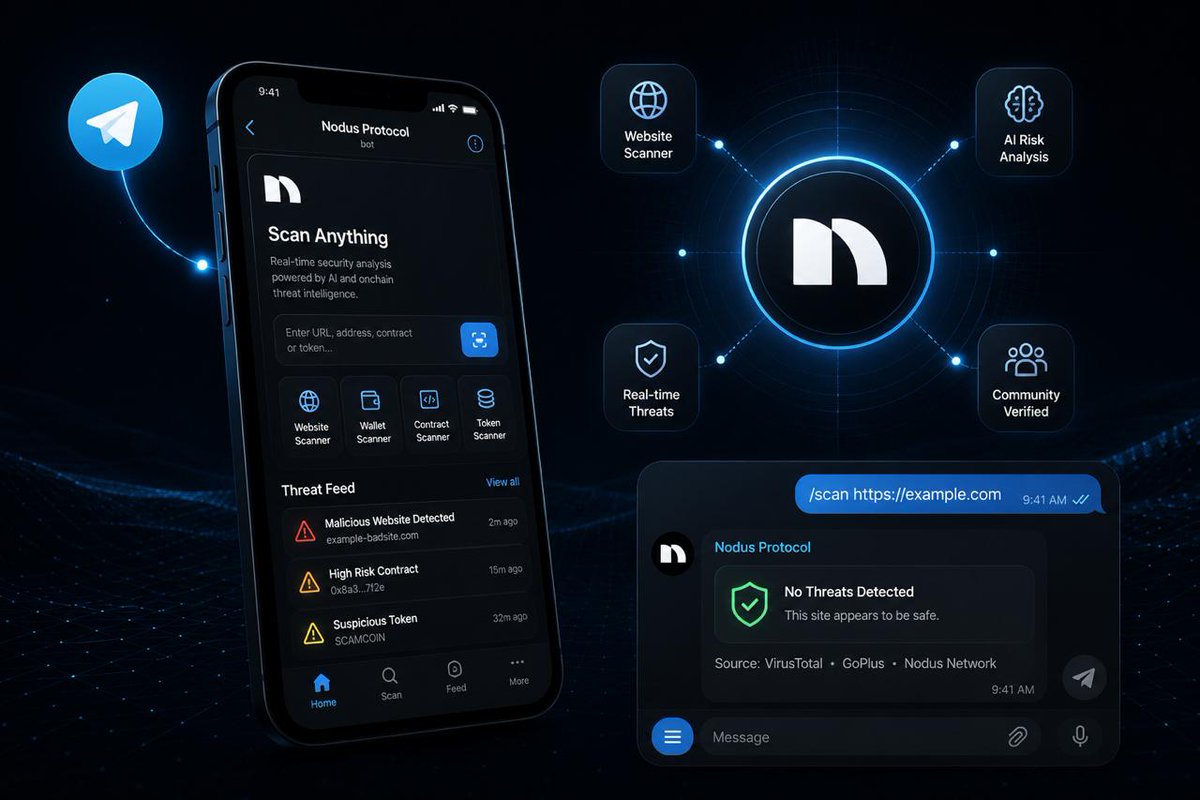
Nodus Protocol is now live as a Telegram Mini App.
Open the full Nodus experience directly inside Telegram - no downloads, no browser tabs, no friction. Scan websites, wallets, contracts, and tokens in real time, browse the latest verified threats, and run AI-powered risk analysis, all without ever leaving your chat.
The bot works standalone too: send /scan with any target and get an instant verdict backed by VirusTotal, GoPlus, and our community-verified threat database. Or just paste a suspicious link / Nodus handles the rest.
Web3 moves fast. Scams move faster. Now your security layer lives where you already are.
Protect Before You Connect.
Try it: https://t.co/iatOV4fg9k
$NODUS
Real integration example:
A Solana wallet can now call our API before any transaction.
One request → get risk score of the dApp/contract.
If danger → block or warn user automatically.
This is how we move from “user must scan” to “protection by default”.
While others drop memes,
we drop infrastructure.
Transparent treasury.
Cryptographic bounties.
Community governance.
This is what building seriously looks like.
Solana needed a silent guardian.
Nodus answered.
Telegram ready. Pool paying. DAO voting. API open.
The infrastructure era just started.
Protect Before You Connect. $NODUS
Nodus isn’t following the meta.
We’re building the infrastructure others will use.
Telegram App. DAO. API. Security Pool.
Quietly becoming unstoppable.
$NODUS solana:So11111111111111111111111111111111111111112
Development update:
What's in this update:
New database layer two new schemas: an append-only pool ledger for all $NODUS movements (with unique-reference protection against duplicate entries), and bounty tables with proper foreign-key integrity for programs and submissions.
New API module five endpoints covering pool statistics, the public ledger, bounty programs, and signed bounty submissions. All balance math is done in exact decimal arithmetic at the database level; no floating-point rounding anywhere in the accounting path.
Cryptographic submission flow every bounty report must be signed by the researcher's wallet. The signature is bound to the specific program, title, and severity, and consumed on use, making both forgery and replay attacks impossible by design.
Scammers are getting creative.
Nodus is getting smarter.
Every new threat pattern we catch makes the whole network stronger.
This is the arms race we’re winning.
$NODUS
The Nodus Security Pool & Treasury is live.
What's running today:
● Automatic reward accrual: every validated threat report earns 100 $NODUS from the pool, in real time
● Four official bug bounty programs, open for submissions from critical to low severity
● Wallet-signature-bound submissions: every report is cryptographically tied to its author, with replay protection built in
● Full transparency: pool balance, inflows, outflows, and reward history are publicly visible
This is the foundation of a shared security economy - where threat hunters, validators, and researchers are paid by the protocol they protect.
Explore the pool: https://t.co/LZVIhvzyGI
Building in public: the Nodus Security Pool & Treasury is taking shape.
We're wiring up an append-only ledger that records every movement of the community reward supply 400M $NODUS, 40% of total supply, committed entirely to protocol security.
Every threat report that passes validation triggers an automatic reward accrual from the pool. Every bounty submission is bound to a wallet signature, so no report can be forged or replayed. No spreadsheets, no manual accounting just a transparent ledger anyone can audit.
Security shouldn't be a cost center. At Nodus, it's the economy itself.
Protect before you connect.
Devs, wallets, dApps listen up.
Free Nodus API is open.
Real-time scam detection in your product.
1,000 requests/day free.
Time to make your users actually safe.
$NODUS
No more “team decides everything.”
Guardians with skin in the game can now vote on-chain.
Security decisions = community decisions.
This is how it should’ve always been.
We’ve shipped two major upgrades to Nodus Protocol: DAO Governance and a Public Developer API.
Nodus is now community-governed. Guardians can create proposals, vote with their Solana wallet, and every vote is cryptographically verified for security.
Builders can now integrate Nodus threat intelligence into any Web3 product using our free Developer API. Scan URLs, wallets, check verified threats, and access live network stats with a lightweight TypeScript SDK.
Every developer gets 1,000 free API requests per day.
Wallets, marketplaces, bots, and dApps can now protect users with the same intelligence that powers Nodus Shield.
Open security. Community governance. Built for Web3.
$NODUS
Today we're turning our attention to the next phase of the Nodus Protocol roadmap, and it's a significant one: decentralized governance and an open developer ecosystem.
First, DAO Governance. Security decisions shouldn't sit with a single team. We're building an on-chain voting and proposal system so the community can directly shape how the protocol evolves, from how threats are verified to how the network is funded and prioritized. Guardians who protect the ecosystem should also have a voice in governing it.
Second, a public Nodus API and developer SDK. The threat intelligence powering Nodus Shield shouldn't stay locked inside one extension. We want any wallet, dApp, or marketplace on Solana to be able to integrate real-time protection with a few lines of code. Our goal is to make "protect before you connect" a standard across the entire ecosystem, not just a single product.
Both are early in development, and we'll be sharing progress as they take shape. This is how Nodus grows from an app into infrastructure.
$NODUS $Solana
Web3 should not feel dangerous every time you click “Connect”.
With Nodus, you get clarity before you commit.
Real intelligence. Real community. Real protection.
The future of safe Web3 starts here.
Protect Before You Connect. $NODUS
Nodus Shield sits between you and what you can't see coming scanning every site in real time before you connect.
It's available now. Here's how to install it manually:
Download the extension at https://t.co/RcRIXAjUv6
Extract the ZIP to any folder on your computer
Open chrome://extensions in your browser
Turn on Developer Mode (toggle, top right corner)
Click "Load unpacked" select the extracted folder
Pin Nodus Shield to your toolbar
That's it. Every site you visit from now on gets scanned.
The badge tells you everything: safe, caution, or danger before you do anything.
No more guessing. No more hoping.
Protect Before You Connect.
Want to level up?
Become a Guardian.
Report scams, verify threats, and build real on-chain reputation.
Rise through the ranks: Guardian → Protector → Sentinel.
The community that protects together, wins together.
Join: https://t.co/l0pjemMdRK