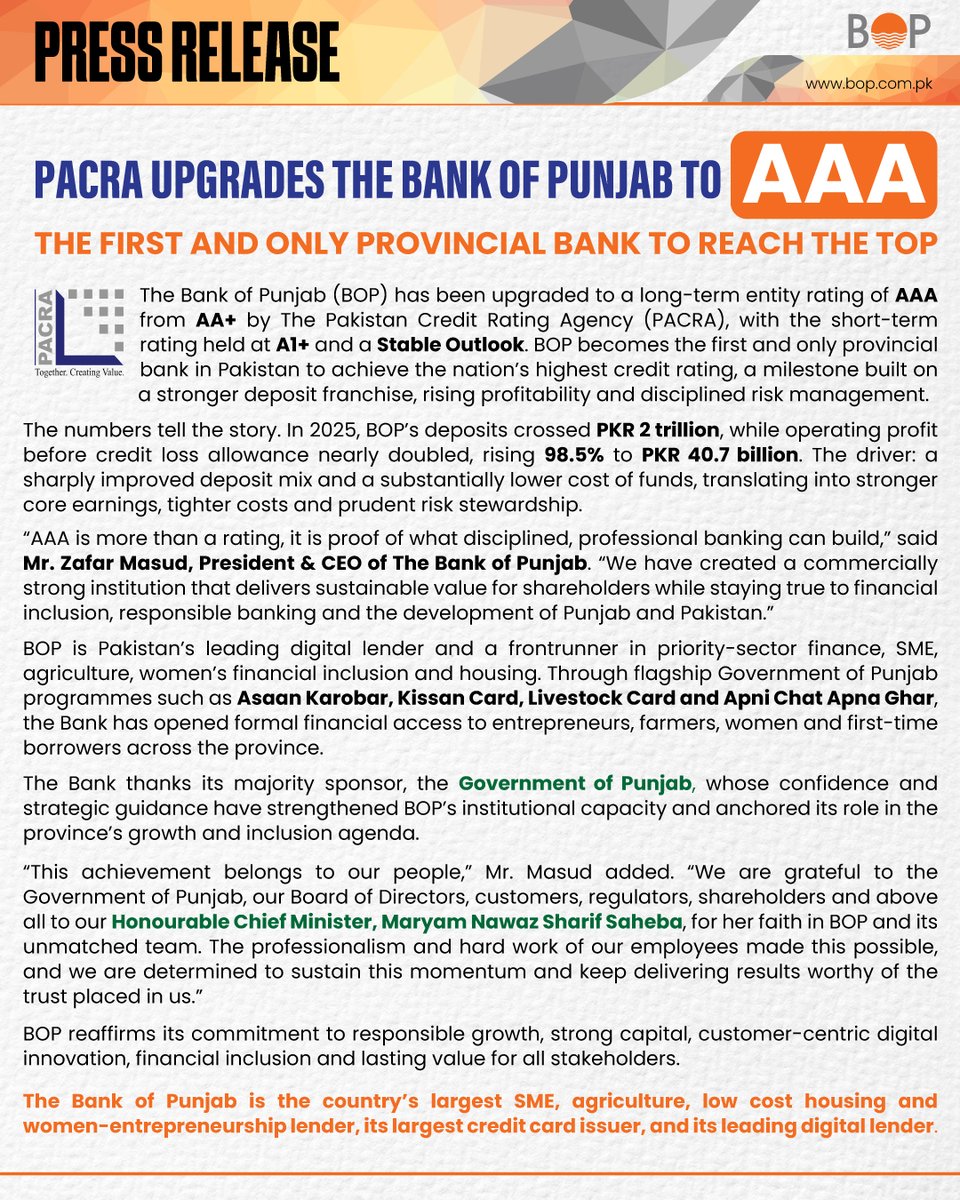
The Bank of Punjab has officially achieved a AAA Long-Term Entity Rating from PACRA, becoming the first and only provincial bank in Pakistan to attain the country's highest credit rating.
This milestone, coupled with crossing PKR 2 trillion in deposits, reflects our commitment to driving financial inclusion and empowering farmers, entrepreneurs, and communities through initiatives such as the Kissan Card, Livestock Card, Asaan Karobar, and Apni Chat Apna Ghar.
Thank you to our customers, partners, and stakeholders for your continued trust. Together, we're building a stronger future.
#TheBankOfPunjab #HarFardKaKhayal #FinancialRatings #PACRA
@GovtofPunjabPK@zafar_masud@AsifRiaz71@nadeemamir69@Ijaz_ur_rehman@nofeldaud@JBShabbir@razabashirs
Pakistan’s grid is doing something rare. Fossil has fallen from 66% to 44%. Nuclear is scaling. Solar is breaking out, wind is joining in & decentralised rooftop solar is scaling at an unprecedented pace. Meanwhile, hydro holds the system together as the generational shift begins.
For two decades, Pakistan’s power mix barely moved. Fossil sat around 60–70%, hydro carried ~30%, and everything else was marginal. Then the energy transition began, and it didn’t follow the usual script.
Nuclear moved first. From ~2% in 2000 to ~17% by 2025, it’s one of the few systems globally where nuclear share is clearly rising. That growth is deliberate, built, and running at high capacity, quietly strengthening the backbone of the grid.
Wind edged in gradually. But the real disruption came from solar. From effectively zero to ~8% in a short window, driven less by policy and more by economics. High tariffs, unreliable supply, and cheap panels triggered a massive surge in behind-the-meter installs.
That’s the key nuance. A large share of Pakistan’s solar boom sits off-grid and isn’t fully captured in official generation data. It makes the system look slower to change than it actually is, and makes building a clean dataset far more challenging than in most countries.
Two very different forces are now moving together. Nuclear is scaling from the top down, engineered and centralised. Solar is spreading from the bottom up, reactive and decentralised. They’re not competing. They’re stacking.
Hydro sits in the middle, doing what it has always done, balancing and stabilising the system. Fossil is still large and still necessary, but it’s no longer growing. From ~66% down to ~44%, it’s clearly losing ground.
Pakistan hasn’t followed a clean transition pathway. It’s been pushed into change by cost, constraints, and demand. The result isn’t one technology replacing another. It’s a system being reshaped from multiple directions at once.
Hydro anchors. Nuclear scales. Solar breaks out. Wind warms up. Fossil fills what’s left.
Not merely a transition. A system under pressure, starting to bend.