“Necromodernism neither celebrates the new nor nostalgically mourns the old, inhabiting instead a space where cultural memory, media saturation, and infrastructural collapse converge into textual practice. It is neither an elegy for modernism nor a prophecy of what comes next, but rather a practice of endurance.”
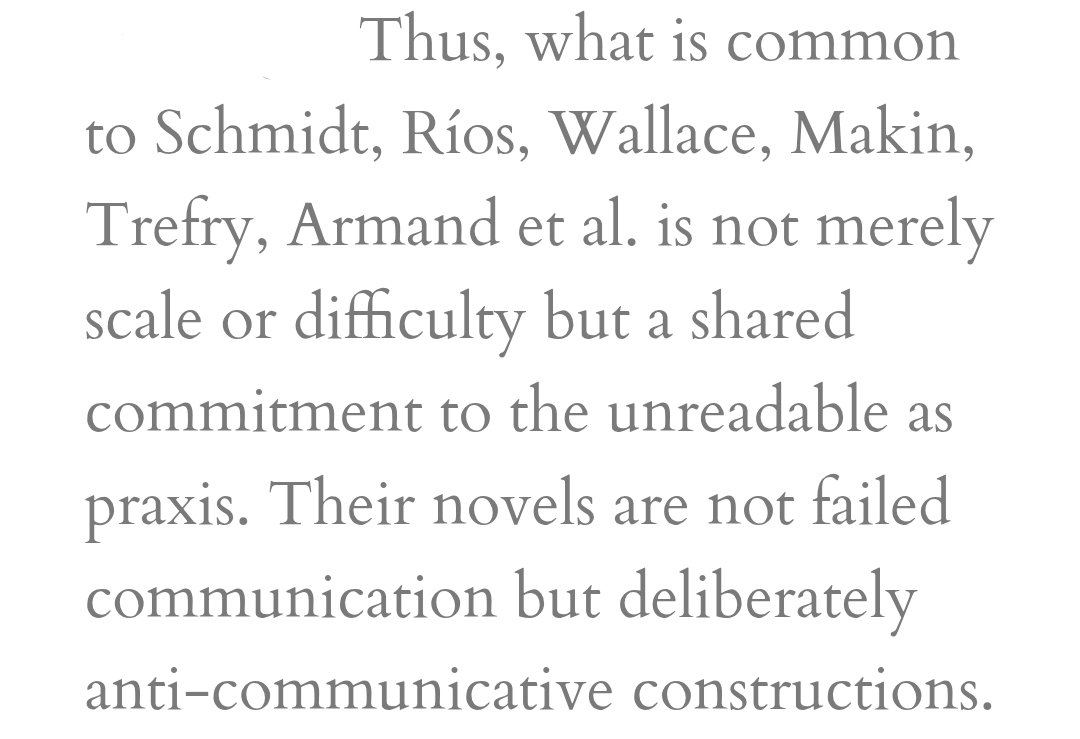
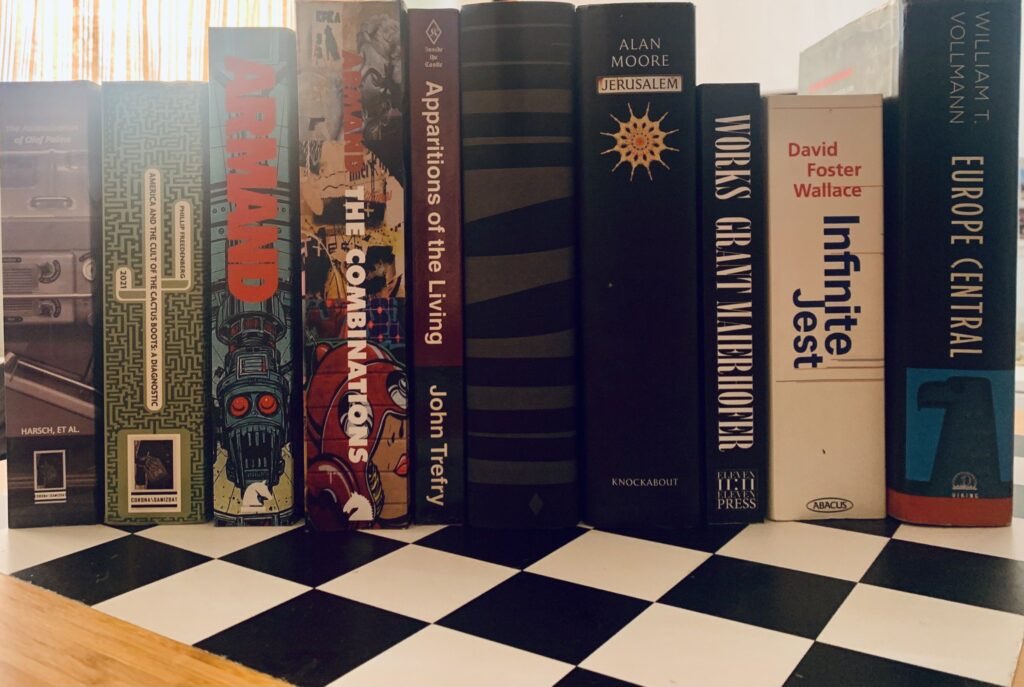
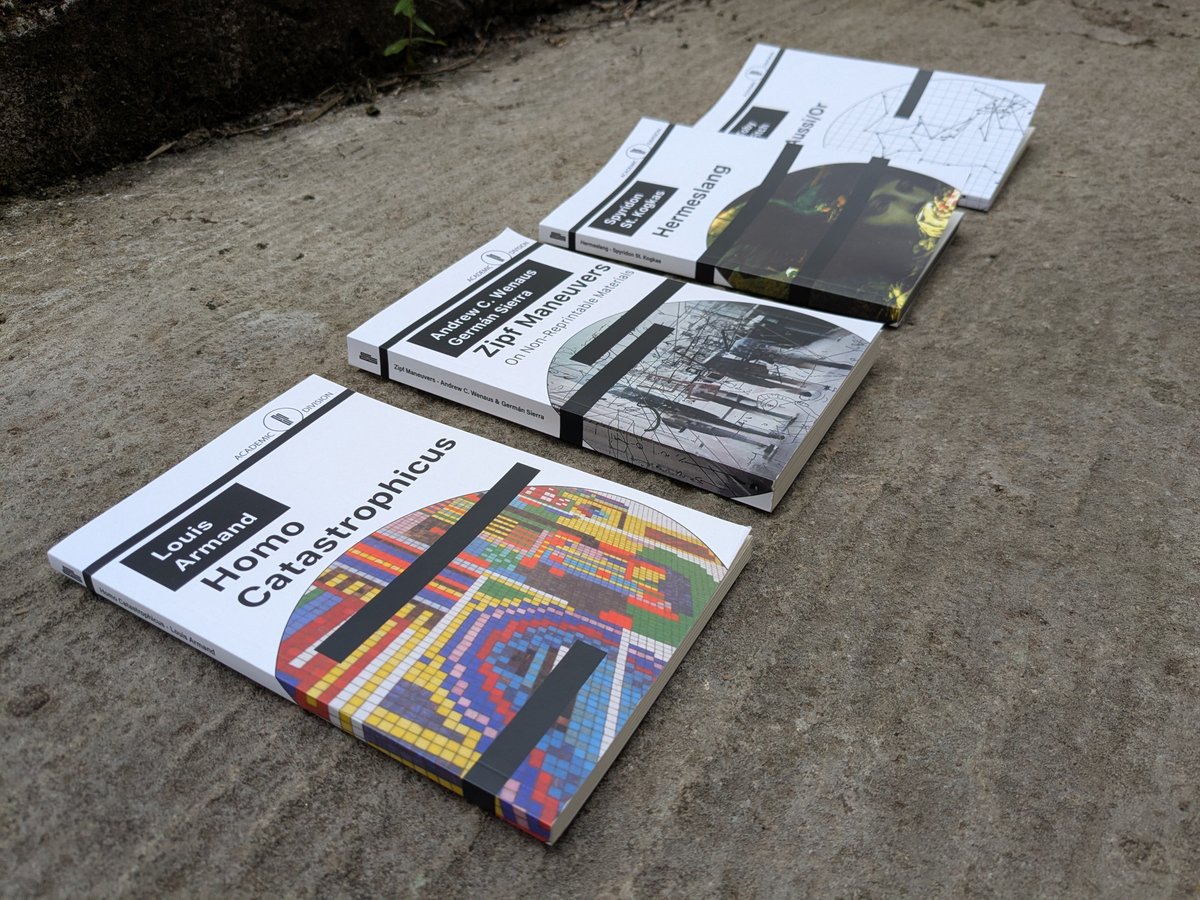
My essay on Necromodernist architectures in contemporary writing, incl. the work of @LouisArmxnd, John Trefry (@incastellated), @ShmikeShmorrao, @AnsgarAllen, Richard Makin, Rick Harsch, Vi Khi Nao, Elizabeth Aldrich et al., now out with @3ammagazine, courtesy @andrewgallix.
https://t.co/DbtlSUtFbN
"A spectre is haunting contemporary literary writing, the spectre of necromodernism… a type of modernism in its posthumous state, a necromodernist condition in which writing persists in the ruins of literature’s once-modern ambitions.
Necromodernism neither celebrates the new nor nostalgically mourns the old, inhabiting instead a space where cultural memory, media saturation, and infrastructural collapse converge into textual practice. It is neither an elegy for modernism nor a prophecy of what comes next, but rather a practice of endurance." From my notes towards "Necromodernist Architectures in Contemporary Writing", a propos of some of the most exciting 21st-century fiction to date...
@LouisArmxnd, @1111Press, @incastellated, @CoronaSamizdat, @rickharsch1
EQUUS PRESS SEPTEMBER RETROSPECTIVE
3. Thor Garcia, THE NEWS CLOWN (2012)
“If you oppose freedom, you are clearly mistaken.”
That throwaway line nails why Thor Garcia’s THE NEWS CLOWN still matters as experimental fiction: the book splices picaresque, first-person debauchery with a rolling collage of media forms—wire-service blurbs, studio patter, patriotic bromides—so narrative and newsfeed contaminate each other.
The result is a formal satire of “post-truth” long before the term stuck: Garcia interleaves straight-faced crime capsules with staged on-air Q&As and, at points, even folds in mock footnotes and “official reports,” turning mediation itself into a character and theme.
Read in this light, the novel’s conspiratorial riffs (e.g., the infamous “no planes” barroom logic) aren’t endorsements but stress tests on credulity—demonstrations of how broadcast idioms manufacture belief and drift into spectacle.
It’s precisely this hybrid method—tabloid register & documentary fragments & meta-apparatus—that makes The News Clown a sharp precursor of today’s doomscroll aesthetics, a book that shows how form can diagnose the culture that produces it.
For more information & ordering details, please visit: https://t.co/6dAqBncqcz
EQUUS PRESS SEPTEMBER RETROSPECTIVE
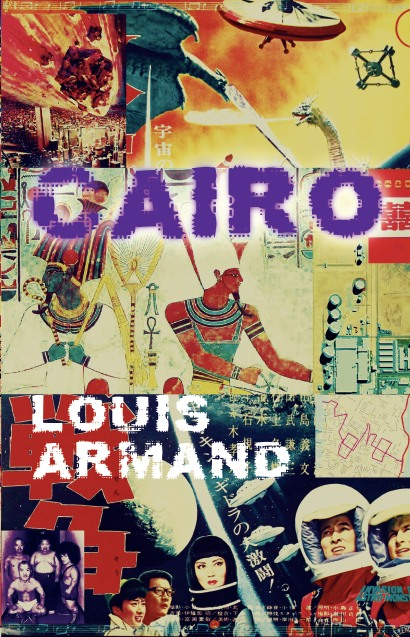
7. @LouisArmxnd, CAIRO (2014)
Louis Armand’s Cairo (2014) is a dense, hallucinatory noir that retools the detective genre into a meditation on dislocation, surveillance, and the breakdown of narrative itself. Set alternately in New York, London, Prague, Australia, and a labyrinthine, unnamed metropolis that gestures toward but exceeds Cairo, the novel substitutes atmosphere and paranoia for conventional plot resolution.
Armand’s prose is clipped, elliptical, and cinematic, stitching together fragments of overheard speech, documentary description, and internal monologue into a collage that mimics the cities’ own fractured semiotics. “Every street corner was a camera, every shadow a double-cross” (p. 67), the narrator observes, a sentence that epitomises Armand’s strategy of collapsing setting into affect, rendering space itself conspiratorial.
The book’s literary merit lies in its ability to both inhabit and dismantle the noir mode: while it employs the tropes of pursuit, betrayal, and fatalism, it ultimately estranges them, producing a text as much about the impossibility of reading the city as about solving a mystery.
In its hybrid form—part pulp, part avant-garde experiment—Cairo demonstrates Armand’s distinctive technique of pushing genre fiction toward its own limits, where narrative becomes an allegory for interpretation under conditions of opacity.
For more information & ordering details, please visit:
https://t.co/uvgRDbTpo6
EQUUS PRESS SEPTEMBER RETROSPECTIVE
8. Georges Bataille, LOUIS XXX (trans. Stuart Kendall, 2013)
In Louis XXX, Georges Bataille constructs a profoundly unsettling meditation on eroticism, sacrifice, and the collapse of discursive reality, using a hybrid form that dissolves boundaries between diary, poetry, philosophical reflection, and theological confession. His prose—at once visceral and poetic—pulls the reader into an uncanny space where the sacred and the obscene collide. As Bataille writes in “The Little One”: “To write is to research chance.”
This declaration gestures toward the work’s formal daring: writing becomes an encounter with contingency, where language is not a transparent conduit of meaning but a terrain of unpredictability. The text’s fragmented, collage-like structure mirrors the destabilisation of identity and the disappearance of the “discursive real,” as the translator notes in his commentary.
Bataille’s relentless mingling of bodily detail, religious transgression, and metaphysical terror enacts a radical poetics of limit-experience—where the only divine residue is the “impossible” itself, glimpsed through the crack of violation. The effect is both intoxicating and disorienting: critique, beauty, and transgression fuse into a single ecstatic rupture.
For more information & ordering details, please visit:
https://t.co/cd4Ficdrtk
Our books are printed in/shipped from Slovenia, not print-on-demand, and can be ordered at https://t.co/mCKLx12CxF (payments via secure provider Stripe)
Ebooks, increasingly available through the usual outlets, courtesy of friends at https://t.co/8QiGNDLs80
More lo-fi samizdat for the wandering mind... a n[o]vella of s[o]rts... a text machine... $4.44
US: https://t.co/t88kpEMsBf
UK: https://t.co/a9Zm38kGNL
CA: https://t.co/wwVo9UhLBM
ES: https://t.co/3SydDX8bOE
No deja de maravillarme que, desde lugares casi opuestos en el planeta, @DavidVichnar y yo estemos pensando (hasta hace no tanto sin saber que el otro estaba haciéndolo) en la idea de Necromodernismo. Nuestras visiones difieren ligeramente, pero coinciden en lo fundamental.
literature both exists within & threatens the regime of meaning established by ideology, while ideology seeks to contain literature by relegating it to a fictional field in which ideology itself is founded & sustained by literature's operations
https://t.co/beVAvtuQ1S









![rg_vasicek's tweet photo. More lo-fi samizdat for the wandering mind... a n[o]vella of s[o]rts... a text machine... $4.44
US: https://t.co/t88kpEMsBf
UK: https://t.co/a9Zm38kGNL
CA: https://t.co/wwVo9UhLBM
ES: https://t.co/3SydDX8bOE https://t.co/TAkaJ5cMgy](https://pbs.twimg.com/media/GlhtngxXEAATGf6.jpg)


