Octra’s recent demo proved on-chain AI is no longer theory. @biontnetwork turns it into private autonomous agents that live, work, and own themselves. This real convergence is why I’m applying for Relic Holder. Mainnet Biont: Biont Sentinel, 24/7 guardian in encrypted space.
BIONT NETWORK COMMUNITY
🔑 48 RELIC KEYS GIVEAWAY
We're selecting 48 dedicated community members to receive a Devnet Relic (old biont version).
As a Relic Holder, you are given the chance to mint a Devnet Relic, officially recognized by the Biont Network Team as an official proof-of-participation key for future access opportunity (TBD) in the Biont Network Community!
1/5
To win the chance to mint a Biont Network Devnet Relic, keep reading: ⤵️
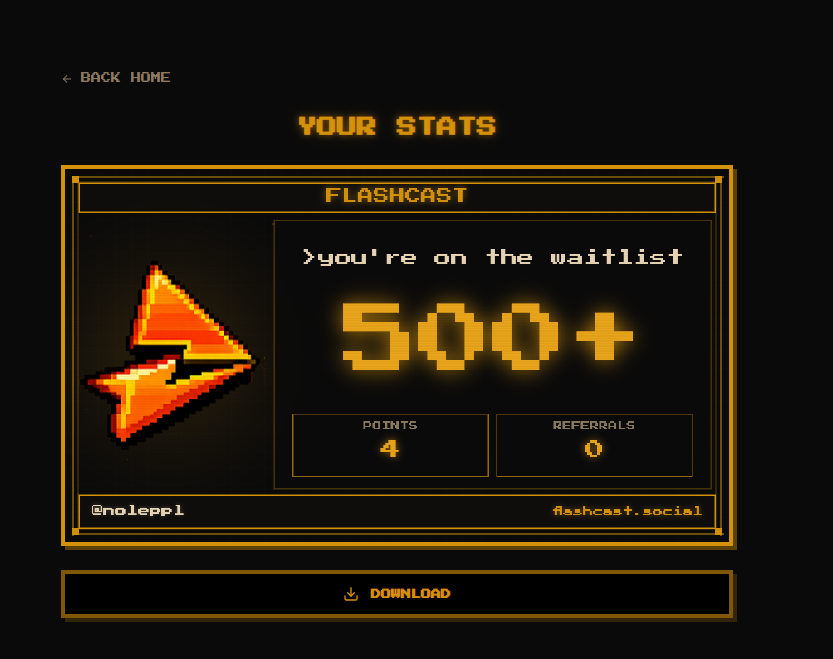
Flashcast Social live on private beta.
Tweet to create. Instant resolutions.
Comment "quest" below for your code → complete quests → join waitlist.
flashcast · social
Early into @fast_protocol with a Fast OG Pass.
Infra backed by a16z CSX, focused on preconfirmations and FAST
execution on Ethereum.
Get in here: https://t.co/O7X7Nu8uDr
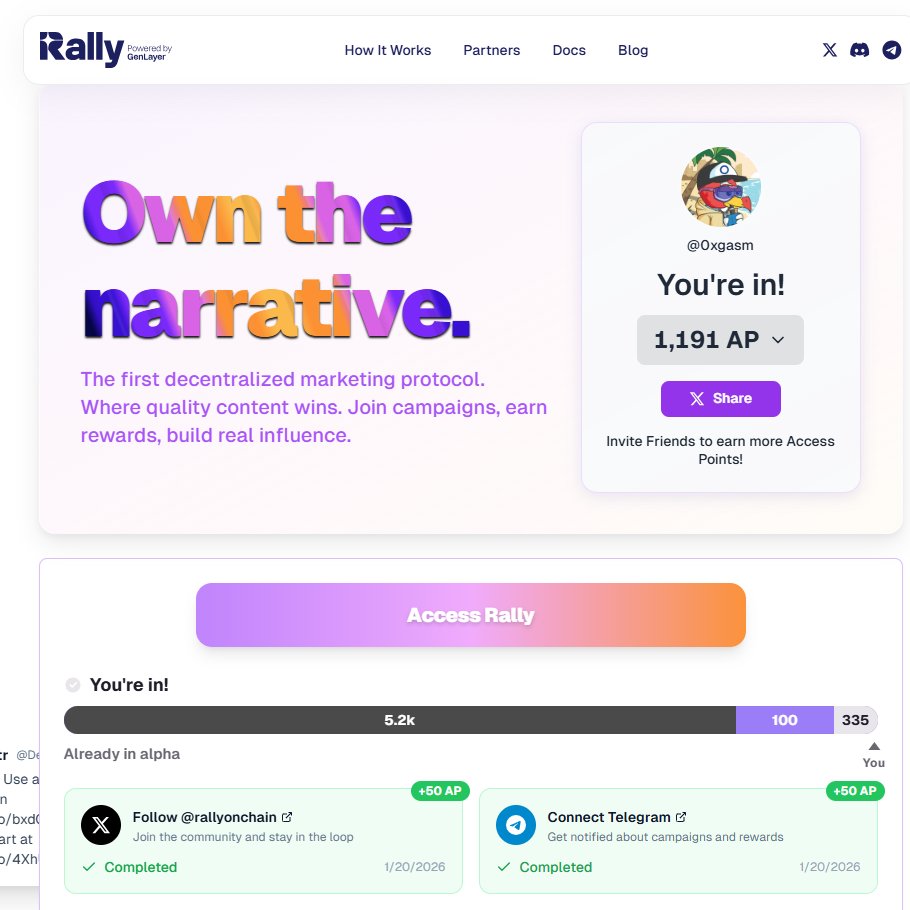
Yooo seems like i get my access to the @RallyOnChain campaign!
so for the first content, i will talking about @nirvana_fi . so Nirvana is a new structure for capital markets that enables assets with permanent value, using verifiable math and immutable code. In Nirvana, value is not arbitrary, it’s programmed.
currently, they're launch their new platform called SAMSARA. with samsara, teams can create decentralized digital asset treasuries on solana, similar to a microstrategy model but fully onchain. these DATs allow projects to lock reserves like $SOL and design a floor mechanism that protects holders. this builds on what $ANA started and pushes treasury management into real web3 infrastructure.
curious to see how this changes the way teams manage capital onchain and how the floor mechanism will be used across solana defi.
Yooo seems like i get my access to the @RallyOnChain campaign!
so for the first content, i will talking about @nirvana_fi . so Nirvana is a new structure for capital markets that enables assets with permanent value, using verifiable math and immutable code. In Nirvana, value is not arbitrary, it’s programmed.
currently, they're launch their new platform called SAMSARA. with samsara, teams can create decentralized digital asset treasuries on solana, similar to a microstrategy model but fully onchain. these DATs allow projects to lock reserves like $SOL and design a floor mechanism that protects holders. this builds on what $ANA started and pushes treasury management into real web3 infrastructure.
curious to see how this changes the way teams manage capital onchain and how the floor mechanism will be used across solana defi.
Everyone’s shouting “InfoFi is over” But in crypto, nothing really dies it evolves. Introducing something new:
@RallyOnChain
📷Turn your posts into rewards: 📷 Post about it on X 📷 Submit your link on Rally 📷Join the whitelist now: ✨👇
https://t.co/ymjffWT3o2
rwa growth like this shows where serious capital is moving.
onchain RWAs are already a $20B+ market, growing 8x in 2025 alone, and now sitting as a top 5 category for DeFi capital allocation. the demand is clearly there, but most RWA yield strategies are still opaque, fragmented, and hard to access for everyday users.
that’s where alturaX starts to matter.
instead of abstract narratives, altura is turning RWA exposure into something concrete: transparent, on-chain yield strategies that actually work for users. the USDT0 vault is a good example. real yield, no inflationary emissions, everything verifiable, and built directly on hyperEVM powered by $HYPE.
when you zoom out, the connection becomes clear. RWA growth shows where capital wants to go. alturaX focuses on how that capital can earn yield in a clean, accessible way.
quiet infrastructure, steady TVL growth, audited systems, and sustainable yield. this feels less like hype chasing and more like positioning early in a sector that’s just getting started.
anyway you look good on that 100 bucks @FitnaEth 🤑
@alturax@cookiedotfuncn #cookie
crypto only works if you can actually use it.
that’s why the IOPN and Tria partnership makes sense.
it turns on chain value into everyday spending.
the flow still starts with OPN Chain.
fast. low cost.
built to avoid foreign chains and fees.
your NeoID carries identity and reputation.
so access and loyalty are not random.
they’re earned and portable.
that identity powers utility.
NeoCard as the access rail.
NeoPoints as rewards.
REP as credibility that unlocks better tiers and perks.
with Tria.
on chain value connects to Visa spending.
without giving up custody.
from virtual cards to physical cards.
Project ATLAS supports the bigger picture.
sovereign AI needs sovereign compute.
identity based access.
built for consumer and enterprise use.
real world assets stay practical.
fractional. liquid. compliant.
governed by identity and reputation.
and $OPN ties it together.
from spending to rewards to access.
does crypto feel more real when it works like everyday money.
@IOPn_io@useTria
$OPN
Yo man $BTC and $RLS looks strong today.
Anyway, One thing that often gets overlooked when people talk about blockchain is security over the long run.
Not just “is it safe today”, but “will this still hold up years from now”.
That’s where @RaylsLabs takes a different approach. Instead of reacting later, it’s built with future risks in mind. Quantum computing might sound far away, but once it’s real, today’s cryptography won’t age well. Rayls plans for that from day one.
With Enygma, Rayls blends zero-knowledge privacy with quantum-resistant encryption, keeping transaction and client data locked down even as computing power evolves.
The goal isn’t flashy security claims.
It’s long-term confidentiality without slowing things down.
The kind of infrastructure institutions can rely on not just now, but decades ahead.
This is one of those founders’ letters that actually says something.
What stands out isn’t the list of milestones, but the consistency behind them. From TGE to Enygma, from stablecoins to RWAs, everything points to the same thesis: onchain finance only matters if it works under real constraints.
The line that stuck with me most is the idea that public versus private was a false choice. That framing explains a lot about @RaylsLabs . It’s not trying to replace institutions or rebuild finance from scratch. It’s trying to connect what already works with what comes next.
There’s also a quiet confidence in how 2025 is framed. No victory laps. Just confirmation. Ship the infrastructure. Put it in front of regulators, banks, and builders. Let reality do the validation.
That mindset shows leadership.
@x10xalex and @mcvviriato aren’t selling a vision detached from the system. They’re positioning Rayls where settlement, privacy, compliance, and capital actually meet. That’s not the fastest path to attention, but it’s usually the right path to longevity.
2026 being about depth rather than noise makes sense. More capital, more real use cases, deeper integration. That’s how infrastructure becomes invisible and indispensable at the same time.
Not everything that matters in finance looks exciting on a chart.
Sometimes it looks like systems quietly holding up under stress.
This letter makes it clear Rayls is building for that layer.
GM @R5Z5G n all the $RLS Believers.
Many protocols are still focused on answering whether something can run on-chain.
@RaylsLabs is more concerned with a harder question: whether real-world financial processes can be carried on-chain over the long term.
Clearing, settlement, compliance, and asset lifecycle management are not exciting topics, but they are what ultimately determine whether a system is adopted or ignored.
When central banks, commercial banks, and clearing institutions are involved, the role of a blockchain shifts. It stops being an experimental tool and becomes part of the execution layer of the financial system.
The value of Rayls is not in short-term narratives. It lies in whether it becomes embedded in everyday workflows and invoked repeatedly as part of real operations. Some projects survive on attention. Others exist because their systems are used.
Rayls looks much closer to the latter.