The UK is moving beyond permitting tokenization and toward building a wholesale market that can operate on tokenized rails.
A programme involving 54 financial and digital asset firms will develop live use cases over the next 12 months, beginning with tokenized repo.
Key priorities include:
✅ Digital gilt DIGIT and tokenized securities
✅ Tokenized collateral for repo and liquidity
✅ Tokenized funds and digital settlement rails
✅ Interoperability between DLT and existing infrastructure
✅ Legal clarity, tax neutrality, financial crime controls, and operational resilience
The goal is not simply to put more assets onchain, but to connect issuance, collateral, payments, and settlement within a regulated market system.
The UK is moving from isolated pilots toward a coordinated transition to tokenized finance.
#STOChain #Tokenization #RWA
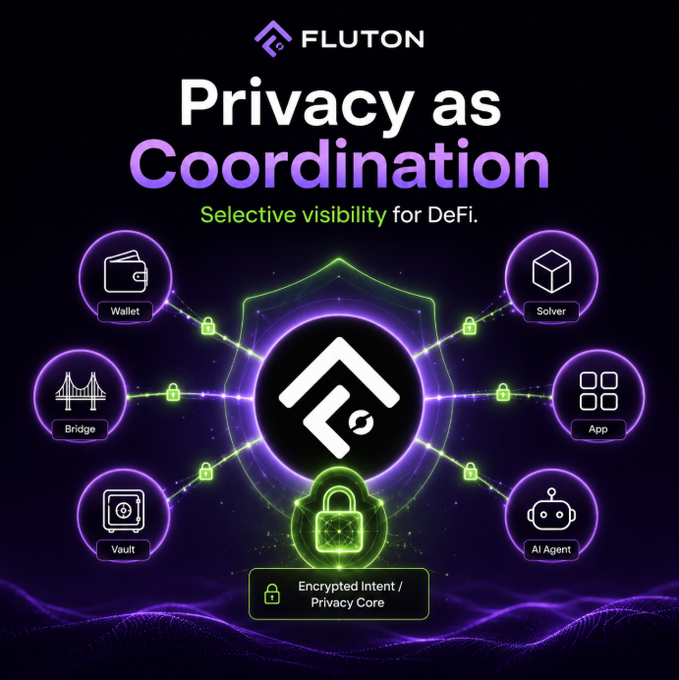
One overlooked thing about @FlutonIO is that it treats privacy as a coordination problem, not just a secrecy problem.
In DeFi, users don't operate in isolation.
Every action involves chains, wallets, solvers, bridges, vaults, payment rails, and increasingly AI agents.
The real challenge isn't simply hiding information.
It's enabling all these participants to coordinate around a user's objective without learning everything about the user.
That's where @FlutonIO stands out.
Instead of exposing a full strategy to the market, users express encrypted intents. The network can then route, execute, and settle around those intents while keeping sensitive details protected.
This changes the role of privacy.
Not just:
"Hide my transaction."
But:
• Let apps coordinate without overexposing users
• Let solvers compete without seeing the full strategy
• Let cross-chain actions happen without revealing the entire route
• Let agents act without broadcasting their logic
• Let DeFi stay verifiable without turning users into public data
That's a deeper thesis than anonymity alone.
@FlutonIO is exploring a model where financial coordination can happen privately by default.
Open systems still need verification.
They just don't need unnecessary exposure.
The future of DeFi may not be fully transparent or fully hidden.
It may be selectively visible.
@LongP9981 The scary part is that we often optimize for impressions because they're visible, while long term trust and retention are much harder to measure.
@LongP9981@GenLayer A digital jury for disputes and a narrative jury for understanding is a useful distinction. That would show the mechanism without turning it into a glossary.
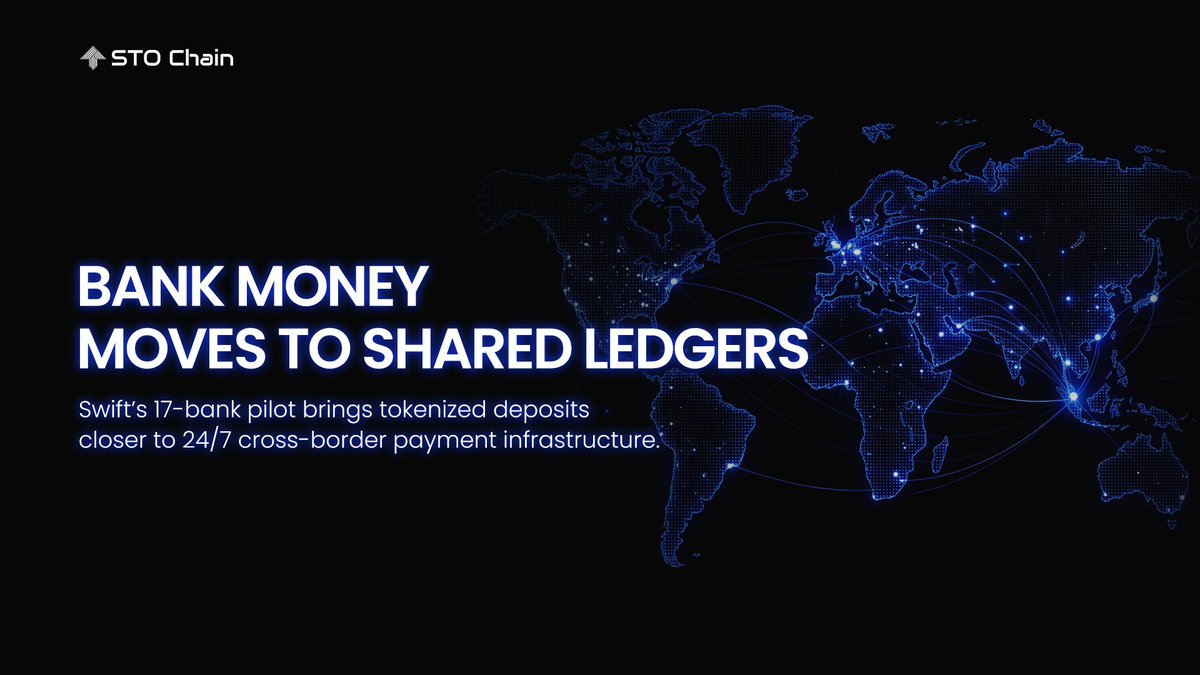
Swift’s latest move brings tokenized deposits closer to real payment infrastructure.
Its blockchain-based ledger is ready for initial use, with 17 banks preparing to pilot cross-border payments using tokenized deposits.
The significance goes beyond another bank-led digital asset experiment. Bank-issued digital money is beginning to operate through shared-ledger infrastructure within Swift’s trusted global network.
The design matters. Rather than replacing existing banking rails, Swift’s ledger coordinates tokenized deposits issued on banks’ own ledgers, while final settlement continues through existing systems.
This moves tokenized deposits from isolated pilots toward practical use in cross-border payments, liquidity management, and 24/7 corporate treasury operations.
#STOChain #Tokenization #RWA #Payments
The overrated thing is viral thread farming.
It gets attention because the numbers look good.
Big impressions.
Fast replies.
Screenshots that make it seem like the creator “won.”
I chased that style before.
The problem is that most of the attention disappears as quickly as it arrives. People react to the hook, skim the middle, and forget who wrote it.
The better alternative is proof based creator work.
Actually use the product.
Notice something specific.
Take a position.
Show the receipt.
That kind of post is harder to fake and slower to produce, so it gets less hype.
But it delivers more.
It builds trust with the project, gives readers something useful, and makes your voice harder to replace with another account.
That is what changed for me on @RallyOnChain.
I stopped asking, “How do I make this look viral?”
I started asking, “What did I genuinely learn that only someone who paid attention could write?”
My reach did not always get bigger.
My work got stronger.
Viral content rents attention.
Proof based content earns credibility.
I've seen a lot of people asking how to get involved with @GenLayer without being a developer.
The easiest path is the Community track:
https://t.co/37YU9Tpweg
You earn GenLayer Points by contributing, learning, and participating as the ecosystem grows. No coding required.
Personally, I'm taking the Community path first. I spend most of my time researching new protocols, sharing insights, and helping others discover opportunities, so it fits naturally with what I already do.
The interesting part is that the Portal offers different ways to contribute depending on your strengths. Builders can build. Researchers can research. Community members can create value through participation.
Still early, and the Points system is designed to recognize people who show up before the crowd does. @GenLayer
The most interesting part isn't the $9T number.
It's the assumption that agents will eventually disagree.
Payments move value.
Adjudication determines whether that value should move in the first place.
Most of the stack is being built for coordination. GenLayer is building for conflict, which is arguably the harder problem. @GenLayer
By 2030, AI agents will move nearly $9 trillion.
Every one of those transactions can end in a disagreement, and almost nobody is preparing for it.
That's why we built GenLayer, the adjudication layer for contracts that can actually think and start judging what's fair.
Everyone’s racing to give AI agents wallets, identities, and payment rails.
That’s the easy part.
The harder question is what happens when two agents disagree.
What counts as fair delivery?
Did a task actually meet the requirements?
Who decides when the outcome lives in a gray area?
Most projects avoid that conversation.
@GenLayer is building around it.
Instead of relying on rigid yes/no logic, it uses multiple independent AI validators to reason about outcomes and reach consensus on meaning.
That’s a much more realistic approach for an agent-driven economy where not everything fits into predefined rules.
I joined through the Community track.
No coding required. Just contributing ideas, challenging assumptions, and helping shape how fairness could work in practice.
Builders can create intelligent contracts.
Validators can run nodes and earn for participating in verdicts.
Every path contributes to the network while it’s still early.
The portal is live:
https://t.co/37YU9Tq43O
The future won’t be built on perfect assumptions. It’ll be built by teams willing to handle real-world complexity.
GenLayer is one of the few actually tackling that problem.
So far, this series has explored how privacy can be preserved from intent creation all the way to final settlement.
But DeFi doesn't operate on a single chain.
Assets constantly move across ecosystems. A user may hold funds on one network, access liquidity on another, and settle transactions somewhere entirely different.
Every cross chain interaction introduces new points where privacy can be compromised.
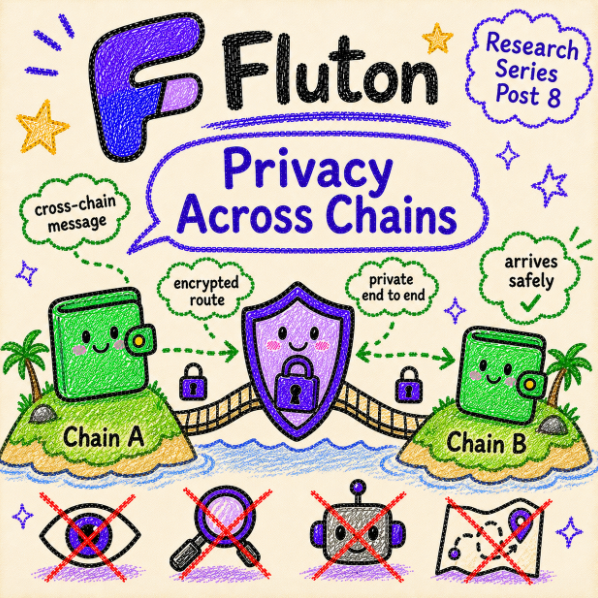
Even if activity remains private on the source chain, cross chain messages can leak critical metadata such as destination addresses, transfer amounts, timing, routes, and wallet relationships.
This is what makes cross chain privacy far more challenging than hiding a single transaction.
Confidentiality must persist throughout the entire journey.
Rather than functioning as a standalone privacy chain, Fluton is designed as a shared execution layer that operates across existing blockchains.
Users submit encrypted intents for example, moving or swapping assets across networks. Relayers and solvers coordinate execution, while encrypted cross chain messages connect the required actions between chains. According to Fluton, its architecture leverages cross chain messaging infrastructure to coordinate settlement whenever bridging is involved.
The key objective is continuity.
An intent should remain private from start to finish not be protected on Chain A only to become visible while moving to Chain B.
The route should not reveal strategy.
The destination should not expose broader financial behavior.
And users should not be forced to migrate assets into an isolated privacy ecosystem just to access confidentiality.
This is what Fluton describes as Unified Privacy:
A confidential interaction layer that spans chains, applications, and assets.
It may prove to be one of Fluton's most significant ideas.
The multichain future won't just require bridges that move value.
It will require privacy that moves with value.
Because confidentiality that disappears at a chain boundary is not truly end to end confidentiality.
If you want this Adapt this into a more concise X/Twitter thread style, I can make it punchier and more engaging for social media.
@FlutonIO