@EricBalchunas Pass hit the ground on the second to last play of the game but the Raiders spiked the ball and it couldn’t be overturned. NFL needs a rule change there.
@MedusaMarkets@BobLoukas No, the idea is for the people to hold all of the crony politicians accountable, not give them more power and money. Fiscal conservatisim will lead to low inflation and affordability.
@HedgeyeComm@Merzy_123 Just have every agent set up a Lightning wallet. No permission needed, no KYC, and censorship resistant payments unlike Stablecoins.
@HedgeyeComm@Merzy_123 Why not just use Bitcoin over the Lightning network. Scarce BTC, permissionless, censorship resistant, clear regulations as a commodity.
This post looks like the start of a VERY sophisticated and well-funded PR operation to get support for Democrats to regulate AI into oblivion. Let me show you how it works:
1.) This guy, with minimal followers and no previous account activity, goes to the Wall Street Journal which publishes an exclusive with quotes from him on his resignation 18 minutes BEFORE this post goes up. Planning was clearly done in advance.
2.) Within hours, it has tens of thousands of reposts and the account has 100k+ followers. The post is punchy, quotable, it almost seems professionally written. The first three accounts to quote tweet it all do so within 15 minutes of the initial posting. Remember, this account had basically zero engagement beforehand, so an organic reach explanation seems unlikely.
According to Grok those accounts are @_NathanCalvin (General Counsel at Encode AI), @peterwildeford (Head of Policy at the AI Policy Network), and @DKokotajlo (Head of the AI Futures Project), all of which are up-and-coming AI-Doomer policy advocacy nonprofits.
The AI Futures Project website says it is funded “primarily” by the Survival and Flourishing Fund, which says on its own website that it has advised Jaan Tallinn, Skype creator and one of the leading investors in Anthropic, to grant over $2.5 million to the AI Futures Project since 2024.
Encode AI says on its website that it is ALSO funded by the Survival and Flourishing Fund, which in turn says that it told Anthropic investor Jaan Tallinn to grant $516,000 to Encode AI in 2025.
And wouldn’t you know it, the Survival and Flourishing Fund ALSO says it told Jaan Tallinn to grant $2 million to the AI Policy Institute, the 501(c)(3) affiliate of the AI Policy Network, as well.
What are the odds that the first three quote tweets of Coxon’s post would all be major AI-restriction policy advocates funded generously by the same donor, who also happens to be one of the leading investors in, and a board member of, Anthropic, the company Coxon was resigning from? And all within 15 minutes of posting (two within ten)?
3.) Jacob Coxon doesn’t have much of a resume, but we do know that, in 2022, he got a $20,159 scholarship for the “long term future scholarship program” from the Good Ventures Foundation, one of the philanthropic vehicles of Dustin Moskovitz, a notorious AI-doomer who has spent tens if not hundreds of millions on policy advocacy to strictly regulate AI, while also being an Anthropic Investor himself.
It also just so happens that the 14th person to quote Coxon’s post was @MaxNadeau_ (27 minutes after posting) who is the program officer for the Technical AI Safety team at Coefficient Giving, another of Moskovitz’s philanthropic spending vehicles. Max is not a frequent poster, his last posts before quoting Coxon were before Labor Day, but he was remarkably quick off the mark for this one.
4.) Basically every major Democrat politician and candidate has suddenly glommed on to this post, and conveniently, as the people cry out foe answers, Bernie Sanders already has a bill written to “ban super intelligence” and regulate AI into oblivion, and will be releasing later this week. The bill, among many other things, will create “a new cabinet-level federal agency to safeguard the public from the dangers of artificial intelligence” that will be “advised by an Artificial Intelligence Advisory Board comprised of experts on artificial intelligence.” Do you think, perhaps, Anthropic and its many investors who fund AI policy advocacy might have interest in getting to place a pet “expert” on the board of an entity that dictates what AI is and isn’t allowed to do? And isn’t it fortuitous that this whistleblower came forward with his oh-so scary stories so close in proximity to the release of the most radical piece of AI legislation ever introduced?
Dude you know those pesky securitization rules that went in place after the 2008 financial meltdown?
Well, the SEC just exempted datacenter debt from key securitization rules
The SEC said a major subset of data-center securitizations don’t need to have disclosures and investor protections that similar deals require. That includes risk retention, a requirement that companies issuing asset-backed securities retain some of the debt to better align their interests with investors. (Bloomberg)
Incredible. Jensen is completing the circle.
- Bankers don’t like GPUs as collateral because the depreciation is unpredictable
- It’s unpredictable because a new GPU can obsolete an old one
- Jensen knows his own roadmap
- so he’s offering depreciation insurance to the banks
- the depreciation insurance (up to 25%) helps the banks get marginal deals over the line
Speculation
- Nvidia will also advise the banks on “reference designs” for datacenters that will make them fungible
- Having them be fungible means that the debt can repackaged into Asset Backed Securities, Collateralized Loan Obligations and Collateralized Debt Obligation (ABS, CLOs and CDOs from 2008 haha)
- This allows tranching to get investment grade ratings on the debt so that it can be resold to pension funds and insurance firms
- It also allows the banks to trade idiosyncratic project specific credit risk for sector wide credit risk
So Jensen is trying to get his customers the same cost of financing as real estate rather than venture equity.
This is going to move the data center game out of the VCs and into the big leagues.
"Bitcoin is just a database."
So build one. Then make it impossible for anyone, including you, to:
• Create new units.
• Rewrite history.
• Freeze balances.
• Change the rules.
That's the hard part.
Bitcoin's innovation isn't the database.
It's a database with no administrator.
Most people picture a Bitcoin payment like a bank transfer. Money leaves one account and lands in another.
That's not what happens.
Here's what actually happens, because once you understand the process, half the FUD surrounding Bitcoin disappears.
They claim to follow logic and science, but that’s just a mask. Once you look at the patterns in their behavior, a different reality appears.
I’ve identified the "holy trinity" the woke left actually worships, and it has nothing to do with facts. Check out my latest Take below.
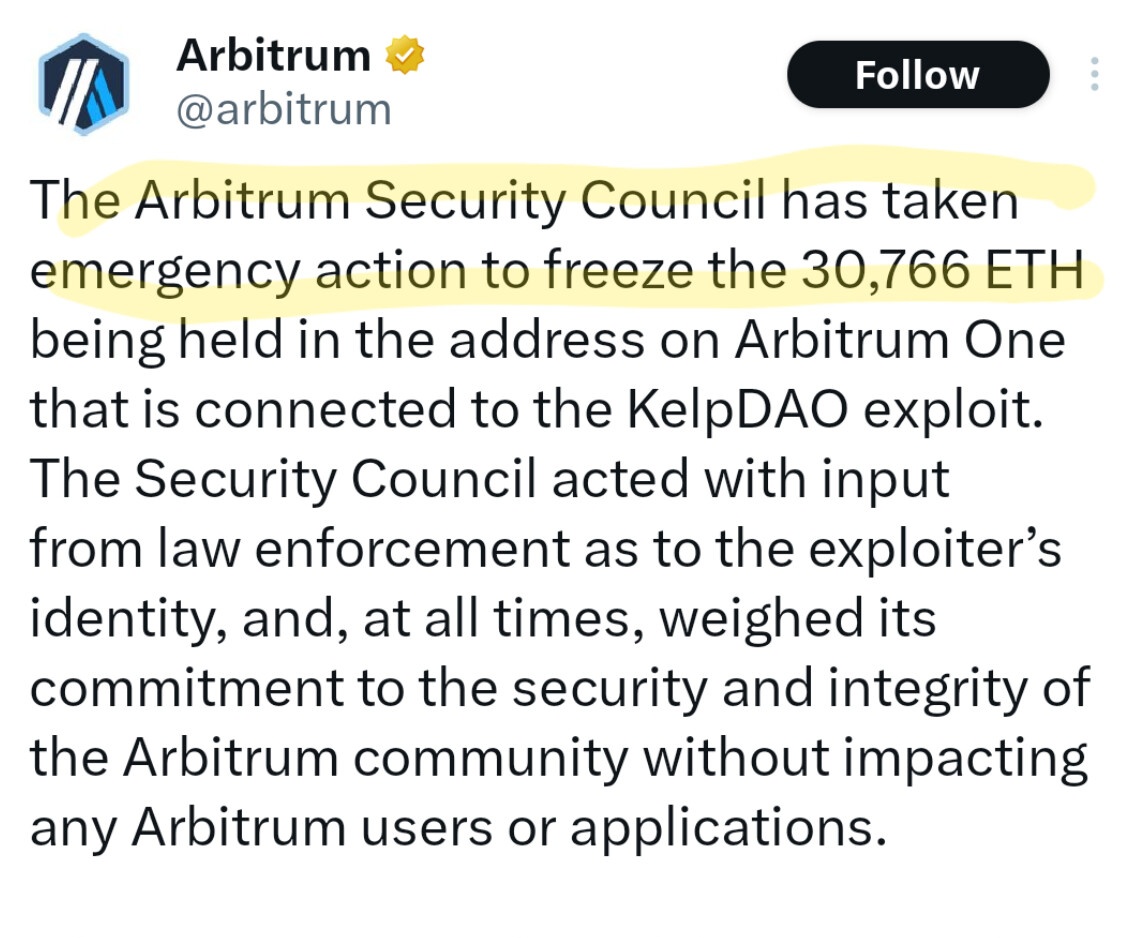
Look guys, it's actually really straightforward, a bunch of people staked their ETH on the Ethereum blockchain to earn yield, except they didn't want their capital to be locked up, so they actually staked with a liquid staking protocol called Lido who provided them a liquid staking receipt token called stETH, except they decided to juice their yield further by depositing their stETH receipt tokens into a restaking protocol called Eigenlayer, except they didn't want to lock up their capital, so they actually restaked with a liquid restaking protocol called KelpDAO who provided them with a liquid restaking receipt token called rsETH, except they decided to juice their yield further by depositing their rsETH tokens into a lending protocol called Aave so that they could open a leveraged looping position that borrows ETH against the rsETH collateral and restakes the ETH into rsETH which is then deposited as collateral, except it turns out rsETH used a cross-chain bridge called LayerZero that was hacked by north koreans causing rsETH to become undercollateralized and now these looping positions are stuck and unprofitable, and everyone is pointing fingers at each other, and also DeFi is a very serious industry
The shitcoin ecosystem is facing an existential crisis. The only 2 real use-cases for the web3 ended up being stablecoins and crypto lending. Both of these can be implemented with Bitcoin-native systems without unsecure rube-goldberg machines, ponzi tokens, ICOs and blockchains interconnected with "smart contracts" that depend on dubious "tokenomic engineering" for their security models.
As these systems collapse and fail one after the other, the decentralization theater is being exposed for what it is: smoke and mirrors.
The reckoning is near.
Bitcoin's quantum defense just got its first working prototype.
Olaoluwa @roasbeef Osuntokun, CTO of Lightning Labs, published a functional tool to the Bitcoin developer mailing list that solves one of the hardest problems in Bitcoin's long-term security, how to protect the network from quantum attacks without locking millions of users out of their own wallets.
The problem is a painful paradox. Bitcoin's leading quantum defense proposal (BIP-360) would disable the current signature system network-wide if a quantum threat emerged. That protects the network, but every wallet that hasn't migrated to the new quantum-resistant format gets frozen permanently. The coins are still there. The rightful owner just can't access them.
Osuntokun's prototype is the escape hatch. Instead of proving ownership with a digital signature, the system lets users mathematically prove they created the wallet using its original seed phrase, without ever revealing the seed itself. Recovering one wallet doesn't compromise any others derived from the same seed. It replaces "I can sign this transaction" with "I can prove this wallet came from me."
It already runs on a consumer MacBook. Generating the proof takes about 55 seconds. Verification takes under two seconds. The proof file is roughly 1.7 MB.
There's no formal proposal to integrate this into Bitcoin yet and no deployment timeline. But the prototype closes a gap that had only existed in theory until now, a credible path to quantum resilience without the collateral damage of stranding user funds.