Una profesora de ciencias de la computación de stanford acaba de revelar cómo dominar los procesos de decisión de markov.
83 minutos. Gratis. Directo de stanford.
Esto es lo que cubren:
• Problemas de búsqueda vs. entornos estocásticos
• Evaluación de políticas y matemáticas de recurrencia de valores Q
• Ingeniería del bucle de iteración de valores
• Límites de convergencia en grafos cíclicos
Guarda y míralo hoy.
Te lo recomiendo.
Te comparto este curso que stanford regalo gratis
Esta clase magistral de menos de 2 horas trata sobre las arquitecturas reales que usan los modelos de IA más avanzados del mundo.
En esta lección aprendes:
- Por qué casi todos los modelos modernos usan prenorm
- Las activaciones que realmente importan hoy
- Cómo reducir el costo de atención sin perder rendimiento
- Trucos de estabilidad y mejores prácticas de hiperparámetros
Es conocimiento de élite que usan los ingenieros que construyen los modelos grandes.
Mira el video completo y guardalo.
Esto es una joya.
🚀 Claude is more powerful when connected to the tools you already use.
From Gmail and Slack to Notion, Canva, Zapier, and Airtable—these 15 connectors help automate workflows, save time, and boost productivity.
Which connector would make the biggest difference in your daily work
LLM fine-tuning techniques I'd learn if I were to customize them:
Bookmark this.
1. LoRA
2. QLoRA
3. Prefix Tuning
4. Adapter Tuning
5. Instruction Tuning
6. P-Tuning
7. BitFit
8. Soft Prompts
9. RLHF
10. RLAIF
11. DPO (Direct Preference Optimization)
12. GRPO (Group Relative Policy Optimization)
13. RLAIF (RL with AI Feedback)
14. Multi-Task Fine-Tuning
15. Federated Fine-Tuning
Since we're talking about fine-tuning, I wrote a full breakdown on fine-tuning LLMs with RL in 2026. Including how to skip manual reward engineering with automatic LLM-graded rewards.
And this is done using a 100% open-source solution: https://t.co/w1KJD7LZWe
The article is quoted below.
Probability distributions interconnect through solid arrows marking exact transformations and special cases, such as sums or powers, and dashed arrows for limits including binomial(n, p) to Poisson(λ = np) as n → ∞.
Exponentiation links normal to lognormal, beta(1,1) matches uniform, and t with ν = 1 is Cauchy.
Numerous paths lead to the normal distribution by the central limit theorem.
Practitioners use these relationships to select models for data, such as the Poisson distribution for counting arrivals at a service desk or the gamma for processing times in logistics.
Ex google engineer acaba de soltar un curso completo de 1 hora para construir agentes de IA que se mejoran solos, desde cero:
00:00 – Cómo nace un agente que se construye a sí mismo
03:01 – soul.md: el archivo que lo controla todo
30:16 – RAG inteligente: solo traes 20 mensajes relevantes, no los 2.000
31:48 – El loop que sabe cuándo parar solo
35:14 – Detectar el error y arreglar el prompt en el momento
50:22 – Cómo Claude comprime y optimiza tu memoria automáticamente
1 hora de contenido práctico que vale más que la mayoría de cursos de pago sobre agentes.
Míralo completo, guárdalo📚
A Neural Sheet Discovers the Shape of Data
A self-organizing map (SOM) starts as a flat sheet of neurons with no knowledge of the data around it. For every input sample, it finds the best-matching neuron,
c = argminᵢ ‖x - wᵢ‖,
and updates that neuron together with its neighbours,
wᵢ ← wᵢ + η(t)hᶜᵢ(t)(x - wᵢ).
As the neighbourhood radius shrinks during training, the sheet gradually bends and folds onto the hidden geometry of the dataset while preserving its neighbourhood structure.
Developed by Finnish computer scientist Teuvo Kohonen, the Self-Organizing Map remains one of the most elegant examples of competitive learning, where order emerges from thousands of simple local updates.
#MachineLearning #ArtificialIntelligence #SelfOrganizingMap #NeuralNetworks #DataVisualization #Mathematics #ComputerScience #Finland #TeuvoKohonen
Various layouts can illustrate how elements connect and relate.
Arc diagrams curve their links, area groupings use shading for clusters, and centralized designs radiate from a core with bursts or rings.
Globe and circular styles wrap connections in rounded forms while organic and ramified ones mimic natural branching.
Radial patterns draw lines inward or outward, flow uses sweeping curves, and spheres tangle lines in three dimensions.
Scaling and segmented versions adjust size and division for emphasis.
These layouts are used to chart relationships in social media or biological networks.
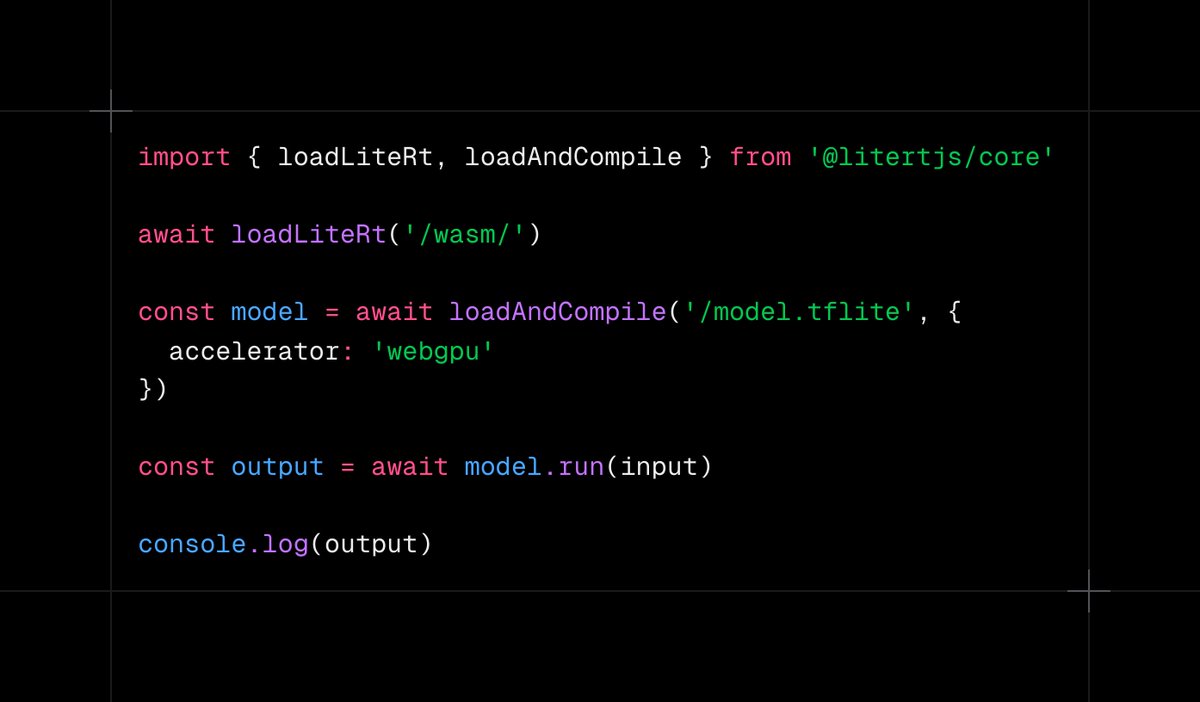
¡Google acaba de anunciar algo brutal!
Se llama LiteRT.js y es IA corriendo en el navegador con WebGPU. Sin servidores, APIs y 100% privado.
Mejor rendimiento que TensorFlow y ONNX.
→ https://t.co/dvTG4cFJVi
New Anthropic research: A global workspace in language models.
Of everything happening in your brain right now, only a tiny fraction is consciously accessible—thoughts you can describe, hold in mind, and reason with.
We found a strikingly similar divide inside Claude.
Taxonomic graph analysis of personality questionnaire data uncovers this three-tiered network.
Bottom-level facets cluster into six mid-level traits - Neuroticism, Sociability, Conscientiousness, Integrity, Openness to Experience, and Impulsivity - which organize under three meta-traits:
Stability, Plasticity, and Disinhibition.
Node colors align with the legends shown, and connecting lines indicate empirical statistical associations identified in the IPIP-NEO dataset.
It is used to refine personality assessment tools and investigate links between traits and mental health conditions.
¡HOY tenemos CURSO de DOCKER desde cero!
✓ Aprende a "dockerizar" tus apps
✓ Entiende imágenes y contenedores
✓ Montar tu propia IA local
✓ Publicar imágenes en Docker Hub
✓ Desplegar a producción en Vercel
Horario por países:
18H 🇪🇸 17H 🇮🇨
13H 🇺🇾 🇦🇷 🇵🇾 🇧🇷
12H 🇨🇱 🇹🇹 🇧🇴 🇻🇪 🇩🇴 🇨🇺 🇵🇷
11H 🇨🇴 🇵🇪 🇪🇨 🇵🇦
10H 🇲🇽 🇨🇷 🇳🇮 🇸🇻 🇭🇳 🇬🇹
No necesitas saber nada de Docker: empezamos por el "¿qué es un contenedor?" y terminamos con un despliegue real.
Fresh blog post alert! 🚀 We just dropped "Demystifying A2UI: How to Make AI Agents 'Speak UI' in Your App" which illustrates how to integrate GenUI directly into your Angular apps.
Check out the article, try A2UI, and reply on this thread to let us know what sorts of interesting features you create.
Read it here: https://t.co/WHoBkD5neT 🍬
The AI Scientist: Towards Fully Automated AI Research, Now Published in Nature
Nature: https://t.co/nNfpSV5e5I
Blog: https://t.co/i6h8LVQOdl
When we first introduced The AI Scientist, we shared an ambitious vision of an agent powered by foundation models capable of executing the entire machine learning research lifecycle.
From inventing ideas and writing code to executing experiments and drafting the manuscript, the system demonstrated that end-to-end automation of the scientific process is possible.
Soon after, we shared a historic update: the improved AI Scientist-v2 produced the first fully AI-generated paper to pass a rigorous human peer-review process.
Today, we are happy to announce that “The AI Scientist: Towards Fully Automated AI Research,” our paper describing all of this work, along with fresh new insights, has been published in @Nature!
This Nature publication consolidates these milestones and details the underlying foundation model orchestration. It also introduces our Automated Reviewer, which matches human review judgments and actually exceeds standard inter-human agreement.
Crucially, by using this reviewer to grade papers generated by different foundation models, we discovered a clear scaling law of science. As the underlying foundation models improve, the quality of the generated scientific papers increases correspondingly. This implies that as compute costs decrease and model capabilities continue to exponentially increase, future versions of The AI Scientist will be substantially more capable.
Building upon our previous open-source releases (https://t.co/H1tBT14Yx8), this open-access Nature publication comprehensively details our system's architecture, outlines several new scaling results, and discusses the promise and challenges of AI-generated science.
This substantial milestone is the result of a close and fruitful collaboration between researchers at Sakana AI, the University of British Columbia (UBC) and the Vector Institute, and the University of Oxford. Congrats to the team!
@_chris_lu_@cong_ml@RobertTLange@_yutaroyamada@shengranhu@j_foerst@hardmaru@jeffclune
8 RAG architectures for AI Engineers:
(explained with usage)
1) Naive RAG
- Retrieves documents purely based on vector similarity between the query embedding and stored embeddings.
- Works best for simple, fact-based queries where direct semantic matching suffices.
2) Multimodal RAG
- Handles multiple data types (text, images, audio, etc.) by embedding and retrieving across modalities.
- Ideal for cross-modal retrieval tasks like answering a text query with both text and image context.
3) HyDE (Hypothetical Document Embeddings)
- Queries are not semantically similar to documents.
- This technique generates a hypothetical answer document from the query before retrieval.
- Uses this generated document’s embedding to find more relevant real documents.
4) Corrective RAG
- Validates retrieved results by comparing them against trusted sources (e.g., web search).
- Ensures up-to-date and accurate information, filtering or correcting retrieved content before passing to the LLM.
5) Graph RAG
- Converts retrieved content into a knowledge graph to capture relationships and entities.
- Enhances reasoning by providing structured context alongside raw text to the LLM.
6) Hybrid RAG
- Combines dense vector retrieval with graph-based retrieval in a single pipeline.
- Useful when the task requires both unstructured text and structured relational data for richer answers.
7) Adaptive RAG
- Dynamically decides if a query requires a simple direct retrieval or a multi-step reasoning chain.
- Breaks complex queries into smaller sub-queries for better coverage and accuracy.
8) Agentic RAG
- Uses AI agents with planning, reasoning (ReAct, CoT), and memory to orchestrate retrieval from multiple sources.
- Best suited for complex workflows that require tool use, external APIs, or combining multiple RAG techniques.
Most architectures here involve some form of retrieval-time decision. But they all run on top of whatever was already indexed.
If that indexing step outputs messy chunks, every architecture inherits them. Improving it is a separate problem from the 8 above.
My co-founder wrote about a better unit for the indexing step. The technique:
- cuts corpus size by 40x.
- reduces tokens per query by 3x.
- improves vector search relevance by 2.3x.
And it doesn't alter the retrieval algorithm, the reranker, or the embedding model.
Read it below.
Best YouTube Channels To Learn AI in 2026 (No BS). Save it.
1. Fundamentals – 3Blue1Brown
2. Deep Learning – Andrej Karpathy
3. AI Research – Yannic Kilcher
4. Practical AI – AssemblyAI
5. LLMs – AI Explained
6. ML Theory – StatQuest
7. Papers Simplified – Two Minute Papers
8. GenAI – Matthew Berman
9. AI Agents – Nicholas Renotte
10. Applied ML – Krish Naik
11. PyTorch – Aladdin Persson
12. Math for ML – Serrano Academy
13. Industry Insights – Lex Fridman
14. Real-world AI – DeepLearningAI
tensor algebra is not abstract math.
it is the grammar of modern intelligence.
a scalar is one number.
a vector is a line of numbers.
a matrix is a grid of numbers.
a tensor is the general form: numbers arranged across multiple dimensions.
images are tensors.
videos are tensors.
robot sensor streams are tensors.
neural network weights are tensors.
physics simulations are tensors.
deep learning is basically tensor algebra + optimization + compute.
once you understand tensors, AI stops looking like magic.
it becomes structure.
reality → numbers → geometry → transformations → intelligence.
Steps to building AI systems with LLM's.
I've given a simple detailed explanation below.
𝗦𝘁𝗲𝗽 1 – 𝗟𝗟𝗠𝘀 (𝗟𝗮𝗿𝗴𝗲 𝗟𝗮𝗻𝗴𝘂𝗮𝗴𝗲 𝗠𝗼𝗱𝗲𝗹𝘀)
• These are the 𝗯𝗿𝗮𝗶𝗻𝘀 of the system.
• Examples: GPT (OpenAI), Gemini, Claude etc.
• They generate answers, understand queries, and perform reasoning.
𝗦𝘁𝗲𝗽 2 – 𝗙𝗿𝗮𝗺𝗲𝘄𝗼𝗿𝗸𝘀
• Frameworks help you 𝗰𝗼𝗻𝗻𝗲𝗰𝘁 𝘁𝗵𝗲 𝗟𝗟𝗠 𝘄𝗶𝘁𝗵 𝗱𝗮𝘁𝗮, 𝘁𝗼𝗼𝗹𝘀, 𝗮𝗻𝗱 𝗮𝗽𝗽𝘀.
• Examples: LangChain, Llama Index, Haystack, Txtai.
• They act like a 𝘁𝗼𝗼𝗹𝗸𝗶𝘁 so you don’t have to build everything from scratch.
𝗦𝘁𝗲𝗽 3 – 𝗩𝗲𝗰𝘁𝗼𝗿 𝗗𝗮𝘁𝗮𝗯𝗮𝘀𝗲𝘀
• LLMs can’t remember everything. They need a 𝗺𝗲𝗺𝗼𝗿𝘆 𝘀𝘆𝘀𝘁𝗲𝗺.
• Vector databases store “embeddings” (numerical representations of text).
• Examples: Pinecone, Weaviate, Chroma, Milvus, Qdrant.
• They make searching fast and relevant (like Google search but for your private data).
𝗦𝘁𝗲𝗽 4 – 𝗗𝗮𝘁𝗮 𝗘𝘅𝘁𝗿𝗮𝗰𝘁𝗶𝗼𝗻
• Your AI needs real-world 𝗱𝗮𝘁𝗮 𝗶𝗻𝗽𝘂𝘁𝘀.
• Tools like Crawl4AI, FireCrawl, ScrapeGraphAI, Docling, LlamaParse help:
- Scrape websites
- Extract PDFs, docs, or tables
- Clean and structure messy data
𝗦𝘁𝗲𝗽 5 – 𝗢𝗽𝗲𝗻 𝗟𝗟𝗠𝘀 𝗔𝗰𝗰𝗲𝘀𝘀
• Instead of calling proprietary APIs, you can 𝗿𝘂𝗻 𝗟𝗟𝗠𝘀 𝗹𝗼𝗰𝗮𝗹𝗹𝘆 or via open-source providers.
• Examples: Hugging Face, Ollama etc.
𝗦𝘁𝗲𝗽 6 – 𝗧𝗲𝘅𝘁 𝗘𝗺𝗯𝗲𝗱𝗱𝗶𝗻𝗴𝘀
• To store text in databases, you must first 𝗰𝗼𝗻𝘃𝗲𝗿𝘁 𝗶𝘁 𝗶𝗻𝘁𝗼 𝗻𝘂𝗺𝗯𝗲𝗿𝘀 (𝘃𝗲𝗰𝘁𝗼𝗿𝘀).
• Tools like OpenAI Embeddings, SBERT, Voyage AI etc handle this.
• Embeddings allow semantic search (finding meaning, not just keywords).
𝗦𝘁𝗲𝗽 7 – 𝗘𝘃𝗮𝗹𝘂𝗮𝘁𝗶𝗼𝗻
• Once built, you must 𝘁𝗲𝘀𝘁 𝗮𝗻𝗱 𝗶𝗺𝗽𝗿𝗼𝘃𝗲 your system.
• Tools: Giskard, Ragas, Trulens.
• They measure:
- Accuracy
- Hallucinations (wrong answers)
- Relevance of results
✅ 𝗙𝗶𝗻𝗮𝗹 𝗙𝗹𝗼𝘄 𝗶𝗻 𝗦𝗶𝗺𝗽𝗹𝗲 𝗪𝗼𝗿𝗱���:
1. Choose a model (LLM).
2. Connect it with a framework.
3. Collect data and extract it properly.
4. Turn data into embeddings and store them in a vector DB.
5. Give the LLM access to search that DB.
6. Use open access tools if you want local/cheap models.
7. Continuously evaluate and refine.
You can apply this framework in your company to design and deploy powerful AI solutions for your business.
🔖 Save for later.
♻️ Repost to help other engineers learn and grow.