Hi fellow builder! Let's connect 🤝!!
Here is my newly opened homepage!
https://t.co/5J7ZqJRa8x
I'm at the beginning of my journey and I would like to learn from you guys, interact, and grow together :)
Wish me luck, I wish you the best of luck !!
Before a ninth-grade biology final, half the class spent 10 minutes writing about their worries.
Among the more anxious students, the writers scored about 6 points higher. B+ instead of B−.
A later college study found no benefit, so results vary.
https://t.co/NQBY3opxM7
After reading a text three times, students predicted they'd remember 71%. A week later: 54%.
Read once, answer with the text closed, then check: predicted 66%, remembered 66%.
Rereading feels like knowing. Checking tells you.
https://t.co/XLl1icuati
Your mind went blank in the exam. Usually the memory isn't gone.
Worry crowds the working memory you think with, and stress hormones get in the way of recall, from about 20 to 30 minutes after the stress starts.
The path out is blocked, not erased.
https://t.co/NQBY3opxM7
42% of the "give me the solution" messages were sent without a single attempt at the problem.
Try first. Across 53 studies, trying before instruction beat instruction first on concepts and transfer (g = 0.36).
Then ask AI where you went wrong.
https://t.co/Cga73y1JbG
Testing yourself right after studying feels productive.
Two days later, students with equal gaps between tests kept 60%. Those whose gaps started right after study kept 49%.
Pushing the first test back by a few cards raised recall from 44% to 52%.
https://t.co/7b7eEvXFc3
With ChatGPT, students solved 18 of 24 practice exercises. Without it, 14.
Their gain on the test afterwards, without AI? 5.0 vs 4.2 questions. Not a significant difference.
Getting through the practice is not the same as learning it.
https://t.co/Cga73y1JbG
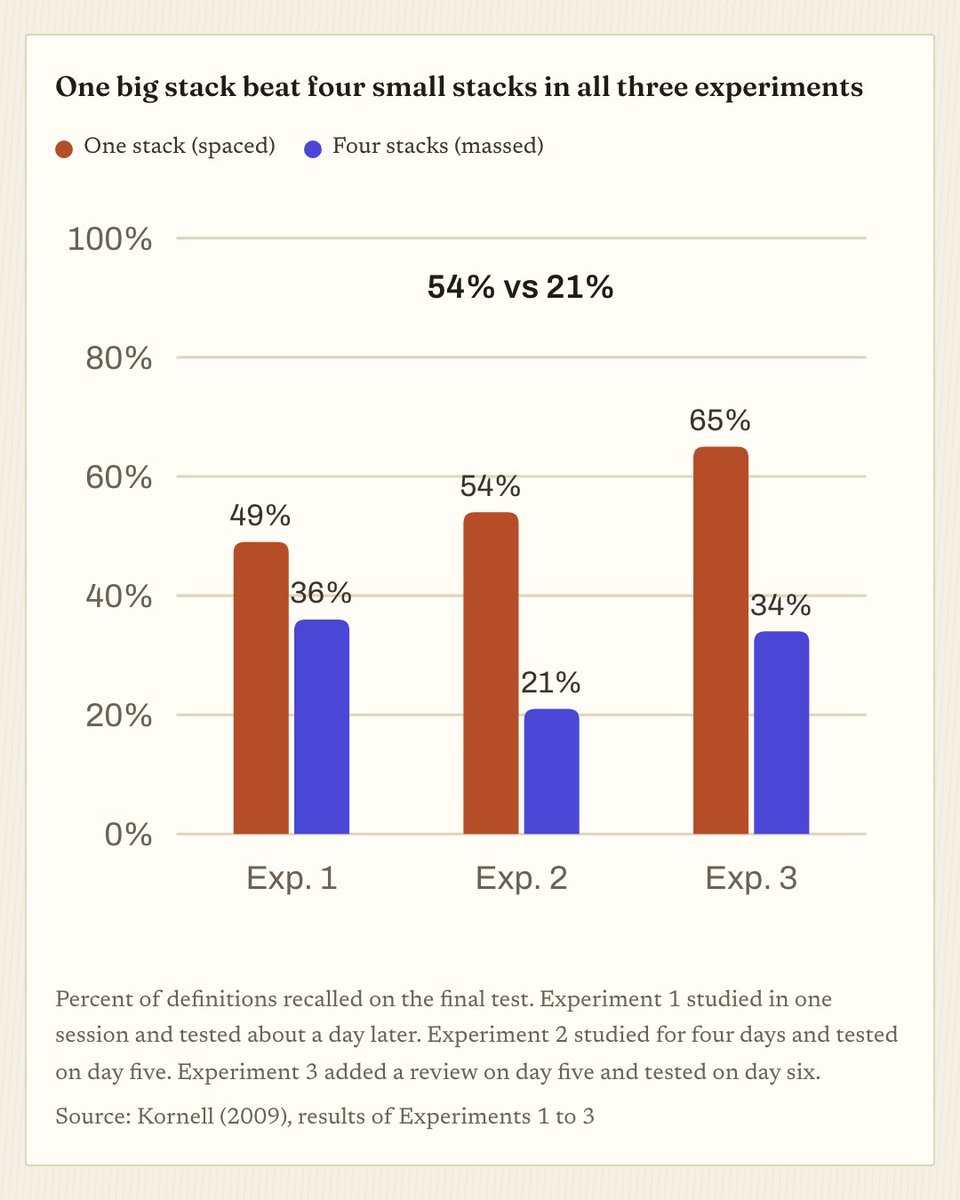
20 flashcards studied as one big stack, 20 as four small stacks. Same number of views, over four days.
Big stack: 54% recalled. Small stacks: 21%.
Yet after the first session, 72% of learners who picked a side said the small stacks worked better.
https://t.co/7b7eEvXFc3
Students learning Python with ChatGPT: 64% of their messages asked for solutions, 18% for explanations.
At the same practice progress, each extra solution request went with 0.31 fewer test questions solved. Each explanation request, 0.25 more.
https://t.co/Cga73y1JbG
The Leitner box usually doubles the gap after each right answer: 1, 2, 4, 8, 16 days.
In a meta-analysis, growing gaps did about as well as equal ones (g = 0.034). What helped was spacing reviews out at all (g = 0.74).
Stop tuning the schedule.
https://t.co/7b7eEvXFc3
People who preferred pictures expected to remember pictures better. People who preferred words expected to remember words better.
Their actual recall? Unrelated to their style.
Style went with what people expected to remember, not what stuck.
https://t.co/r0bizMt9xb
Same text, same study time.
One group drew a concept map with the text open. The other closed it and recalled what they could.
A week later: 67% vs 45%, in favor of recall.
Three in four students had expected the map to work as well or better.
https://t.co/JPLbUwn5ag
Fifth graders read passages one day and listened to them another.
The "visual learners" scored higher both ways. The crossover the theory predicts never showed up.
And 68% of the kids had no clear visual or auditory style at all.
https://t.co/r0bizMt9xb
No study has tested NotebookLM's Audio Overviews.
Across 46 studies, listening to a text and reading it led to about the same comprehension. One class study found podcast listeners scored lower.
Use listening as review. Then say three points aloud.
https://t.co/JPLbUwn5ag
"I'm a visual learner."
In one survey, 93–96% of teachers agreed that people learn better in their preferred style.
Experiments built to test that found almost no support, and several found results that flatly contradict it.
https://t.co/r0bizMt9xb
Given a cancer staging guideline, NotebookLM staged 86% of 100 test cases right. GPT-4o with the same text pasted in: 39%.
In a second study, pasting the guideline into the prompt barely helped.
The authors credit how NotebookLM looks up the passages.
https://t.co/JPLbUwn5ag
Two in three flashcard users said they use them mainly in exam week. Only 6.8% spread them across the term.
In another study, spacing beat cramming for 90% of people. Yet after the first session, 72% believed cramming worked better.
https://t.co/kGkxyDeoB1
Active classes do beat lectures. By how much?
Across 67 studies of college science courses, 33.8% failed in lecture classes and 21.8% in active ones.
A real gap. Nothing like the pyramid's 5% vs 90%.
https://t.co/LOu7Dh6XdM
Quizlet or Anki?
No study has compared them head to head. Both can space your reviews now.
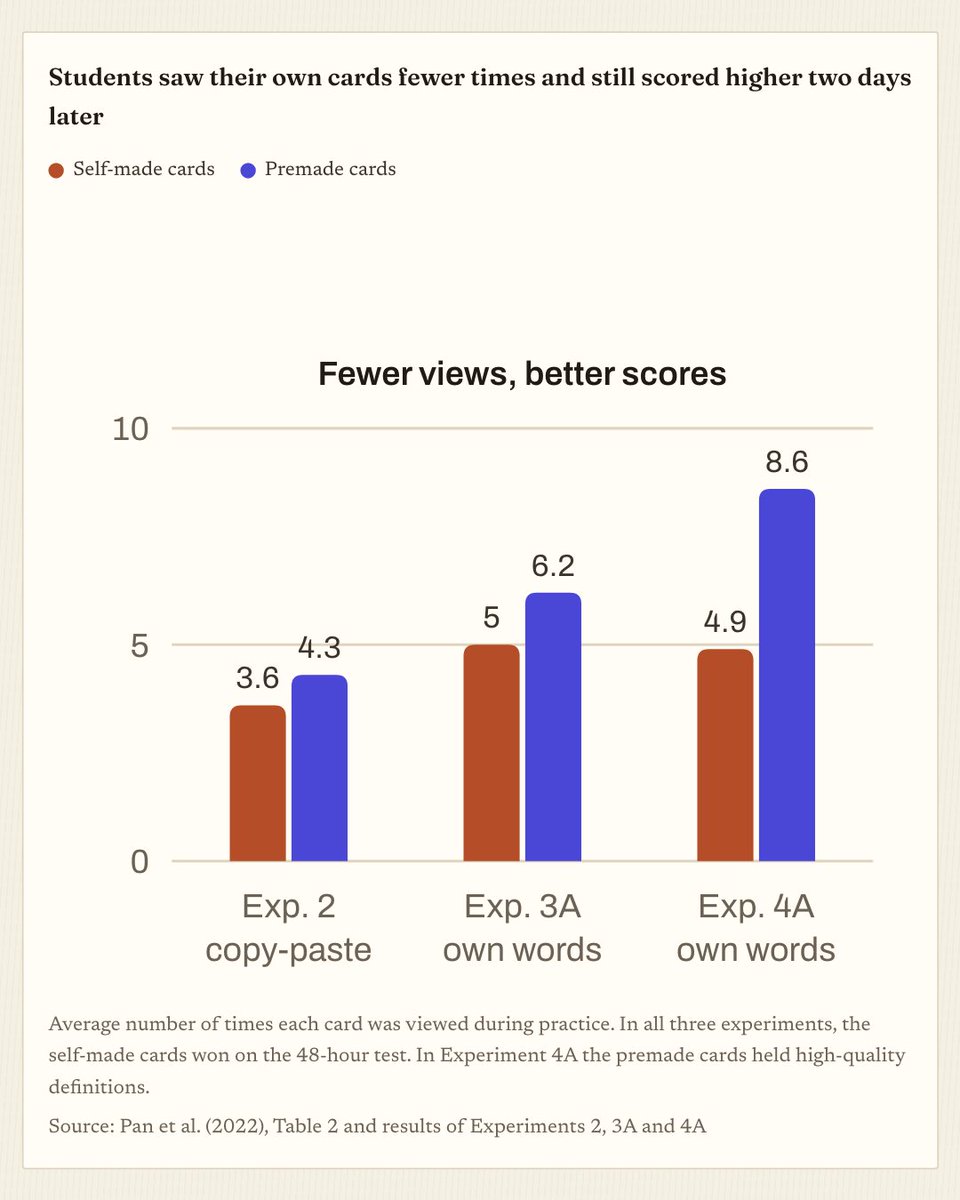
What experiments do show: cards you make yourself beat premade ones two days later. Unless you retype the text word for word. That didn't help.
https://t.co/kGkxyDeoB1
A version of the learning pyramid was in print in 1852, before memory experiments even existed.
Researchers found 63 versions from 1906 to 1940. They disagree. "Retained from hearing" is 10% in a 1906 version, 20% in a 1967 one, 5% in NTL's.
https://t.co/LOu7Dh6XdM
In one experiment, students saw each premade flashcard 8.6 times and each card they made themselves only 4.9 times.
Two days later, their own cards still won.
Making cards eats practice time. In these experiments, it was worth it.
https://t.co/kGkxyDeoB1