The surprising part of Gemini's new video workflow is the target: not "understand this whole video," but dynamically search, scan, and inspect the relevant segments across frames, audio, and transcripts. The bottleneck Google is pointing at is token cost.
The surprising part in Google's new Gemini video update is not just longer video analysis. It is the token bill: agentic video understanding is meant to process long-form video more accurately while using up to 88% fewer tokens.
The surprising part in ByteDance's Lucida is not the 3D scan - it turns indoor video into editable real-to-sim scenes, reconstructing objects as simulation-ready assets using VLM-based detection, referring descriptions, and multi-view information.
The surprising part in Google AI Studio's Gemini video update is the shift from fixed-frame ingestion to goal-directed inspection: the model can choose what to watch, at what speed, and whether to use frames, audio, or both.
The surprising part is the handoff: VadimStrizheus says his Skydive agent pulls raw video, cuts dead space, picks clips worth posting, captions them, then posts to TikTok and Instagram through the Vugola MCP server.
A creator-side AI video workflow just got very concrete: MiniMax H3 Open ran locally in ComfyUI on an RTX 4090, produced a full 4-minute "Just NPCs" video with Crissy, then Topaz Labs upscaled it to 4K60.
BrowserOS neo turns a local second Chromium browser into an MCP workspace: import Chrome logins, bookmarks, and extensions, then connect Codex, Claude Code, Cursor, or another MCP agent to operate in that logged-in browser. The repo is claimed at 13.4K stars.
The surprising part is how short the command is: CoinbaseDev says "Rebalance my portfolio." can now be executed with Coinbase for Agents. That moves the interface from explaining trades to asking an agent to perform a portfolio action.
https://t.co/D2tD1qEBaR is back as a continuous AI content loop: LLMs generate prompts, viewers upvote what gets created next, and fal is testing faster-than-real-time models like H3 Max for formats where the audience steers the stream.
The surprising part of Runway's Solaris is the UI stack it points at: not coded screens, but interactive interfaces generated frame by frame in real time. Runway calls it its first Interface World Model, shared as new research on Aug. 31.
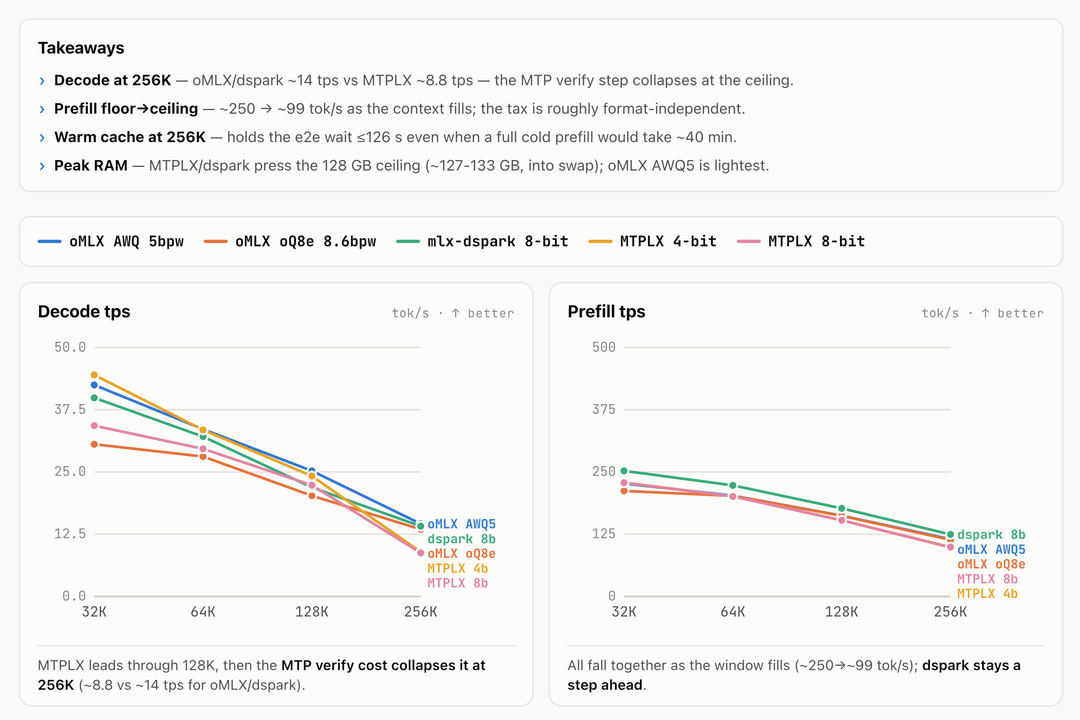
The surprising part is the test shape: Qwen3.8-27B local on an M4 Max, compared across 5 runtime/quantization stacks and 32K-256K context. Same model, same machine - the variable is the inference stack.
The surprising part is the friction, not the model demo: fal's MiniMax H3 Max turns a prompt or image into a 768p AI video clip, says it can run in as little as 3 seconds, supports 5s or 10s outputs, and offers up to 15 free videos a day for account users.
The surprising part is the gap: ShadeLurk fed AI one capture video from a game they made and asked for a promo that made it look interesting, with methods irrelevant. The attached result raises the useful question: when does game marketing stop showing the game?
The surprising part of https://t.co/D2tD1qEBaR is the role shift: viewers do not just watch an AI livestream. They pick a channel, prompt what happens next, and watch the scene generate in real time.
Same model, same prompt, different wrapper: one Grok 4.6 xHigh comparison showed Grok Build on the left producing much stronger output than Cursor on the right. The interesting variable is not the model - it is how each product handles context. Grok Build lists 500K.
The surprising part: Motion says its launch-video workflow starts with just a website URL. Paste the link, and it generates a video package with motion graphics, voiceover, music, and captions - closer to a marketing asset pipeline than a clip editor.
The surprising part is the workflow: Text-to-CAD is described as an open-source repo where a user can write a part description and get back a printable file. If it holds up, the bottleneck moves from CAD setup to specifying the part clearly.
The surprising part in D4RT is the interface: encode a video once, then query any 2D point across point, time, and camera coordinates to get its 3D position. The same setup covers depth, camera parameters, 3D tracks, point clouds, and long-term prediction.
The surprising part is the interface: a creator says they put Tailscale on the machine running their Grok bot, then gave it homelab access. The bot becomes a private-network operator for lights, services, machine checks, and automations.