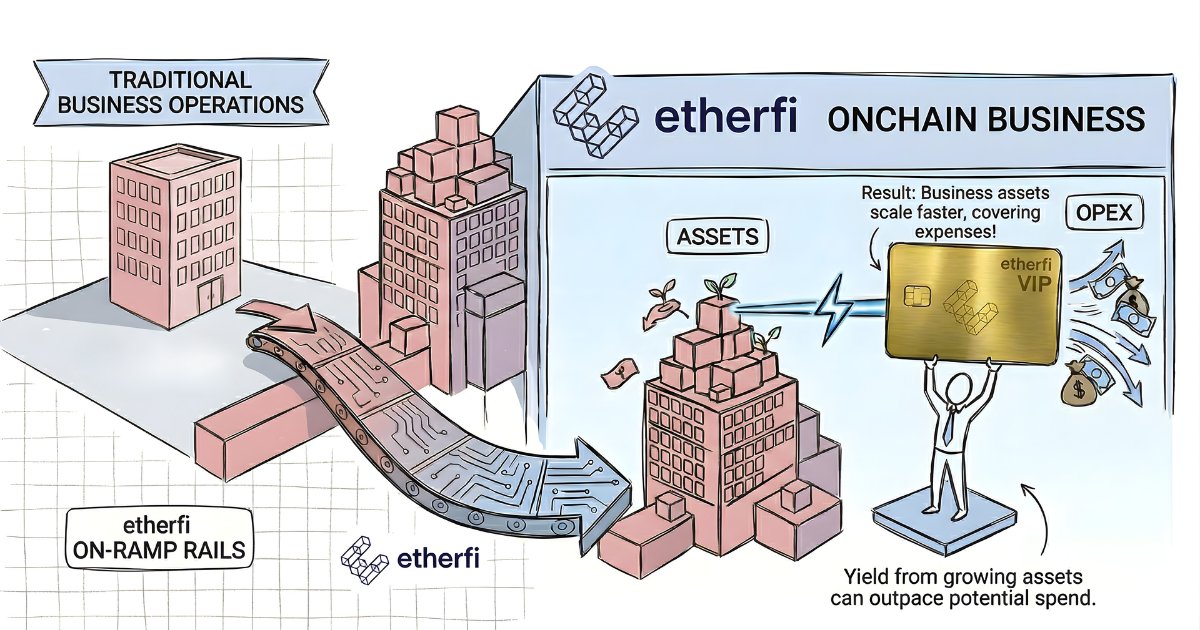
I've put my business on @ether_fi Cash rails.
So far, it honestly feels like financial magic.
Using yield bearing collateral to fund real world expenses.
I wrote all about my experience in the post below 👇
The Daily Degen - Saturday, June 20th, 2026
Bears, Bonds, Buybacks, Bounces, Macro, Videos, + New Projects! + $ETH, $XPL, $BTC, $EIGEN, and more!
Shout-out to brilliant accounts mentioned with <10k followers (make sure to give them a follow!):
- @Nomaticcap (defi poasting + podcasting extraordinaire)
- @pahueg (S-Tier of S-Tier macro/crypto YT channel)
- @_alfiekerswell (hardcore macro gigabrainage)
And shout-out to new projects highlighted: @EZManagerCL
And please RT/etc to support!
Link in next tweet 👇
@rasmr_eth I know this doesn't explain it, but this is typically a good hook to keep them interested to hear more.
"Most profitable company per employee ever"
Could Ethereum one day have $750B - $1T TVL?
And be worth $20k per $ETH or more at that point?
- @dunleavy89 makes the long-term bull case for $ETH to @Nomaticcap and @DeFi_Dad
Really interesting to see the contents of some of these treasuries and what they hold.
Respect to @ensdomains for holding so much $ETH on the treasury 👏
Over 60% of crypto TVL is on Ethereum and L2s. If Ethereum fails, the entire crypto ecosystem could be at risk. What's your take on Ethereum's dominance? Will it hold or cause a collapse? 🚀🔍 #Crypto#Ethereum#DeFi
•Value accrues to ETH because it provides the economic security for everything inside the vault. To meaningfully attack or rewrite the assets and contracts on Ethereum, an adversary must control a large fraction of ETH (one-third disrupts consensus; 51% allows rewriting). This makes ETH’s value derivative of the total economic activity and assets it secures, not of the fees paid to use it.
•Fees are friction. High fees reduce activity; therefore, fee revenue is a poor primary valuation metric. The network’s worth lies in the scale and quality of the activity it enables and protects.
•Current dominance and flows: Ethereum still commands roughly two-thirds of DeFi activity, the majority of meaningful stablecoin volume and infrastructure, and over 55% of RWA activity. Stablecoin balances on exchanges have collapsed to multi-year lows (~$14M), indicating capital is moving on-chain and into staking rather than speculative trading.
•Regulatory angle: Better advocacy for Ethereum in Washington is needed to accelerate tokenization and stablecoin growth. Other chains (Solana, Ripple/XRP) have more aggressive business development. Dunleavy argues that Ethereum’s success is existential for the broader crypto asset class because it hosts 50–75% of meaningful on-chain activity.
•Valuation outputs: Using today’s observed on-chain activity and assets secured, he derives a current fair-value estimate in the $6,000–$6,900 range. For 2030, he models scenarios based on total assets secured on Ethereum:$750B–$1T in on-chain assets → ETH $20,000–$50,000
Base case $2T in assets → ~$55,000
Bull case $5T in assets → ~$138,000
•Technical catalyst: The upcoming Glamsterdam upgrade is expected to raise gas limits and deliver 70–80% lower transaction costs, materially expanding the vault’s capacity without sacrificing security.
•Cycle context: Stablecoin and RWA activity has remained resilient or grown even during the recent period of price weakness, unlike prior cycles where capital simply left the ecosystem. This suggests the fundamental flywheel is already turning.