China open-sourced a fully local memory system that gives any AI agent human-like long-term recall.
No cloud. No API bills. No flat vector piles.
- 61.38% fewer tokens per session
- 76% persona accuracy (up from 48%)
- 51.52% higher task success rate
- works with any agent
100% Open Source.
Cohere has released open-source models Transcribe, Command A+, and North Mini Code so far this year, all available under Apache 2.0. With more to come...
Own your AI.
As of LiteParse v2.8.0, image → PDF conversion no longer depends on ImageMagick. Instead, it’s now handled natively in Rust 🦀
The result? Conversion is now 1.2× to 7.2× faster, depending on the image format⚡️
But the bigger win is what this enables: we’re one step closer to making LiteParse fully self-contained, with zero external system dependencies 🚀
If you’re using LiteParse, make sure to upgrade and to check out the project on GitHub 👉️ https://t.co/jgcEJgICQ0
Airtap has launched an AI agent that users can talk to via iMessage or RCS.
Airtap AI agent focuses on tasks that normally run entirely within mobile apps, allowing users to run them on a recurring basis.
For example, Airtap integrates with Google Maps, allowing users to preview and create routes on the fly!
RAG vs. Graph RAG, explained visually!
RAG has many issues.
For instance, imagine you want to summarize a biography, and each chapter of the document covers a specific accomplishment of a person (P).
This is difficult with naive RAG since it only retrieves the top-k relevant chunks, but this task needs the full context.
Graph RAG solves this.
The following visual depicts how it differs from naive RAG.
The core idea is to:
- Create a graph (entities & relationships) from documents.
- Traverse the graph during retrieval to fetch context.
- Pass the context to the LLM to get a response.
Let's see how Graph RAG solves the above problem.
First, a system (typically an LLM) will create a graph from documents.
This graph will have a subgraph for the person (P) where each accomplishment is one hop away from the entity node of P.
During summarization, the system can do a graph traversal to fetch all the relevant context related to P's accomplishments.
The entire context will help the LLM produce a complete answer, while naive RAG won't.
Graph RAG systems are also better than naive RAG systems because LLMs are inherently adept at reasoning with structured data.
Once the right architecture is in place, the next leverage point is efficiency.
Most RAG architectures rely heavily on vector search, and that layer can be made 32x more memory efficient using binary quantization.
I covered the full implementation in the article below.
👉 Over to you: Which RAG architecture are you running in production?
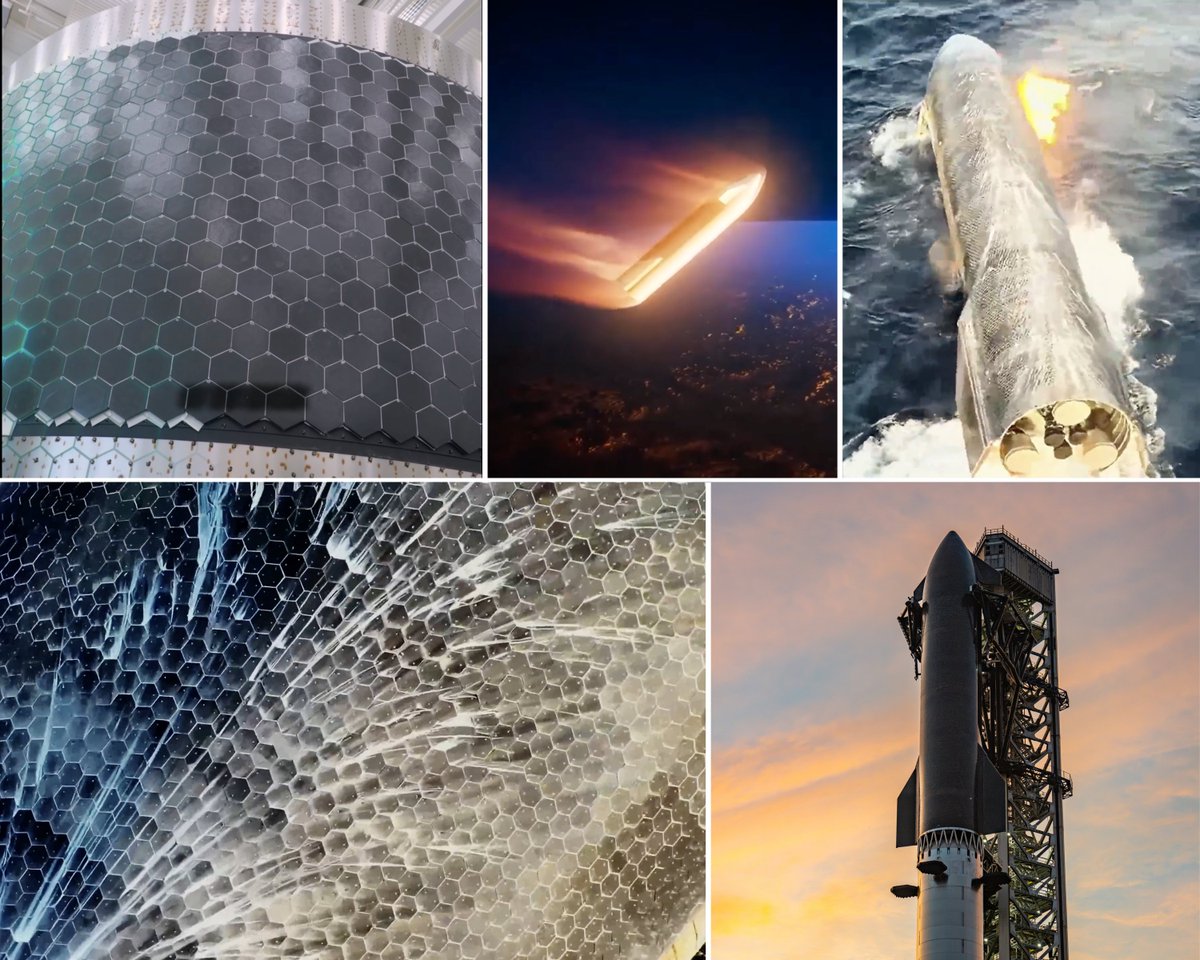
“No one has ever built a fully reusable orbital heat shield”
When Starship reenters at orbital velocity, it comes in like a flaming meteor….a raging ball of fire. Most heat shields partially melt or get destroyed during reentry
SpaceX is solving this incredibly hard problem right now with the most advanced heat-shield tiles ever flown
Starship V3 upgrades are improving tile retention and durability with every flight. The progress is insane
GPT-5.6 Sol is ridiculously good at building beautiful websites.
But if your prompt says “make me a landing page,” you will get the same generic AI design as everyone else.
Here are 10 copy-paste prompts that make almost any website look expensive:
Announcing OpenWorker! An open-source agent that doesn't just chat with you, but delivers finished work -- like hand you a polished document, send a slack message, or update a calendar entry.
Ask it to prepare a customer brief, untangle your calendar, draft a report, or triage a Slack alert. It works across your files and everyday tools, produces the deliverable, and checks in before doing anything consequential.
OpenWorker runs on your Mac, with Windows support coming soon. It does not lock you into any one model. Bring your own API key and run it with GPT 5.6 Sol, Claude Fable, Gemini 3.6, an open weight model (like Kimi, GLM, DeepSeek, Inkling), or Ollama to keep your data local. Your data does not leave your machine except through an LLM provider and integrations that you choose.
@rohitcprasad and I are building OpenWorker because AI coworkers are an important way to get work done, and we want there to be an open, privacy-preserving, model-independent option. Check it out and let us know what you think!
Try it out: https://t.co/P0mGnI1o31 (requires your own API key)
Source code: https://t.co/NYCiTD6hSq
🚨 BREAKING: Claude can now design logos that look like they cost $10,000.
I tested it myself.
The final result cost me exactly $0.
Here are the 7 prompts I used:
Save this for later