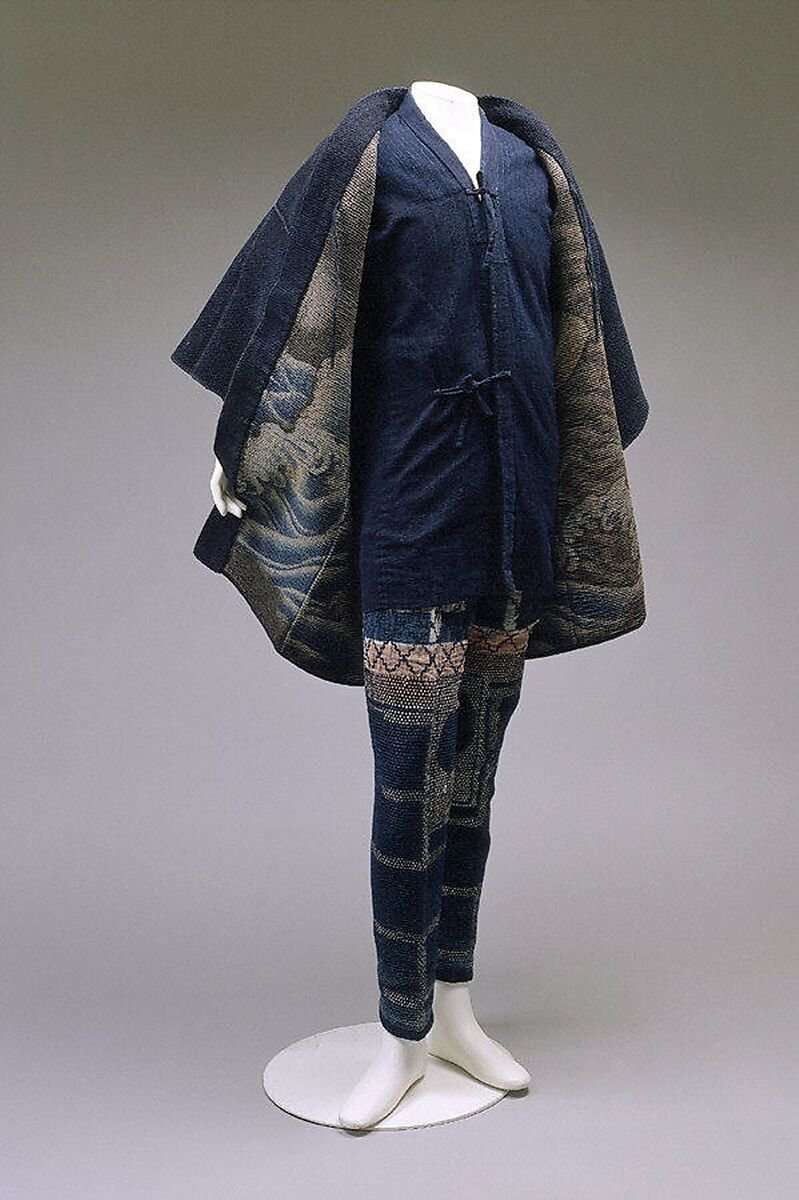
In nineteenth-century Japan, firefighters entered burning neighbourhoods wearing thick quilted cotton coats.
Edo was built largely from wood, and densely crowded streets allowed fires to spread rapidly. Firefighters therefore occupied a respected and highly visible position within urban life.
Their coats were practical, but they were not always plain.
The outer surface could remain comparatively restrained, while the interior carried a dramatic design. This example depicts Susanoo-no-mikoto, the younger brother of the sun goddess Amaterasu, rescuing the last daughter of an elderly couple from a monstrous serpent.
The choice was not accidental. A firefighter facing a burning city could carry the story of a monster-slayer against his body.
What stays with me is that the most powerful decoration was placed inside.
It was not necessarily created for strangers watching from a distance. It remained close to the person entering danger.
That makes the coat feel less like a uniform and more like private armour for the mind.
We often display courage on the outside because we want others to recognise it. This garment suggests another possibility: sometimes a symbol is most powerful when only its wearer fully knows it is there.
The flames were real. The myth was ancient. Between them stood an ordinary human being who still had to take the next step forward.
Authentic source: The Metropolitan Museum of Art
https://t.co/h3NdzeDrTM
Credit: The Metropolitan Museum of Art / Public Domain.