@MarcBhafc It’s football mate. Managers have fave players & O’Riley isn’t one of Hurzeler’s. Gomez is however, as we saw by how much he was played this season, in positions not natural to him. I think it’s a shame he’s on his way, as I think he offers us something different in midfield.
🚨 2026/27 Conference League - QR1!
✅ LEFT - Seeded on the Draw
❌ RIGHT - Unseeded on the Draw
➡️ Complete qualifying projections with all the % chances and seedings at our Page (link in bio)!
Whether it is Tony Blair’s interventions, the bond market’s reaction or privatised utilities warning of doom, the pattern is the same.
When anyone suggests progressive change, those with wealth and power push back. Whether the figure in question is @AndyBurnhamGM or @ZackPolanski, progressives need to understand what we are up against, and how to defeat it.
Very often, I find, science fiction names what politics struggles to. In James SA Corey’s series of novels the Expanse, the violent dystopian streets of Baltimore are given a name for what happens when the old order breaks down faster than people can describe it: the Churn. It is the brutal reorganisation of power, when familiar rules collapse and those who survive are the ones who read the signs early.
Britain is in one now. In fact, two churns are happening at once.
The first is electoral. May’s local elections were a rupture with the past. Labour lost roughly 1,100 councillors. Reform won 1,257 seats and 10 councils. The Greens won Hackney and Lewisham. In Makerfield, the parliamentary constituency where Andy Burnham is seeking a route back to the Commons, Reform took every council ward.
The progressive vote has fragmented and Reform has captured a large part of the anger. The container in which transformative politics could once be argued for and delivered – a dependable Labourmajority in the Commons – is visibly crumbling.
The second churn is deeper. Burnham named it when he said Britain had been “on the wrong course for 40 years”. That was a diagnosis of the political economy that has governed Britain since the late 1970s: financialisation, privatisation, hollowed-out public services and the transfer of wealth and power away from workers, communities and the public realm.
This is why the events of recent weeks matter. Burnham needs a state that is able to pay for big-ticket, social-democratic projects: council homes, clean energy, public transport, water, skills and resilience. Those things cannot be wished into being. They require public investment at scale.
That is where Rachel Reeves’s fiscal rules become more than an accounting device. In plain English, they are self-imposed limits on borrowing. They are political choices, not laws of nature. But they matter because they set the boundaries of what Labour says it can afford.
They matter for Burnham’s possible project for the country, because the current rules would inhibit the kind of public investment that a new settlement with the British people would require.
Yet he cannot simply announce he will tear them up. Governments borrow by selling gilts. If investors believe a government will borrow recklessly, they demand higher interest rates to lend to it. That raises the cost of all government borrowing and squeezes the money available for everything else. This is the discipline every Labour politician now feels.
Three weeks ago, Burnham tested the boundary. He floated a defence carve-out: the idea that extra borrowing for defence could sit outside the fiscal rules, as Germany has done by using special funds to increase military spending. It was a narrow proposal but one that raised larger questions about how we finance what we deem to be important. What followed is what some call “market discipline”. From the period around Burnham’s Makerfield announcement onward, the pound came under pressure and gilt yields rose as markets priced political uncertainty. Private creditors warned against Thames Water being brought into public ownership. Then, last Monday, Burnham’s team told Bloomberg he would make no changes to Reeves’s fiscal rules if he became prime minister. The defence carve-out was ruled out too.
I was not surprised by the retreat. Nor do I think it is useful to call it betrayal. Burnham cannot win a leadership contest if the markets are running against him before he has even started. But the retreat itself is the lesson. It illuminates what is standing in the way of a new social democracy. It is not simply “the markets”. It is the economic architecture Britain has built: Treasury rules, Bank of England decisions, pension fund structures and investor expectations combining to discipline any politics that threatens the settlement. What happened last week was a lesson in how power works.
Burnham matters not because he is a saviour. Progressives have had enough of saviours. He matters because he has said aloud what Westminster still avoids: Britain’s crisis is rooted in the economic settlement itself.
That settlement, what economists increasingly call rentier capitalism, is not abstract. It is a country where water bills rise while shareholders are rewarded, where housing wealth matters more than people having secure homes, and where democratic choices narrow whenever they threaten asset holders. Meanwhile, the state manages the fallout: crumbling infrastructure, higher costs and a cost of living crisis deepened by rentier extraction.
That is why the reaction to Burnham’s comments on the fiscal rules is revealing. Chancellors rewrite fiscal rules all the time when it suits them. Gordon Brown had his golden rule. George Osborne had his surplus target. Philip Hammond revised the framework. Rishi Sunak changed it. Jeremy Hunt changed it. Reeves has changed it again. The question is not whether fiscal rules can change. They plainly can. The question is who gets to change them, and for what purpose?
There are three fights progressives now have to pick.
The first is fiscal. Democracy must regain the power to invest. Public investment is still constrained less by national need than by what ministers think the bond market, the Bank of England and the Treasury will tolerate. A real shift would start from need, not nerves.
That means a Bank of England mandate that recognises a basic truth: inflation is not only caused by too much demand. It is also caused by too little capacity. When there are too few homes, rents rise. When public transport is weak, people are forced into expensive alternatives. When energy is costly and unreliable, bills rise. Investment is not the enemy of stability. Done properly, it is how stability is built.
The second fight is ownership. Public goods should be built and owned in the public interest. Thames Water entering special administration is the obvious place to start. Regional public housing corporationscould build at scale on public land, financed by rental income rather than annual Whitehall grants.
That is also why the language of “public control” – used increasingly by Andy Burnham – deserves scrutiny. Few want a return to top-down nationalisation. But franchising, as the Bee Network in Manchester demonstrates, is not public ownership. Private operators running Bee Network services made hundreds of millions in profit last year. The network is better than what came before – but it remains a private-profit, public-risk model. Control without ownership leaves the fundamental problem intact: the public absorbs the downside while shareholders take the gain.
The third fight is constitutional. Proportional representation for Westminster, an elected second chamber and deeper devolution are not procedural tidying-up. They are conditions for progressive power in a fragmented country. The forces ranged against transformation do not need PR: they already have the City, the rightwing press, corporate lobbying, the Treasury worldview and the bond market. Progressive Britain has no equivalent machinery. PR is the glue that could allow a broad majority to govern together.
Burnham was right: Britain has been on the wrong course for 40 years. But last week showed the harder truth. The old settlement will not politely bow out for its replacement. It will price the risk, police the boundaries and demand reassurance before the argument has even begun. The churn is far from over.
* Clive Lewis is the Labour MP for Norwich South
* Clive Lewis will be speaking about these issues and more with Andy Burnham at Change Now! Mobilising the Progressive Majority
A final piece of advice from Holly Butcher - written the day before she passed away from cancer at just 27:
“It’s a strange thing knowing you’re going to die young.
At 26, I thought I had time…
To fall in love.
Start a family.
Grow old.
But cancer doesn’t care about plans.
Now, I understand how fragile life really is. Every single day is a gift, not a guarantee.
I’m not writing this to scare you. I’m writing to remind you: really live.
Stop stressing over little things. Be kind to your body- move it, nourish it, stop criticizing it. One day you’ll wish you had appreciated it.
Go outside.
Look at the sky.
Feel the sun.
Just be.
Spend less time chasing “stuff” - more time making memories. Don’t skip moments with people you love.
Laugh more.
Write a note.
Tell someone you love them.
Complain less.
Give more.
Helping others brings more joy than anything you can buy.
Be present.
Put your phone down.
Show up - really show up.
You don’t need to have it all figured out. You don’t need a perfect body, or a perfect life.
Just follow what makes your heart light up. Say no to what drains you. Make changes when you need to.
And please - donate blood. I wouldn’t have had that extra year without it. And that year gave me memories I’ll hold close… forever.
Thank you for reading this.
Live your life well.
And maybe… we’ll meet again someday.”
Holly 🩷
Repost & share Holly’s important advice. ❤️
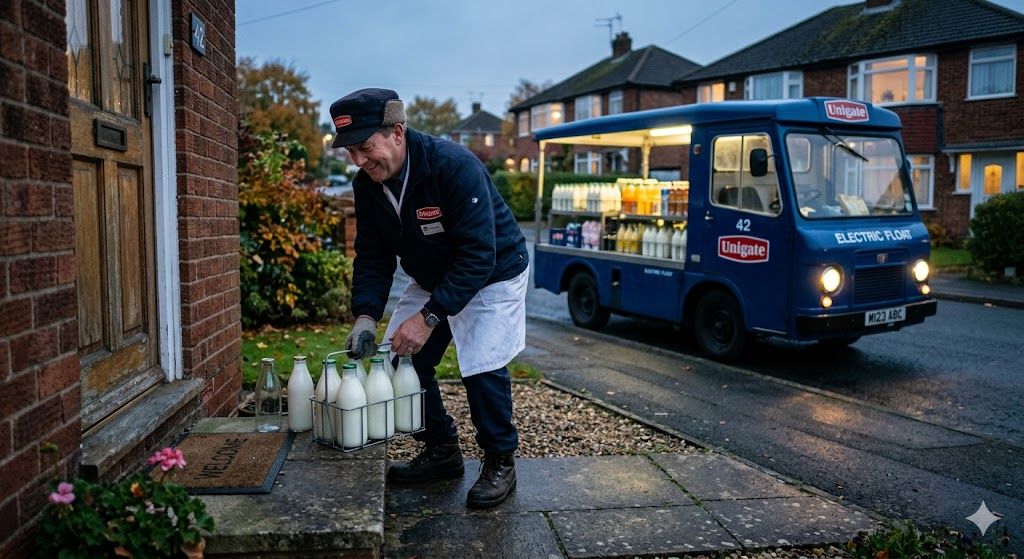
In 1995, 45% of British milk was delivered to the doorstep before seven in the morning by a milkman in an electric float.
In 2026, it is 3%.
The milkman has been effectively abolished inside one human generation. The supermarket walked in, undercut the cost by a few pence per pint, and the daily ritual of British household life, glass bottles clinking on the step at half past six, was gone by the time the children of 1995 had finished secondary school.
The cost to the customer was a few pence per pint.
The cost to the system was, in rough order: the glass bottle that was washed and reused hundreds of times, replaced with a plastic bottle that is used once and recycled imperfectly. The local dairy that supplied one town, replaced with a national processor that supplies half the country. The milk that arrived four hours after milking, replaced with milk that arrived three days after milking after a journey of 200 miles. The conversation on the doorstep, replaced with a self-checkout beep.
The milkman himself, incidentally, had the lowest recorded rate of heart disease of any male occupation in Britain. He walked approximately 12 miles a day, finished work by 10am, and ate a cooked breakfast. He has been replaced, in the same delivery role, by a zero-hours Amazon Flex driver sitting in a Ford Transit.
A small piece of British daily infrastructure was quietly demolished.
Nobody was consulted.
The milk is still being produced. It is just being produced further away, transported further, kept in plastic, and sold at a different margin, by a different business, to a customer who never sees who milked the cow.
The milkman knew your name.
The self-checkout does not.
Alert 🚨
Please share (the original post) and make others aware. Thank you.
Liverpool Street Station, which sits on a historic part of the north-eastern corner of the City of London, is about to get a modern makeover.
@PJTheEconomist I'm old enough to remember when ardent economists and tabloids were saying that the £40bn total budget proposed by Corbyn in 2017 would destroy the economy. Three years later treasury gave more than that to a peer's company operating a "track and trace" system that didn't work
That’s obviously bollocks.
People didn’t want Labour. They didn’t want Tories on steroids either. So they voted Green. It’s not a conspiracy, it’s just voters saying, “Nah, not you.”
And spare me the culture war nonsense. If this country supposedly can’t stand women or minorities, then how exactly did a blonde lass from Bolton win, in a party led by a gay Jewish fella from the South? Doesn’t quite fit the dramatic little story, does it?
The truth is you and Farage thought it would be a cakewalk. Wave a few flags, shout about migrants, collect the votes. Instead, you got a metaphorical bloody nose. Turns out people can smell recycled rhetoric from a mile off.
You’re on 90k a year, banging on about “the working class” like you clock in at a warehouse before Parliament. There’s something almost impressive about earning that much while pretending you’re one late gas bill away from disaster. The average Joe isn’t stupid. He’s tired, skint, and wide awake.
Reform and the Great Yarmouth People’s Front trying to cosplay as working class is genuinely comedy gold. It’s like watching lads who’ve never done a proper graft shift in their lives explain to bricklayers why Abdul down the road is the reason their wages are low.
No. People are struggling because you lied about Brexit, you hollowed out industry, and you treat the working class like a photo opportunity with steel-toe boots.
And the more you shout, the more obvious it becomes.
“When the foundations are extractive, everything built on top is expensive.”
Govt economic policy has to change and change rapidly.
Any review on energy has to consider public ownership as an option.
Here’s why:
This isn’t just about a bad year or a temporary spike. It’s not something we fix with another sticking plaster or short term rebate.
This is structural.
For 40 yrs we’ve treated the basics of our economy as assets to sweat, not foundations to strengthen. Energy, water, transport, housing, even parts of our food system have been organised around extraction first, production second.
When the foundations are extractive, everything built on top is expensive.
High energy prices don’t just hit families trying to heat their homes. They hit factories, pubs, farms, small manufacturers. They feed straight into food prices, rents and transport costs.
That’s why the cost of living crisis & the cost of doing business crisis are the same crisis.
You can’t build a serious manufacturing base on top of an energy system designed to reward volatility.
You can’t have food security when water companies are loaded with debt and paying out dividends.
You can’t grow regional industry when transport is fragmented and overpriced.
You can’t ask small firms to invest when commercial rents are inflated by land speculation.
Tinkering won’t cut it.
Price caps without structural reform just socialise the risk and privatise the reward.
Short term subsidies ease the pain but leave the model untouched.
Industrial strategy without control over energy costs is industrial strategy with one hand tied behind its back.
If we’re serious about growth and renewal, we’ve got to talk about democratic control of the basics.
Not control for its own sake. Control that lowers the cost of capital. Control that aligns investment with long term public need. Control that treats water, energy, transport, housing and food as the infrastructure of prosperity, not chips in a global casino.
A Productive State doesn’t micromanage everything. It does something more important. It shapes the rules, owns or co-owns the natural monopolies, and makes sure essential services run at cost plus resilience, not cost plus maximum extraction.
Right now we’ve got manufacturers paying some of the highest industrial energy prices in Europe. Households squeezed. Government spending billions managing the fallout instead of fixing the cause.
Every time we patch instead of reform, we lock in higher structural costs. For families. For firms. For the state.
The business groups are right to worry.
But we won’t fix this by begging for another relief scheme.
We fix it by rebuilding the foundations.
Energy priced for production, not speculation.
Water run for resilience and public good, not dividend flows.
Transport integrated to support growth.
Housing treated as infrastructure, not a tax shelter.
Food supply anchored in security, not fragility.
Until the basics are under far stronger democratic guidance, the cycle carries on.
Higher bills.
Higher business costs.
Lower investment.
Lower growth.
That isn’t fate.
It’s a policy choice.
And we can choose differently.
For all the different owners of @RoyalMail , the financial analysts, (paid off & gone). The marketing companies, (paid off & gone), regional directors, (paid off & gone). Shareholders, (paid off & gone). Watch this video - it's not rocket science.
It's quite amusing that twice a season neutral football fans arbitrate whether Crystal Palace v Brighton is a valid rivalry, with many concluding it's not.
Yet, their elitist view is irrelevant. The two clubs clearly loathe each other, with the rivalry predicated on 50+ years of conflict — unlike nonsensical feuds based on location.
Mullery/Venables/Noades prompted the war, though the original tensions existed thanks to fierce battles for glory in the lower divisions.
The hatred has stuck, both clubs are better for it — it's the first game supporters seek when the fixtures are released.
Off the pitch, the ill feeling is clear. On it, Lewis Dunk and Dean Henderson have assumed the mantle of the rivalry, grabbing every opportunity to wind up the opposition. Henderson’s cup-lift mime yesterday perfectly encapsulated it.
There is one issue with the game, yet it has nothing to do with either club. The desire from Premier League broadcasters to turn the contest into something it's not, the cliched ‘M23 Derby’, impacts the outside credibility of the rivalry.
If the history was properly respected and understood beyond the two clubs, much of the criticism would fade away. #CPFC | #BHAFC
You'll want to be sitting down for this bit.
Water companies are currently £82.7 billion in debt, have paid themselves £85 billion in dividends, leak over a trillion of litres of water per year, dump sewage for almost 4 million hours per year, have been convicted of over 1,200 criminal acts since 1989 and an average of 35% of your bill goes on nothing but paying more interest and yet more dividends.
And not a single company has ever lost their operating licence. 👇