THE UNPLEASANT MASSACHUSETTS MILLIONAIRES SURTAX PRESENT VALUE MATH
The Massachusetts millionaires surtax has produced the immediate increase in state tax revenues that its proponents anticipated. An additional four percent tax on annual income above $1 million has resulted in the state collecting approximately $3.38 billion in surtax revenue in fiscal 2026, which represents a 13.3 percent increase in Massachusetts personal income tax collections (and an 8 percent increase in total state tax collections relative to what they would have been without the surtax, holding other revenues constant).
The initial revenue increase has also benefited from the strong stock market, which has increased realized capital gains and other investment income among wealthy taxpayers. Massachusetts collected approximately $3.22 billion in capital gains taxes during fiscal 2026, while surtax collections exceeded the state's $2.4 billion budget benchmark by nearly $1 billion.
These immediate gains are unsurprising because the surtax applies to an existing population of wealthy residents and business owners whose economic activities and residency decisions take considerable time to change.
From the present value perspective, however, the more consequential economic issue is whether the surtax permanently reduces the growth rate of Massachusetts adjusted gross income through slower business formation, reduced hiring and investment, and the outmigration of wealthy families and business owners. Massachusetts has already experienced a substantial increase in net AGI outmigration relative to its historical levels, particularly to Florida and New Hampshire.
Consider a scenario in which the surtax permanently reduces annual Massachusetts AGI growth by just 0.5 percentage points, which is close to the observed AGI outmigration shift over the passage of the tax. Using a baseline nominal growth assumption of 4.32 percent, consistent with approximately 2 percent real economic growth and long-term market inflation expectations, and a nominal discount rate of 5.02 percent based on long-term municipal bond yields, the present value of Massachusetts' future personal income tax collections would fall dramatically.
Without the surtax, the present value of the existing $25.37 billion annual income tax revenue stream would be approximately $3.62 trillion. With the surtax adding $3.38 billion in immediate annual revenue but reducing future income growth from 4.32 percent to 3.82 percent, the present value would decline to approximately $2.40 trillion. The resulting net fiscal loss would be approximately $1.23 trillion, or 33.9 percent of the present value of all future income tax collections without the surtax. A present value loss of 1/3 of all future tax revenues!
One should realize how small the permanent growth reduction would need to be for the surtax to become fiscally counterproductive under these assumptions. The break-even reduction in annual Massachusetts AGI growth is only 0.093 percentage points, or approximately 9.3 basis points. At that threshold, the present value of the additional surtax revenue is exactly offset by the decline in future income tax collections.
Even if only one-fifth of the assumed/observed 0.5 percentage point growth reduction were attributable to the surtax, the resulting 0.1 percentage point reduction would still produce an estimated net present value loss of approximately $30.5 billion.
The long-term economic assessment of the surtax should therefore focus not simply on how much additional revenue it collects today, but on whether it permanently reduces the rate at which Massachusetts creates businesses, attracts investment, retains high-income taxpayers, and generates taxable income.
Donald Trump is a malignant narcissist. He is a defective person. He has deep insecurities and even deeper cravings. He disguises both with bluster and bravado. He has a lifetime of secrets and lies - about inheritance, grades, health, wealth, acumen - and he used them to build false constructs.
The Apprentice was big for him; it allowed him to act out his idealized self. And - it identified something he was actually good at - being a reality TV show host.
His disorders include narcissism, sociopathy, paranoia, and sadism. He doesn't process anything strategically. He is transactional. He doesn't think. He feels. It's in the form of impulses and cravings.
Grandiosity is his greatest CRAVING. Humiliation is his greatest fear. Protecting his secrets and lies is paramount.
A certain number of his supporters have malignant normality - they see a distorted reality through his behaviorally disorders. That's the cult, and they constituted his POWER.
His enablers - GOP officials and RW media - rely on him for power and profit. If he falters, they falter - and if he falters bigtime, they evaporate. They serve as his CRUTCH.
Again - his grandiosity is his craving, his base of supporters is his power, and his enablers are his crutch.
What happened in the election was the result in Trump 2.0 being different than Trump 1.0. The difference was borne from his narcissistic come-uppances. In the civil defamation suits, he was narcissistically battered (exposed as a predator and $90M judgment); and in the Trump Org civil suit, he was narcissistically pulverized (exposed as a fraudster and $350M judgment he struggled mightily to post bond for and couldn't until it was reduced). In the Manhattan criminal case, he was narcissistically traumatized - true humiliation, because it branded him a criminal. Plus, the process was brutal for him - he had to physically be there, observe rules, watch nobody show up to court for much of his defense, watch old friends like Pecker and Hicks speak truth against his narrative, AND he presented no defense because he's impotent as a witness, and - after all that - he lost - to a jury - unanimously, beyond a reasonable doubt, on all charges, after a very short deliberation. He had to see ALL this in person up close, and this is a guy who always controls his environ.
He faced many other charges and ran for office again to stay out of jail. When he won, he was going to be vengeful to the max. It was in the cards.
BUT - who would he be vengeful TO? His pathology does not let him see past himself. So - he hates Democrats, Republicans, Independents, giraffes, bunny rabbits, and he CANNOT feel or process empathy, shame, or contrition.
You honestly couldn't give power to a worse person.
He got old and ill and is now owned by his aberrant pathology. And the GOP was weak. And the cult was addicted to dopamine from owning libs thanks to Fox.
His mantra became "I can do whatever I want." And he did. And he overreached. Economically. Humanistically. Globally.
Yesterday, that overreach took him down. Enough truth filtered through the echo chambers. The frustration and negativity became too much for too many. His profiteering and his insensitivity about it, so abnormal, was beyond the pale.
Why am I posting all of this? I am doing it because we suffered so much because we were so collectively oblivious, quick to normalize, and we underestimated everything - including the power of grift.
If left to his own devices, he would have rewritten history. Where would we be then?
Yesterday's result is cause for celebration. But it's paramount that we see HIM - not for who he is, but for WHAT he is. It's paramount we understand him and how we got here and how we never let it happen again.
I see very little introspection occurring. Everything is analyzed in simplistic terms. As always, there is noise - false narratives and other nonsensicalities - obfuscating the full truth.
I made this post - in a noise-free zone - to push the narrative that I think matters most, that I hope we get around to discussing soon. Or eventually. History does not HAVE to repeat itself. Rip the Band-Aid off this guy.
Thanks for reading.
Massachusetts has an interactive map that lets you find farms, farmers markets and agricultural activities near you.
Search by location for farmers markets, farm stands, pick-your-own farms, maple sugar houses, orchards, Christmas trees and more.
https://t.co/YLSaUfcdPL
Trump’s hatred of anyone else’s shadow has now manifested itself in the destruction of the Kennedy Center’s iconic weeping willows. The trees are fixtures of Boston’s Common and were, at the time of their planting, representative of a country’s sorrow. It’s death by 1000’s cuts.
The moment of one of today’s Russian strikes on Kyiv.
I can see that fewer and fewer people are reading news from Ukraine. I understand that on a Sunday morning, people don’t want to read about war. They want to sleep a little longer, drink good coffee, and sit in the sun. I understand that. The algorithms on X limit content about war, destruction, and suffering. You have to make an effort to even see this information.
All of this is understandable on a human level. But unfortunately, if you remove Putin and the war from your information feed, they do not disappear from reality.
Putin is a sadist and a maniac. He is a threat to all of humanity.
There needs to be active resistance. News from Ukraine needs to be shared. People need to keep their focus.
Despite a sleepless night, I’m still here. And I’m grateful to everyone who continues to stand with us.
One day, we’ll drink morning coffee together in a beautiful, peaceful Kyiv.
They did not take cursive from the schools because children no longer needed it. They took it because of what it was quietly building in them.
Consider what the exercise actually is. A child, six years old, is handed a pen and asked to draw a single unbroken line that becomes a word. The wrist must float. The fingers must hold a living pressure, never quite the same twice, always correcting. The eye must follow the ink forward and trust the hand to finish what it has begun. There is no lifting, no stopping, no starting over mid-word. The loop must close. The ascender must rise and return. The sentence must travel from one margin to the other as a single continuous gesture, and at the end of it the hand must still be steady.
Twelve years of this. Every day. Ten thousand small acts of sustained, self-correcting attention, carried out below the level of conscious thought, until the motion belongs to the body and the body belongs to the motion.
This is not penmanship. It is the slow construction of an interior form.
The hand that has learned to carry a line without breaking it is the hand of a mind that has learned to carry a thought without breaking it. The two are not metaphors for one another. They are the same faculty, trained in the same child, by the same daily discipline. Continuity of the stroke becomes continuity of the reasoning. The patience of the loop becomes the patience of the argument. The commitment to finish a word one has started becomes the commitment to finish a sentence, a paragraph, a life's idea, without reaching for the nearest distraction halfway through.
Print is a different creature entirely. Print lifts. Print stops. Print assembles a word out of separate, stamped, interchangeable pieces, each one beginning and ending in isolation. A mind raised only on print learns to think the way print is made, in discrete tokens, in replaceable units, in fragments that can be recombined by any outside hand without the owner noticing the substitution. It is precisely the shape of thought a language model produces. It is precisely the shape of thought a language model can steer.
Cursive is kata. This is the whole of it. A form repeated daily, for years, not for the sake of the form but for what the repetition lays down in the practitioner beneath the form. The swordsman does not train kata so that one day he may fight in kata. He trains it so that when the moment comes and there is no time to think, the movement is already inside him, older and deeper than thought, and it rises on its own. Cursive was the kata of the literate mind, the daily quiet drilling of continuity, of patience, of a line held steady under the long pressure of its own length. And the signature it produced at the end, that small flourished mark unique to a single human being on earth, was only the outward proof of an inward form no machine and no other hand could ever reproduce.
Take the kata away and the practitioner is left with vocabulary in place of faculty. He can recognise a whole thought when he encounters one. He cannot carry one himself. He can admire a finished argument. He cannot sustain one long enough to close its loop. He begins books he does not finish, sentences he does not end, ideas he abandons the moment the screen in his palm offers him a brighter one. And when the machine begins feeding him tokens in the exact shape his schooling taught him to receive, he meets it with no interior resistance at all, because no interior form was ever built in him to push back with.
They removed it quietly, across a generation, and they removed it in the last years before the machines arrived. Twelve years of daily practice in unbroken, embodied, self-authored thought, gone from the curriculum of almost every child in the Western world, just as the instruments designed to complete their sentences for them came online.
The hand forgets. The mind, having never been taught the kata, forgets a thing it never knew it had.
That is what cursive was. That is what was taken. And that is why the thought of anyone who still writes by hand, in long unlifted lines, remains, quietly, stubbornly, and without their ever needing to announce it, their own.
Now the question stands open. What else has been banned, phased out, quietly retired from the curriculum and from common life over these same decades, under the same soft excuses? Mental arithmetic. Memorisation of poetry. Latin. Logic as a formal subject. Map reading. Knot work. The keeping of a commonplace book. The reading aloud of long passages in class. Singing in parts.
What was each of those actually building in the child, beneath the surface of the lesson, and whose interest was served by its disappearance?
#BREAKING: Sen Whitehouse: “…today Donald Trump issued an executive order to the postmaster general and DHS, his DHS, ordering the postmaster general, who he appointed, to seize control of mail-in ballots and invent a method with DHS, for delivering mail-in ballots only to people Donald Trump’s DHS believes should receive mail-in ballots. Yes, you heard that correctly.”🤦♀️
Thomas Massie just went nuclear on Trump’s DOJ for bringing zero “charges, arrests, or investigations” over the Epstein files.
“Who should be investigated?”
“I’ll name them right here.”
“Leon Black.”
“Jes Staley, accused of terrible things.”
“Leslie Wexner.”
“Why did the FBI list him as a co-conspirator in their own documents in a child sex trafficking case, and then tell him that they had no questions for him?”
“Over 3 million documents describing horrible things, unspeakable things, much of it redacted.”
“Over two dozen people have resigned, CEOs, members of government worldwide.”
“But I haven’t seen any arrests or investigations here in the United States.”
“Prince Andrew, Duke of York, who has since been stripped of his royal titles due to his affiliation with Jeffrey Epstein, has been arrested.”
“Peter Mandelson, who previously served as UK’s ambassador to the United States, resigned in disgrace from UK’s House of Lords and the Labour Party, and he’s been arrested.”
“Former Prime Minister of Norway, Thorbjørn Jagland, has been charged.”
“But we don’t see any charges, arrests, or investigations in the United States.”
“What do we see?”
“We see our FBI director celebrating in the locker room at the Olympics overseas.”
“We need justice.”
@RepThomasMassie@MassieforKY
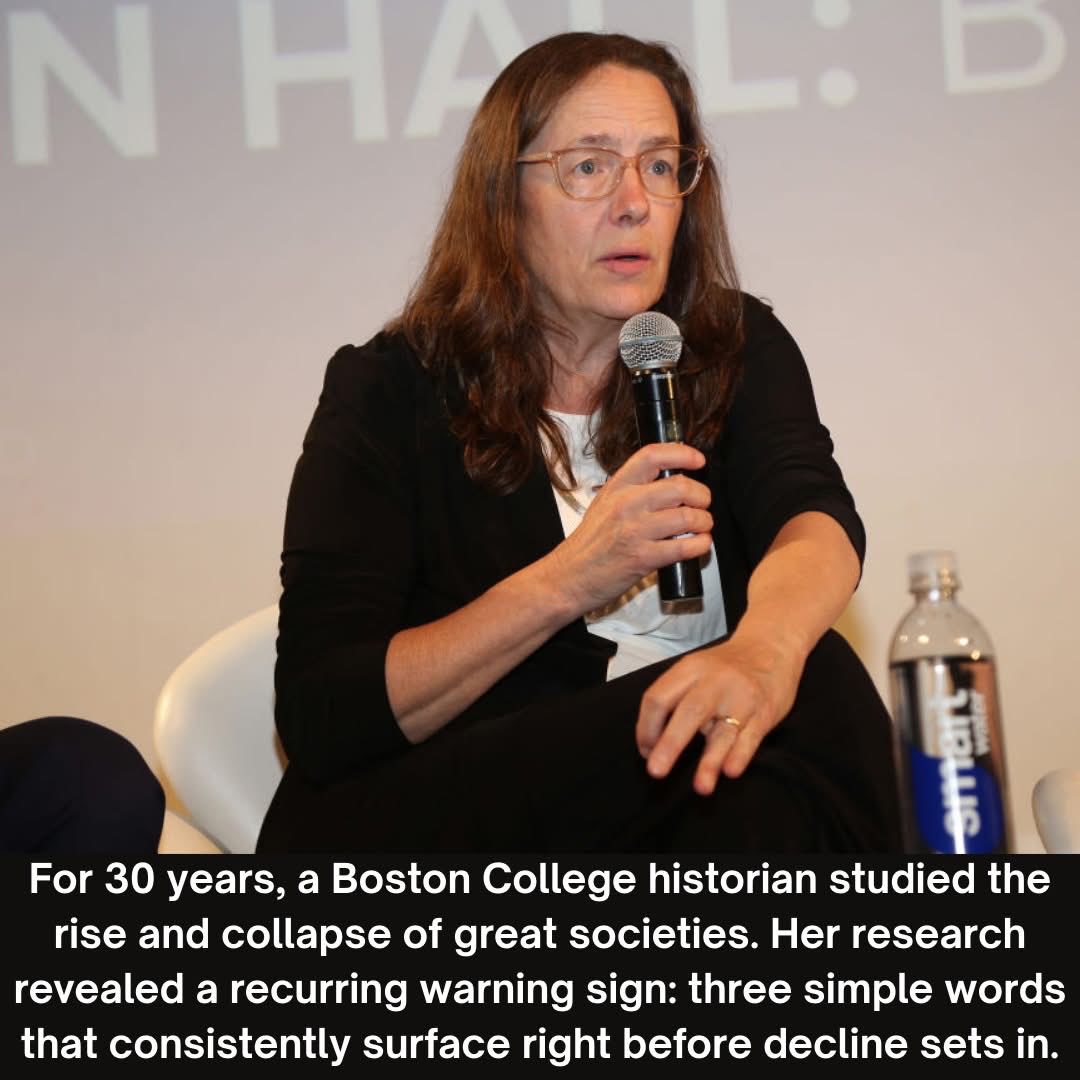
“For more than thirty years, a historian at Boston College has focused on a single question. How do strong, stable societies fall apart?
Her name is Heather Cox Richardson. While most of us skim headlines and feel a vague sense of unease, she spends her time in archives. She reads private letters, local newspapers, speeches, and diaries. She looks for the small fractures that appear long before collapse becomes obvious.
Across centuries of American history, she began to notice a pattern. In moments just before serious crisis, ordinary people often repeat the same quiet reassurance.
Someone will fix it.
It sounds harmless. Even reasonable.
Picture a household in the late 1850s. A family sits at the kitchen table as political tensions rise. Newspaper language grows sharper. Conversations at church become strained. Neighbors who once chatted easily now avoid each other. Something feels unstable, but daily life goes on. There is work to do. Children to raise. Bills to pay.
So they tell themselves what millions of others are also telling themselves. The leaders will handle it. The system is strong. This will pass.
Within two years, the country would be at war with itself. More than 600,000 Americans would be dead.
Looking back, the Civil War can seem inevitable. The timeline feels clear. The warning signs look obvious. But to the people living through it, nothing felt predetermined. They believed things would settle down because they always had before.
Richardson argues that this mindset appears again and again in history. People sense tension. They recognize harsher rhetoric, weakening norms, growing division. Yet many choose reassurance over responsibility. They assume someone more powerful or more qualified will step in.
By the time they realize no one is coming, the window to act has narrowed.
Her work, however, is not about despair. It is about awareness and agency.
History does not only document decline. It also records extraordinary change driven by ordinary people. The women who fought for the right to vote organized for more than seventy years. Many never lived to cast a ballot. The civil rights movement endured violence, imprisonment, and constant uncertainty. Success was never guaranteed.
Those victories did not happen because the odds were favorable. They happened because enough people refused to believe the outcome was someone else’s responsibility.
Richardson emphasizes a simple truth. Institutions are not separate from citizens. Democracies are not self repairing machines. They depend on participation and engagement. When people step back and assume stability is automatic, erosion begins quietly.
Societies rarely collapse in one dramatic explosion. More often, they weaken gradually. Trust thins. Standards shift. Fatigue sets in. Small acts of disengagement accumulate until the damage is undeniable.
Yet the future is not written in advance.
Unlike those who lived through past crises, we have the benefit of hindsight. We can see where earlier generations hesitated. We can identify moments when different choices might have altered the outcome. That knowledge does not guarantee safety, but it gives us clarity.
Inevitability applies only to what has already happened.
The present is still open.
Each era reaches moments that feel uncertain. The difference lies in whether people retreat into the comfort of someone will fix it, or recognize that the system depends on them.
History is not a prophecy. It is a record. It shows how societies falter and how they endure.
The real question is not whether change is possible.
✅✅The real question is whether enough people decide to take responsibility for it.
From “The Vintage News”
I study authoritarianism for a living, so I do not say this lightly: America isn't facing an authoritarian future. America is living an authoritarian present.
(A long 🧵)
/1
Carol of the Bells in Kyiv subway.
Voices of the Embassies of Germany, France, and the United Kingdom came together to perform Shchedryk in the Kyiv metro as a sign of solidarity with Ukraine.
Thankful to everyone who stands with us!
We aren't on the verge of an authoritarian takeover. We are in the middle of it.
But I worry people don't see the whole scheme. They just pay attention to each new daily outrage. So I went to the Senate floor to explain Trump's plan.
Here's a 🧵of the speech. It's important.