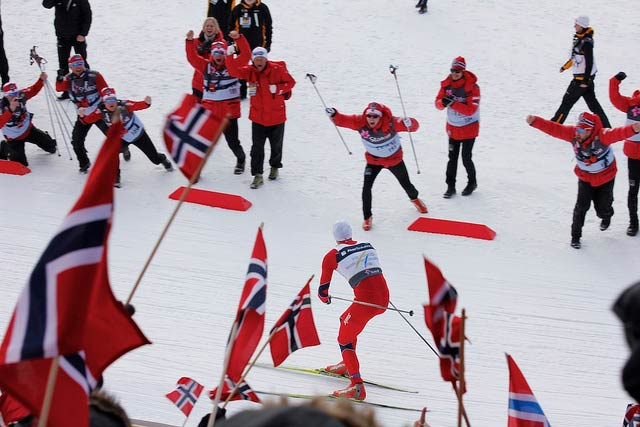
Norway consistently wins the most medals at the Winter Olympic Games, with a population of just 5.6 million people.
A big part of their success is how they treat youth sports—and it’s the opposite of what we do in the US. Here’s what we can learn from Norway:
1. Scorekeeping:
In the US: Youth sports tend to be hyper competitive even at early ages. Leagues almost always keep score.
In Norway: Scorekeeping isn’t even allowed until age 13.
Removing winners and losers keeps the focus on the process not outcomes. It keeps kids engaged longer because it minimizes pressure (and tears) and maximizes fun, learning, and growth. The goal isn’t to win a third grade championship. It’s to love sport and keep playing.
2. Trophies:
In the US: If you give everyone a trophy, you’re creating snowflakes who will never gain a competitive edge.
In Norway: Whenever trophies are awarded, they are handed out to everyone.
If getting a trophy makes young kids feel good, we should give them trophies. Maybe they’ll come back and play again next year!!
As for the creation of snowflakes with no competitive edge—Norway’s athletes are tough as nails and all they do is win.
3. Prioritizing Fun:
In the US: Far too often, the goal is to win.
In Norway: The national philosophy is “joy of sport.”
Youth sports in the US are driven by adults, ego, and money. Youth sports in Norway are driven by fun.
Only half of kids in the US participate in sports. The number one reason they drop out: because they aren’t having fun anymore. In Norway, 93% of kids participate in youth sports. Fun is the foremost goal.
4. Playing Multiple Sports:
In the US: There’s pressure to specialize early and play your best sport year round.
In Norway: Try as many sports as you can before specializing as late as college.
Norway encourages kids to try all types of sport. This reduces injury and burnout and increases all-around athleticism. It also helps promotes match quality, or finding the sport you are best suited for as your body develops, which is impossible if you commit to a single sport too early.
5. Affordability
In the US: There is increasingly a pay-to-play model with high fees for leagues, equipment, and travel. This excludes many kids from playing.
In Norway: It’s a national priority to keep youth sports affordable and therefore accessible for all.
Kids aren’t priced out, which creates opportunities for everyone to participate (and develop into athletes), regardless of their parents’ income level.
We could learn a lot from Norway:
In the US, 70% of kids drop out of youth sports by age 13. This not only diminishes an elite-athlete pipeline, but it also destroys an opportunity for healthy habits and all the character lessons kids can learn from sport.
In Norway, lifelong participation in sport is the norm. The goal isn’t to have the best 9U team. It’s to develop the best athletes. Those are two very different things. And Norway has the gold medals to prove it.
all sauces / dips should be included with your meal at restaurants for free.
sick of paying £1.50 / £2 for a single serving of dip, gotta be the biggest con going
Most common living arrangement for young men used to be with a spouse, now it’s with their parents
If you care about the birth rate so much you could do worse than increasing their disposable income by 9%
@MiguelDelaney Interesting stuff. Would love a Libero (or any other podcast for that matter) pod about the topic. Is that in the cards at all, @MiguelDelaney ?
@JarlWaage Den eneste grunnen til at han får jobbtilbud på over millionen er at han "er" politiker. På mange måter er Stortinget hans versjon av utdanning. Bare at han får over en million i året mens de fleste andre kommer i gjeld etter utdanning.
@hyllnd Argh. That's annoying. Can't do tomorrow unfortunately.
You need to get a Clapton game in next time.
Meant to tell you, we've got your book in our library now as well
@TheFMEditor85 If you could add Clapton CFC that would save my Christmas. Full squad can be found here: https://t.co/acWRC2Cn08
Don't know how to work the editor, but happy to help in any way possible
The same Emily Austin DAZN still employs and and even put to present the FIFA Club World Cup final.
Not surprising when you remember DAZN is owned by Len Blavatnik, one of the world’s biggest pro-Israel donors. Its CEO, Shay Segev, is Israeli and a former military officer.
Here’s a cartoon I did about the far-right weaponisation of vawg. If you’d like to share it with someone who’s not on Twitter, there’s a shareable PDF link at the bottom of this thread. Thank you!
Read about the fight to save the pub and why it is so important to keep community assets here, by @H_Galliven1 in @myldn: https://t.co/DmM7lkDJIY featuring some of our Jola and some of our superb locals
@ped1980@NorskTippingAS@NorLigafotball@nff_info It's been a few years since I saw Norwegian football. And I saw more div 4.
They really should be better than step 5/6 because they all train 3-4 times a week.
But on the other hand I don't think any of them are getting paid much
@ped1980@NorskTippingAS@NorLigafotball@nff_info Yeah I find it really hard to compare the two. I've watched Norwegian div 3 and 4 (Agder and Rogaland) for years and I don't know if they are better than the step 5 and 6 teams I watch in London.
Would love to see a match up one day