$BRCHF / $BRN.AX.
The biggest AI bottleneck is no longer just chips.
It’s energy.
The market is still pricing AI like the answer is simply more GPUs, more data centers, more cooling, more grid capacity, more gas, more nuclear, more everything.
But that is exactly the problem.
AI power demand is already stressing the grid, and the macro backdrop makes it worse: expensive energy, geopolitical oil shocks, infrastructure delays, and hyperscalers fighting for reliable electricity.
That’s why I’m watching neuromorphic / memory-centric computing.
$INTC is already working on this with Loihi / Hala Point.
$IBM is attacking the same problem with NorthPole.
These are not penny-stock stories. They are signals that the memory/energy bottleneck is real, and that the next phase of AI may require architectural efficiency, not just brute-force scaling.
That brings me to BrainChip $BRCHF / $BRN.AX.
BrainChip is still highly speculative. It has diluted shareholders before, revenue is small, and execution risk is obvious. This is not a proven compounder yet.
But Akida is interesting because it targets ultra-low-power Edge AI through spiking neural networks, event-based processing, on-chip learning, and patented neuromorphic IP.
The question is simple:
If AI energy demand becomes the next crisis, do companies that reduce compute waste become more valuable?
Intel and IBM are already in the race.
BrainChip is the penny-stock/high-risk version of the same architectural bet.
Not calling it a winner.
Calling it a name worth researching before the market fully prices the energy bottleneck. @BrainChip_inc
@leopoldasch@elonmusk
Leopold, your Situational Awareness framework correctly focuses on the real bottlenecks behind AGI: compute, power, data centers, infrastructure buildout, and the ability to scale intelligence fast enough.
One company I think deserves a serious look through that same bottleneck lens is BrainChip.
Not because it replaces NVIDIA, AMD, or the trillion-dollar cluster story. It does not. But because after frontier models are trained, the next constraint becomes deployment: how do you push intelligence into the physical world — robots, drones, vehicles, cameras, industrial sensors, satellites, defense systems, wearables, and autonomous devices — without sending everything back to the cloud and without burning data-center-level power at the edge?
That is a different bottleneck: joules-per-inference, latency, thermal limits, privacy, sensor bandwidth, and always-on autonomy.
BrainChip’s Akida is built for that layer. Neuromorphic, event-based inference closer to the sensor, designed for ultra-low-power edge AI, with on-chip learning/adaptation capabilities. In a world where intelligence moves from centralized training clusters into billions of physical endpoints, this becomes strategically important.
The question is not: “Can BrainChip replace GPUs?”
The better question is: “What silicon handles the billions of small, continuous, always-on AI decisions that GPUs are too power-hungry, too hot, or too expensive to handle locally?”
That is where BrainChip could matter.
If AGI creates massive demand for centralized compute, it should also create massive demand for efficient edge inference. The cluster builds the intelligence. The edge deploys it into reality. BrainChip is one of the few public companies directly positioned around that second bottleneck.
Worth a serious look, especially if the next phase of AI is not only bigger models, but intelligence everywhere.
@leopoldasch
Leopold, your Situational Awareness framework correctly focuses on the real bottlenecks behind AGI: compute, power, data centers, infrastructure buildout, and the ability to scale intelligence fast enough.
One company I think deserves a serious look through that same bottleneck lens is BrainChip.
Not because it replaces NVIDIA, AMD, or the trillion-dollar cluster story. It does not. But because after frontier models are trained, the next constraint becomes deployment: how do you push intelligence into the physical world — robots, drones, vehicles, cameras, industrial sensors, satellites, defense systems, wearables, and autonomous devices — without sending everything back to the cloud and without burning data-center-level power at the edge?
That is a different bottleneck: joules-per-inference, latency, thermal limits, privacy, sensor bandwidth, and always-on autonomy.
BrainChip’s Akida is built for that layer. Neuromorphic, event-based inference closer to the sensor, designed for ultra-low-power edge AI, with on-chip learning/adaptation capabilities. In a world where intelligence moves from centralized training clusters into billions of physical endpoints, this becomes strategically important.
The question is not: “Can BrainChip replace GPUs?”
The better question is: “What silicon handles the billions of small, continuous, always-on AI decisions that GPUs are too power-hungry, too hot, or too expensive to handle locally?”
That is where BrainChip could matter.
If AGI creates massive demand for centralized compute, it should also create massive demand for efficient edge inference. The cluster builds the intelligence. The edge deploys it into reality. BrainChip is one of the few public companies directly positioned around that second bottleneck.
Worth a serious look, especially if the next phase of AI is not only bigger models, but intelligence everywhere.
Great framework. I would add one more important layer inside the edge compute bottleneck: ultra-low-power neuromorphic inference. As AI moves from data centers into robots, vehicles, cameras, sensors, industrial systems and physical devices, the constraint will not only be CPU/GPU availability. It will also be power, heat, latency and privacy at the device level.
That is where BrainChip’s Akida becomes very interesting. It is not trying to replace NVIDIA or AMD; it can complement them by offloading always-on perception, sensor fusion and anomaly detection workloads with much lower power consumption. If AI is going everywhere, efficient edge AI silicon becomes a bottleneck too. BrainChip could be one of the companies positioned for that next layer. @StockSavvyShay@BrainChip_inc
Setup alert on $NVDA! 🚨 As shown in the 30m chart, the price has reached a massive decision zone around $200.
📈 Bull Case: Triple Bottom confirmation ("Bottom 3") eyeing the $230 target.
📉 Bear Case: Losing support validates the Rising Wedge breakdown toward the $190 zone.
Make-or-break moment for the next few days. Keep your eyes on the trigger!
📈📉 #NVDA #Trading #PriceAction $SPY $QQQ
Taco 🌮 Tuesday or :
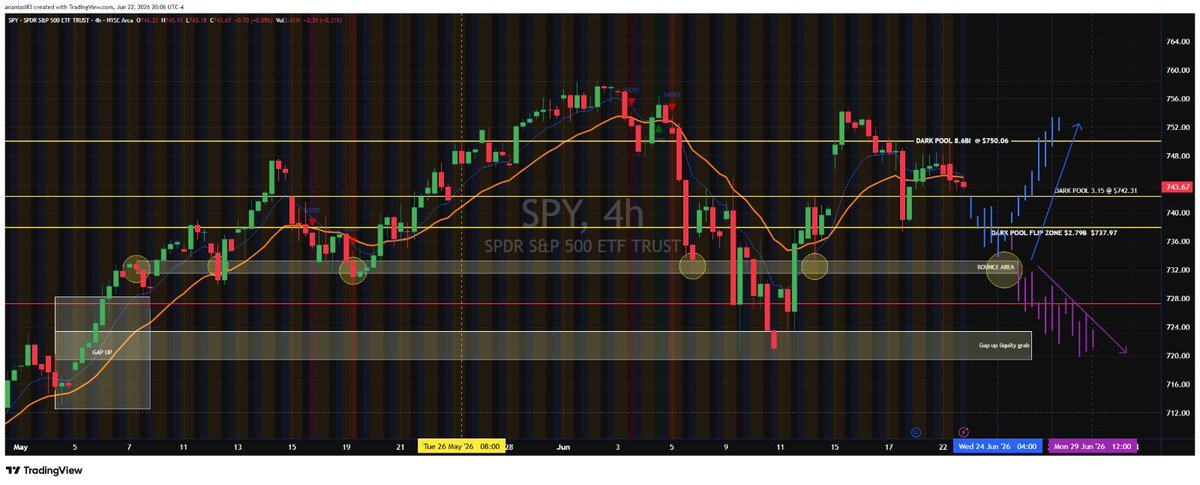
$SPY weekly roadmap:
Watching the 750 resistance / dark pool zone closely. As long as SPY stays below it, I’m looking for a possible pullback into the 738–732 bounce area.
A break below 738 could open the door toward the 720–724 gap
Reclaim 750, and the bearish setup gets invalidated.
Patience. Levels first. #SPY #SPX
BrainChip just expanded beyond vision AI into real-time RF Signal Intelligence. AKD1500-powered Akida platform delivers on-device classification of 20+ RF modulation types at sub-watt power, targeting drones, ISR, SIGINT & satellite communications. $BRCHF
https://t.co/nPietXXC7r
Taco 🌮 Tuesday or :
$SPY weekly roadmap:
Watching the 750 resistance / dark pool zone closely. As long as SPY stays below it, I’m looking for a possible pullback into the 738–732 bounce area.
A break below 738 could open the door toward the 720–724 gap
Reclaim 750, and the bearish setup gets invalidated.
Patience. Levels first. #SPY #SPX
Taco 🌮 Tuesday or :
$SPY weekly roadmap:
Watching the 750 resistance / dark pool zone closely. As long as SPY stays below it, I’m looking for a possible pullback into the 738–732 bounce area.
A break below 738 could open the door toward the 720–724 gap
Reclaim 750, and the bearish setup gets invalidated.
Patience. Levels first. #SPY #SPX
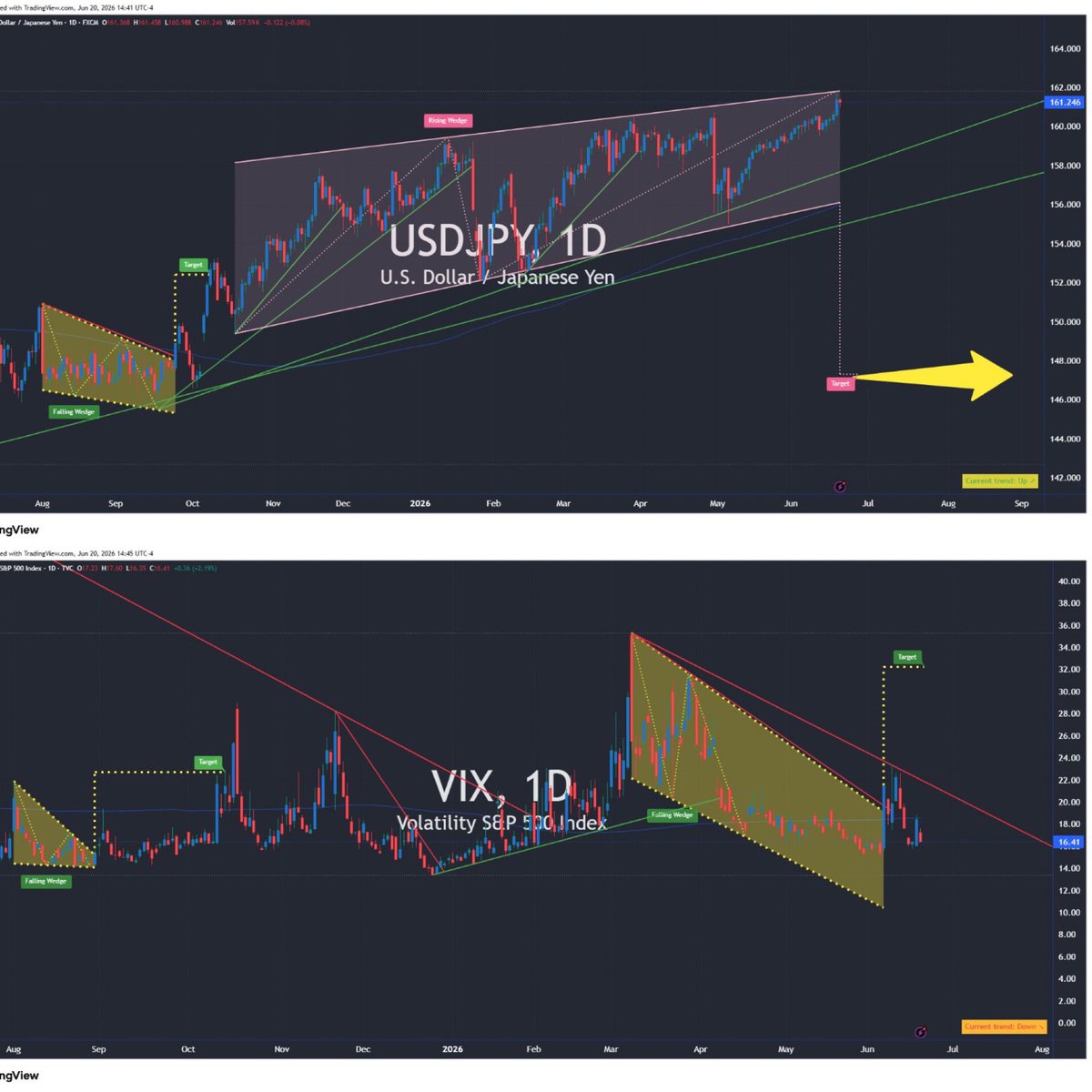
🇯🇵 USD/JPY: Sitting inside a daily rising wedge near 161. A breakdown to 147 signals rapid JPY strength and a potential carry trade unwind.
But a falling USD/JPY alone isn't a $SPY short signal—it could just be a controlled yield repricing. The true key is Volatility.
📉 VIX: Currently ~16 and trending down. No market panic yet.
🚨 The Risk-Off Trigger: We need confluence. A USD/JPY breakdown + VIX reclaiming 18/20/22. If JPY surges AND vol spikes, that’s the exact confirmation needed to expect heavy pressure on equities. Until then, we wait.
$USDJPY $VIX $SPY $MACRO #Trading
@vandy_trades
I wanted this market to keep pushing higher, but this setup is hard to ignore.
the 30-min rising wedge pointing toward ~$715, while the larger 30m / 1h / 2h / 4h double-top structure was pointing closer to ~$680.
Now the interesting part: ~$680 on $SPY sits right underneath the JPM collar call strike area.
Coincidence? Maybe.
But when a technical target lines up with a major options structure into quarter-end, that’s a level I’m watching closely.
Not calling for a crash — just respecting the confluence.