Meta's recent investment in CRED, coupled with Kunal Shah's move into a leadership role at WhatsApp, got me thinking.
What exactly is Meta acquiring through this investment?
If the objective had been purely financial, an investment would have been sufficient.
If leadership hiring had been the primary consideration, a conventional executive hiring approach could have achieved that.
The fact that both happened together suggests a broader strategic alignment.
What I find particularly interesting is that the move has been linked to Meta's ambitions around payments and financial services.
CRED is not known for a breakthrough technology. What it has built, however, is a strong relationship with a highly engaged customer segment and a deep understanding of their financial behaviour.
That raises an interesting question.
In today's digital economy, what creates the greatest strategic advantage: technology, customer access, talent, or capital? Perhaps the answer lies not in any one of those factors individually, but in the ability to align several of them at the same time.
What is your take on it?
#BusinessStrategy #Meta #KunalShah
Following my recent recommendation of 'Learning Domain-Driven Design' by Vlad Khononov, a couple of you suggested that I start a similar book-recommendation series focused on personal growth, life skills, and realistic success.
I liked the idea.
So, going forward, I'll be sharing two book recommendations each week, a few days apart—one focused on technology, business, and leadership, and another focused on personal growth, life skills, and realistic success.
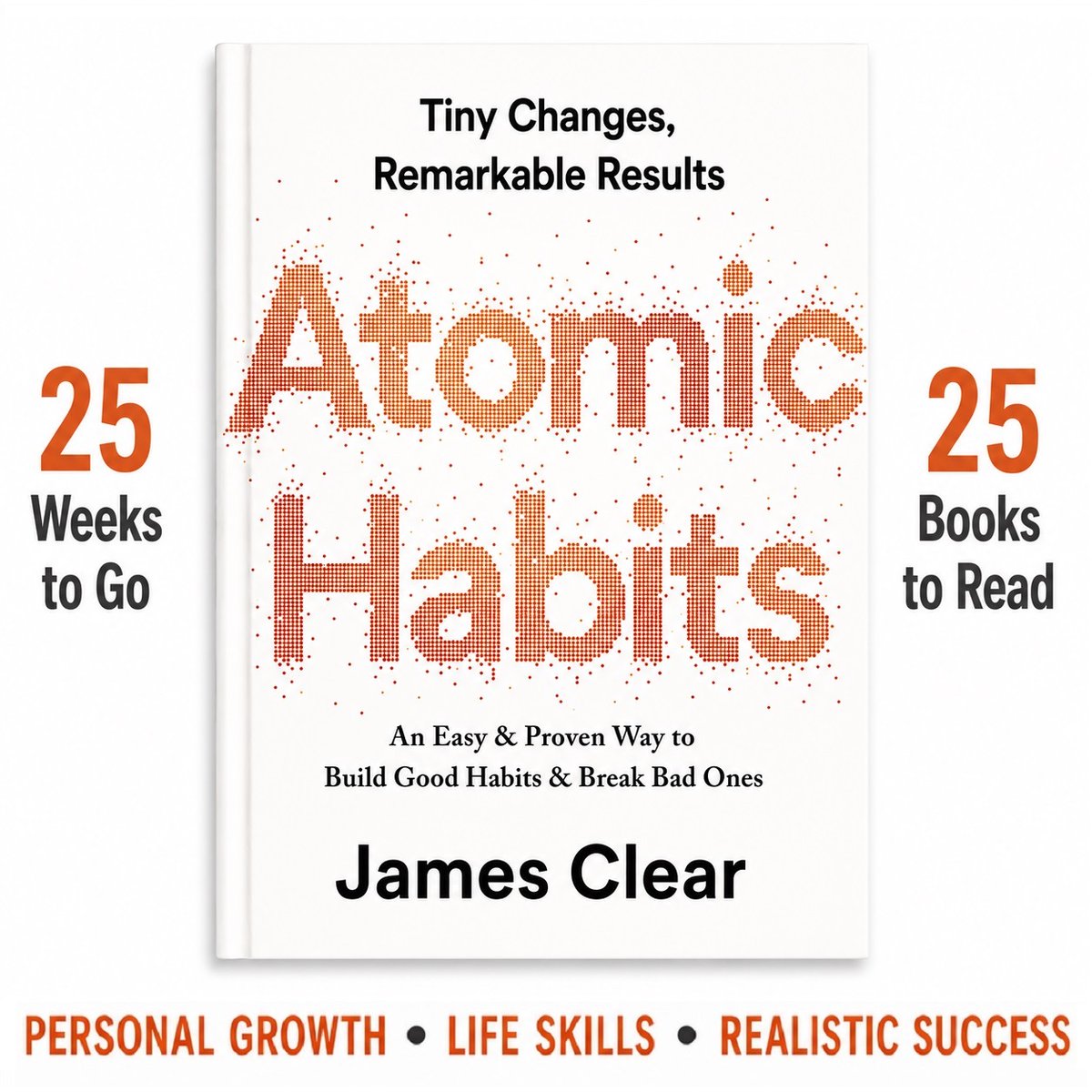
Having already shared the first recommendation from the professional track, here's the first one from the personal-growth space.
📚 Atomic Habits by @JamesClear (Book 1 of 25)
Few books in recent years have influenced the personal-growth conversation as much as Atomic Habits. Its central idea is simple: meaningful change rarely comes from dramatic breakthroughs; it comes from small improvements repeated consistently over time.
Rather than relying on motivation alone, James Clear focuses on systems, environment design, and habit formation. The book offers a practical framework for making steady progress through small, sustainable changes in personal or professional life.
#Books #Readers #PersonalGrowth
With roughly 25 weeks to go in the year, I thought this might be a good time to share 25 books in AI, technology, business, and leadership that I believe are worth reading.
Starting today, I'll try to post one book recommendation each week. Every book in this series is either one that I have personally read and found valuable, or one that is on my reading list because of the perspective and insights it promises to offer.
Learning Domain-Driven Design by @vladikk (Book 1 of 25)
Most technology books focus on code, frameworks, or architecture. This one starts with a different question: how do we ensure that software reflects the realities of the business it is meant to serve?
Drawing on Domain-Driven Design principles, Vlad Khononov explores how technology teams can align software architecture with business strategy, helping build systems that are easier to understand, evolve, and maintain.
A particularly useful read for architects, engineering leaders, product teams, and anyone involved in translating business needs into software solutions.
#Books #ReadersCommunity #Technology
There will be no AI jobpocalypse.
The story that AI will lead to massive unemployment is stoking unnecessary fear. AI — like any other technology — does affect jobs, but telling overblown stories of large-scale unemployment is irresponsible and damaging. Let’s put a stop to it.
I’ve expressed skepticism about the jobpocalypse in previous posts. I’m glad to see that the popular press is now pushing back on this narrative. The image below features some recent headlines.
Software engineering is the sector most affected by AI tools, as coding agents race ahead. Yet hiring of software engineers remains strong! So while there are examples of AI taking away jobs, the trends strongly suggest the net job creation is vastly greater than the job destruction — just like earlier waves of technology. Further, despite all the exciting progress in AI, the U.S. unemployment rate remains a healthy 4.3%.
Why is the AI jobpocalypse narrative so popular? For one thing, frontier AI labs have a strong incentive to tell stories that make AI technology sound more powerful. At their most extreme, they promote science-fiction scenarios of AI “taking over” and causing human extinction. If a technology can replace many employees, surely that technology must be very valuable!
Also, a lot of SaaS software companies charge around $100-$1000 per user/year. But if an AI company can replace an employee who makes $100,000 — or make them 50% more productive — then charging even $10,000 starts to look reasonable. By anchoring not to typical SaaS prices but to salaries of employees, AI companies can charge a lot more.
Additionally, businesses have a strong incentive to talk about layoffs as if they were caused by AI. After all, talking about how they’re using AI to be far more productive with fewer staff makes them look smart. This is a better message than admitting they overhired during the pandemic when capital was abundant due to low interest rates and a massive government financial stimulus.
To be clear, I recognize that AI is causing a lot of people’s work to change. This is hard. This is stressful. (And to some, it can be fun.) I empathize with everyone affected. At the same time, this is very different from predicting a collapse of the job market.
Societies are capable of telling themselves stories for years that have little basis in reality and lead to poor society-wide decision making. For example, fears over nuclear plant safety led to under-investment in nuclear power. Fears of the “population bomb” in the 1960s led countries to implement harsh policies to reduce their populations. And worries about dietary fat led governments to promote unhealthy high-sugar diets for decades.
Now that mainstream media is openly skeptical about the jobpocalypse, I hope these stories will start to lose their teeth (much like fears of AI-driven human extinction have).
Contrary to the predictions of an AI jobpocalypse, I predict the opposite: There will be an AI jobapalooza! AI will lead to a lot more good AI engineering jobs, and I’m also optimistic about the future of the overall job market. What AI engineers do will be different from traditional software engineering, and many of these jobs will be in businesses other than traditional large employers of developers. In non-AI roles, too, the skills needed will change because of AI. That makes this a good time to encourage more people to become proficient in AI, and make sure they’re ready for the different but plentiful jobs of the future!
[Original text in The Batch newsletter.]
How we prompt AI is very different in 2026 than 2022 when ChatGPT came out.
I'm teaching a new course, AI Prompting for Everyone, to help you become an AI power user — whatever your current skill level.
It covers skills that apply across ChatGPT, Gemini, Claude, and other AI tools. How to use deep research mode for well-researched reports on complex questions. How to give AI the right context, including more documents and images than most people realize you can provide. When to ask AI to think hard for several minutes on important decisions like what car to buy, what to study, or what job to take. And how to use AI to generate images, analyze data, and build simple games and websites.
I also cover intuitions about how these models work under the hood, so you know when to trust an answer and when not to.
Along the way, you'll see flying squirrels, a creativity test, some of my old family photos, and fireworks.
Join me at https://t.co/tcQc4iJAJG
If we, as working professionals, want to survive and possibly grow through the AI era, we need a significant perspective change.
Try thinking of the AI-pivoting workplace as a corporate jungle that we've been involuntarily exposed to, and the only way out is navigating through it. There are many known (job losses, hampered growth, etc.) and unknown threats out there that we won't be able to deal with using only our existing skills or a passive attitude of letting the situation sort itself out.
Given that we don't have a choice but to wade through it, we need to start off with understanding the surroundings (AI won't affect everyone in the same way — it will vary by role, industry, and how much of the work is routine vs judgment-driven), do an honest SWOT for ourselves, build on our strengths, address our weaknesses, pick up new skills, and who knows — by the time we're through this, we may not only survive but also discover new opportunities.
Remember, no one is coming for the rescue because the ones with rescue teams and choppers are busy multiplying their billions or making the first one. That said, responses will emerge at organisational and ecosystem levels too — just not uniformly or quickly enough to rely on.
At the same time, we should also remember that we humans have faced such shifts many times before — from industrialisation to the internet era — and have, more or less, not only survived them but evolved through them as well.
#FutureOfWork #AIAtWork #Career
It has been two weeks since @RonanFarrow/@NewYorker's exposé, but we haven't seen the proportionate public response that such a revealing, deep-dive report deserved.
Is it due to the success of OpenAI’s PR machinery, general indifference, or something else? 🤔
When Sam Altman was reinstated at OpenAI after an outside law firm investigation, no report about what was found was ever released. That’s because none was written.
More in my full @NewYorker investigation: https://t.co/HEPHN4E54P
The harder the push from founders and CXOs to focus on creatively reimagined financial parameters rather than established metrics like revenue and profit, the closer we are to the bursting of an ongoing business bubble.
The sooner this happens in AI la-la land, the easier and better it will be for sustainable, and larger-impact AI use cases to emerge.
What happened at Sam Altman's home and at the OpenAI office are unfortunate and totally deplorable incidents. Having said that, it shouldn't allow the narrative to shift away from @RonanFarrow and @andrewmarantz's exposé in The New Yorker.
Team New Yorker (@RonanFarrow & @andrewmarantz) did the heavy lifting; now it’s on OpenAI board, the VCs holding the purse strings, and govt watchdogs to step up.
The reporting on OpenAI and Sam Altman that I've been working on for the past year and a half, for @NewYorker, with @andrewmarantz: https://t.co/HEPHN4E54P
People who can’t predict the next moment of their own lives are busy declaring the end of technologies, products, and companies that have survived, and evolved through, multiple disruption cycles. Hmm...🤔
Charles Bukowski▪️What Matters Most is How Well You Walk Through the Fire 👇
“If you're going to try, go all the way. Otherwise, don't even start. This could mean losing girlfriends, wives, relatives and maybe even your mind. It could mean not eating for three or four days. It could mean freezing on a park bench. It could mean jail. It could mean derision. It could mean mockery--isolation. Isolation is the gift. All the others are a test of your endurance, of how much you really want to do it. And, you'll do it, despite rejection and the worst odds. And it will be better than anything else you can imagine. If you're going to try, go all the way. There is no other feeling like that. You will be alone with the gods, and the nights will flame with fire. You will ride life straight to perfect laughter. It's the only good fight there is.”
#WritingCommmunity #WritersLife
It’s easy to create binary, black-or-white characters, except for the singular truth that we humans are rarely that in real life.
What about creating real-life-adjacent characters, then? For example, Abbas Khan in #HAQ or Kanhaiya Lal in #SANKALP — characters with conflicted morality, subdued but still-there humanity, and a willingness to cross the shifting lines of fairness and justice?
That requires a writer to have not only a deep hold on the writing craft but also an empathetic understanding of the world around us.
Only then can a writer imagine and create a character like Abbas Khan, who goes from being a loving husband and caring father to a religiously driven lawyer and indifferent husband/father, to finally gracefully accepting his legal reality as well as his somewhere-lost feelings for his ex-wife.
We’ve so much more to look forward to from @ReshuNath 👏✨
Today is #WorldAutismAwarenessDay.
We still have a long way to go in terms of creating global awareness, effective localised support systems, and lasting empathy.
Remember — autistic people are simply different, not deficient.
#Neurodiversity#InclusionMatters
There’s a quiet myth around writing that great work emerges only at the extremes: either from a regimented routine or a near-chaotic lifestyle.
For example, while Haruki Murakami prefers to wake up at 4 a.m., write for hours, run, read, and sleep early—repeating the same rhythm every day for months (a kind of mesmerism, as he calls it)—Jean-Paul Sartre wrote through exhaustion, fuelled by stimulants, alcohol, and very little sleep.
It’s worth noting, though, that such extremes are the exception, not the norm, because most good writing gets done somewhere in the middle.
#WritingCommunity #WritersLife






![AndrewYNg's tweet photo. There will be no AI jobpocalypse.
The story that AI will lead to massive unemployment is stoking unnecessary fear. AI — like any other technology — does affect jobs, but telling overblown stories of large-scale unemployment is irresponsible and damaging. Let’s put a stop to it.
I’ve expressed skepticism about the jobpocalypse in previous posts. I’m glad to see that the popular press is now pushing back on this narrative. The image below features some recent headlines.
Software engineering is the sector most affected by AI tools, as coding agents race ahead. Yet hiring of software engineers remains strong! So while there are examples of AI taking away jobs, the trends strongly suggest the net job creation is vastly greater than the job destruction — just like earlier waves of technology. Further, despite all the exciting progress in AI, the U.S. unemployment rate remains a healthy 4.3%.
Why is the AI jobpocalypse narrative so popular? For one thing, frontier AI labs have a strong incentive to tell stories that make AI technology sound more powerful. At their most extreme, they promote science-fiction scenarios of AI “taking over” and causing human extinction. If a technology can replace many employees, surely that technology must be very valuable!
Also, a lot of SaaS software companies charge around $100-$1000 per user/year. But if an AI company can replace an employee who makes $100,000 — or make them 50% more productive — then charging even $10,000 starts to look reasonable. By anchoring not to typical SaaS prices but to salaries of employees, AI companies can charge a lot more.
Additionally, businesses have a strong incentive to talk about layoffs as if they were caused by AI. After all, talking about how they’re using AI to be far more productive with fewer staff makes them look smart. This is a better message than admitting they overhired during the pandemic when capital was abundant due to low interest rates and a massive government financial stimulus.
To be clear, I recognize that AI is causing a lot of people’s work to change. This is hard. This is stressful. (And to some, it can be fun.) I empathize with everyone affected. At the same time, this is very different from predicting a collapse of the job market.
Societies are capable of telling themselves stories for years that have little basis in reality and lead to poor society-wide decision making. For example, fears over nuclear plant safety led to under-investment in nuclear power. Fears of the “population bomb” in the 1960s led countries to implement harsh policies to reduce their populations. And worries about dietary fat led governments to promote unhealthy high-sugar diets for decades.
Now that mainstream media is openly skeptical about the jobpocalypse, I hope these stories will start to lose their teeth (much like fears of AI-driven human extinction have).
Contrary to the predictions of an AI jobpocalypse, I predict the opposite: There will be an AI jobapalooza! AI will lead to a lot more good AI engineering jobs, and I’m also optimistic about the future of the overall job market. What AI engineers do will be different from traditional software engineering, and many of these jobs will be in businesses other than traditional large employers of developers. In non-AI roles, too, the skills needed will change because of AI. That makes this a good time to encourage more people to become proficient in AI, and make sure they’re ready for the different but plentiful jobs of the future!
[Original text in The Batch newsletter.]](https://pbs.twimg.com/media/HIIb1VGaUAAZoAB.jpg)





