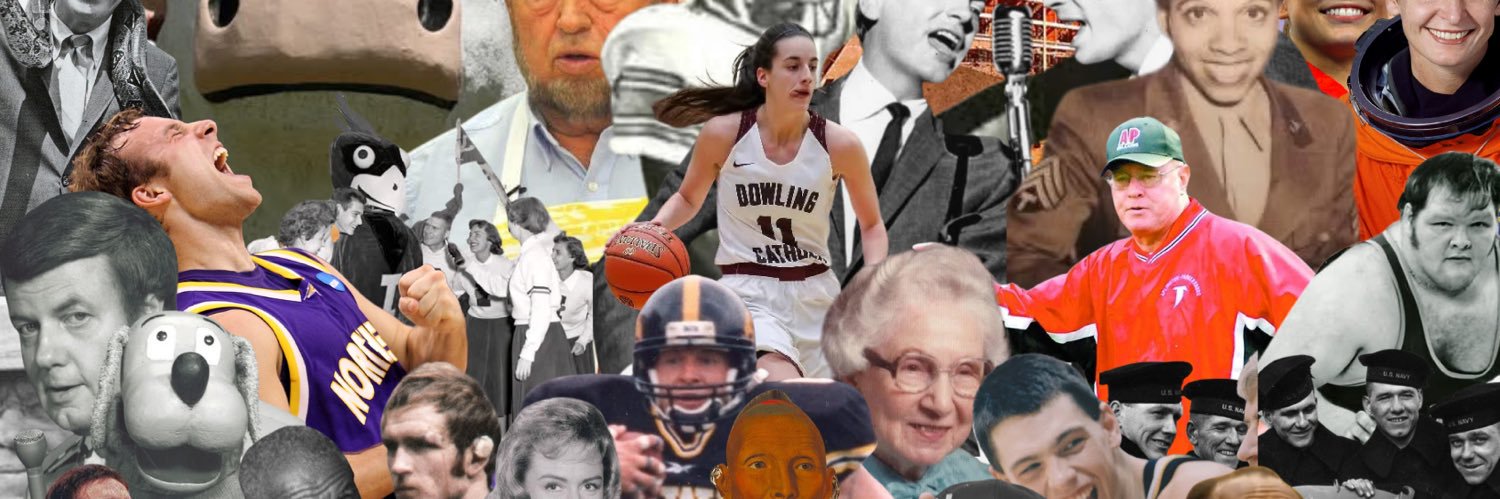
Iowa Time Machine ⏰: On June 4, 1935, Gary “The Roland Rocket” Thompson was born. A legendary scorer who once held the Iowa high school and Iowa State total points titles, Thompson stood small in stature but tall on the court.
Born in Story County, Thompson first gained the attention of Iowans as a 5’6” sophomore, leading the Roland Rockets to the title game of the 1951 Iowa high school basketball tournament. For three years, Thompson led his team to the tournament while racking up an incredible (and state-record-setting) 2,042 points.
After high school, “The Roland Rocket” landed in Ames, where he quickly became a star for the Cyclones in basketball and baseball. During his three years at Iowa State, Thompson continued to score, setting the program's high-water mark with 1,253 points. The most notable night of Thompson’s career came during his senior season, when the Cyclones played host to Wilt Chamberlain’s Kansas Jayhawks in the Ames Armory in 1957. With the Jayhawks riding a twelve-game winning streak, the Cyclones knew a win would take everyone. With the score tied 37-37 as time wound down, Kansas keyed on “The Roland Rocket” while leaving Don Medsker open to hit the game-winner. Although Thompson didn’t take the winning shot, the small man from Story County slayed the proverbial Goliath in scoring, 18-17.
Thompson, Iowa’s first-ever 1,000-point high school scorer, became Iowa State’s first 1st Team All-American in basketball. Following a brief career with the Phillips 66s of the Amateur Athletic Union, Thompson continued to entertain Iowa hoops fans as a broadcaster for decades. #Iowa #OTD #History #Basketball #Baseball
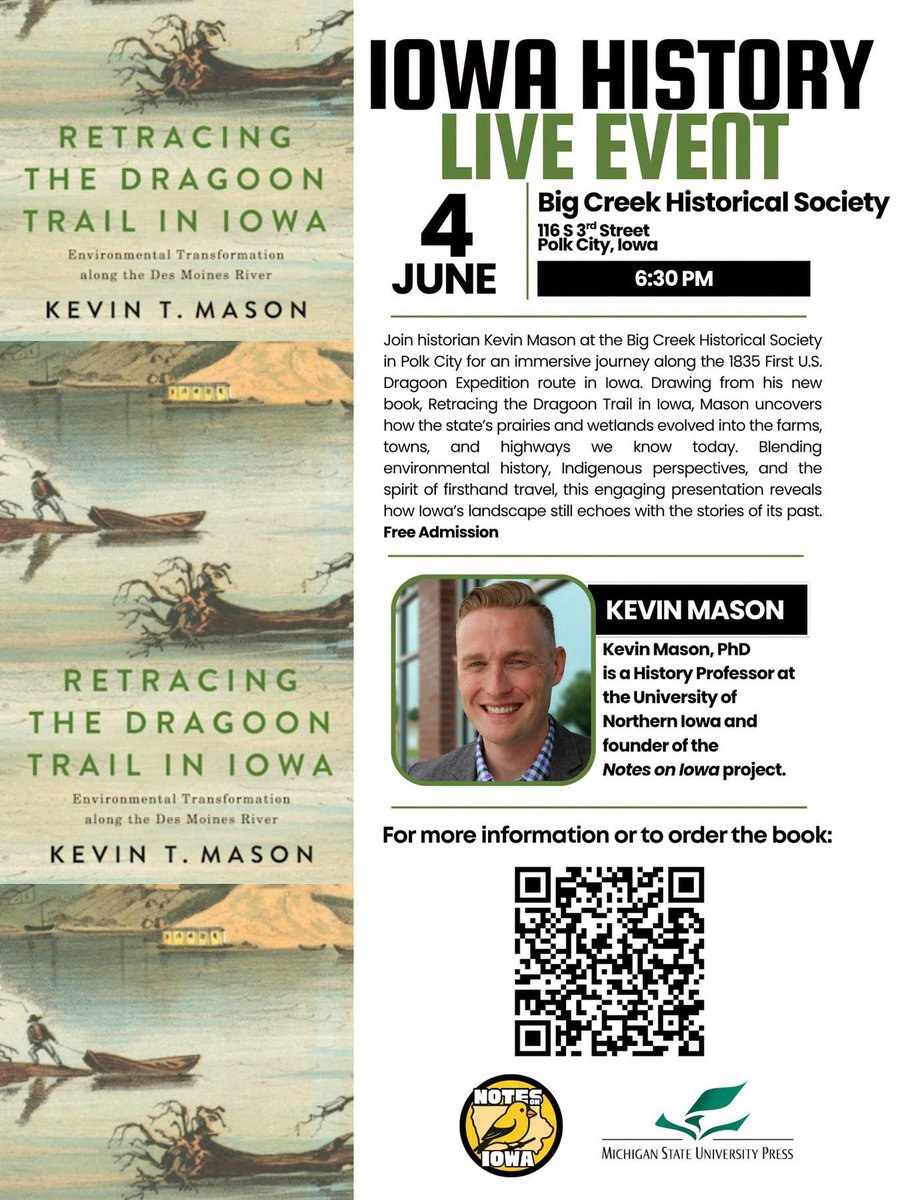
Today’s the day for an Iowa history event at the Big Creek Historical Society: Kevin Mason will be discussing his new book Retracing the Dragoon Trail (Big Creek - Polk City)!
📍116 S 3rd Street - Polk City, Iowa
🗓️ Today, June 4
🕓 6:30 PM
🎟️ Free Admission
Don’t miss this chance to celebrate a new book on Iowa’s past!
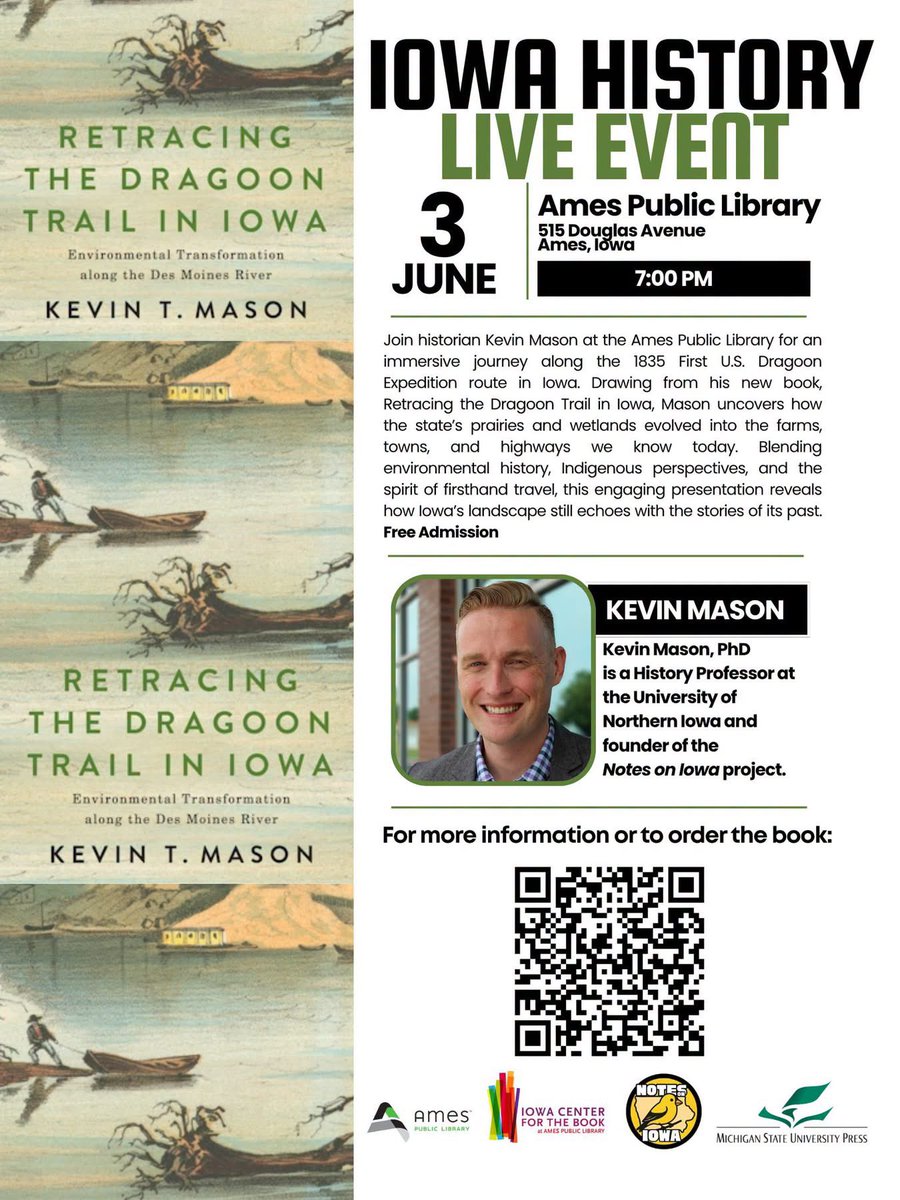
Today’s the day for an Iowa history event at the Ames Public Library: Kevin Mason will be discussing his new book Retracing the Dragoon Trail!
📍515 Douglas Ave - Ames, Iowa
🗓️ Today, June 3
🕓 7:00 PM
🎟️ Free Admission
Don’t miss this chance to celebrate a new book on Iowa’s past!
Iowa Time Machine ⏰: On June 2, 1948, actor Jerry Mathers was born in Sioux City. Best known as Theodore ‘Beaver’ Cleaver on the iconic American sitcom “Leave It to Beaver,” Mathers largely left acting for most of his adult life after achieving status as a child star.
The son of standout Sioux City East and Morningside College basketball star Norman Mathers, Jerry entered the world at St. Joseph’s Hospital in Sioux City. The elder Mathers worked as the principal at Rock Rapids at the time of Jerry’s birth. The family moved from Rock Rapids to California when Jerry was just two years old.
Spotted by a talent scout while out shopping with his mother, Marily Bright Mathers, Jerry soon found himself in various ads. Soon, Mathers began appearing in movies, including “This Is My Love” (1954), “Men of the Fighting Lady” (1954), “The Seven Little Foys” (1955), and Alfred Hitchcock's dark comedy “The Trouble with Harry” (1955). Real fame arrived when Mathers took on the role of Bever Cleaver in 1957. The show, first on CBS and later on ABC, struggled to find a timeslot or audience when it originally aired. However, “Leave It to Beaver” caught on in reruns and eventually grew into an American television classic.
Mathers retired from acting to focus on high school before eventually serving in the United States military. After graduating from the University of California, Berkeley, Mathers worked as a commercial loan officer at a bank and eventually worked in real estate development. Later in life, Mathers made a few acting appearances in programs like “Still the Beaver.” #Iowa #OTD #History #TV #Television
Iowa Time Machine ⏰: On June 1, 1903, newspapers in Muscatine reported on a 49.5-grain pearl found by local man Bert Roby. Worth $3,000 (about $113,529 in 2026), the pearl represents the largest found in Iowa along the Mississippi River during the heyday of the Pearl Button era.
John Boepple started a button-making business after emigrating to America in 1887 by harvesting clams from the rich mussel beds near Muscatine on the Mississippi River. Although many locals questioned the sanity of the German button-making enthusiast, the shop flourished throughout the late 1800s.
The success of Boepple’s business inspired the growth of an iconic Iowa industry. By 1897, Muscatine boasted 53 button-cutting shops fed by ‘clammers’ pulling 3,500 tons of shells from the Mississippi River annually. One such man, Bert Roby, conducted one of the small button-making outfits.
In 1903, the twenty-eight-year-old Roby went out clamming near the high bridge of Muscatine. Finding an unusual shell, Roby pried the clam open and found a flawless sphere of pearl. Offered $2,000 the day of the find, Roby held out and got $3,000 from noted pearl dealer Frank Koeckerwitz. #Iowa #OTD #History #Pearl #MississippiRiver
Two great opportunities in Ames and Polk City to get out and explore Iowa history next week!
Find event details at Retracing the Dragoon Trail (Ames) and Retracing the Dragoon Trail (Big Creek - Polk City).
Iowa Time Machine ⏰: On May 27, 1818, Amelia Jenks Bloomer was born. Her name would later be associated with a style of dress that drew ridicule and fascination in equal measure. Yet, her deeper significance lies in her role as a writer, editor, and advocate who helped carry the early women’s rights movement into everyday conversation.
Bloomer’s early work as a teacher and her 1840 marriage to Dexter Bloomer, a newspaper editor, placed her within networks of print culture and reform activism. Her participation in the 1848 Seneca Falls Convention connected her with figures like Elizabeth Cady Stanton and Lucretia Mott, even as her own views remained more cautious than those of some of her contemporaries. In 1849, she founded The Lily, the first newspaper for women edited by a woman. Initially devoted to temperance, the paper evolved into a platform for women’s rights, shaped in part by Stanton’s contributions under a pseudonym.
In 1851, Bloomer used its pages to promote a new style of dress designed by Elizabeth Smith Miller that freed women from heavy skirts and restrictive corsets. The outfit, soon labeled “bloomers,” became a national sensation. Bloomer herself adopted the style after a public challenge and published instructions for readers, helping to spread the reform. While critics mocked the clothing, its symbolism proved powerful, linking bodily freedom with broader claims for social and political rights.
Bloomer’s later move to Council Bluffs, Iowa, in 1855 brought her reform efforts into a developing western community where questions of opportunity and equality took on new dimensions. Iowa’s relatively progressive property laws for women and its growing institutions, including the University of Iowa, created openings that Bloomer actively promoted in her writing and lectures. Though her influence within the national women’s rights movement waned after the 1850s, she remained engaged in temperance work and in organizations such as the Iowa Woman Suffrage Association. #Iowa #OTD #History #WomensHistory #Advocacy