Petition to save the mural. We’re also looking for a new wall to host the mural. Please DM leads looking to host it in Providence downtown, but we are also open to Boston. The wall needs to be 45 feet tall at least and 37 feet wide at least.
https://t.co/sHX2clmWr4
@atensnut Good for this kid. Takes an incredible amount of stamina and endurance to do that while the surf is pounding on you like that. Def didn't have the right equipment either, still pulled it off though. Makes it that much more impressive of a grab.
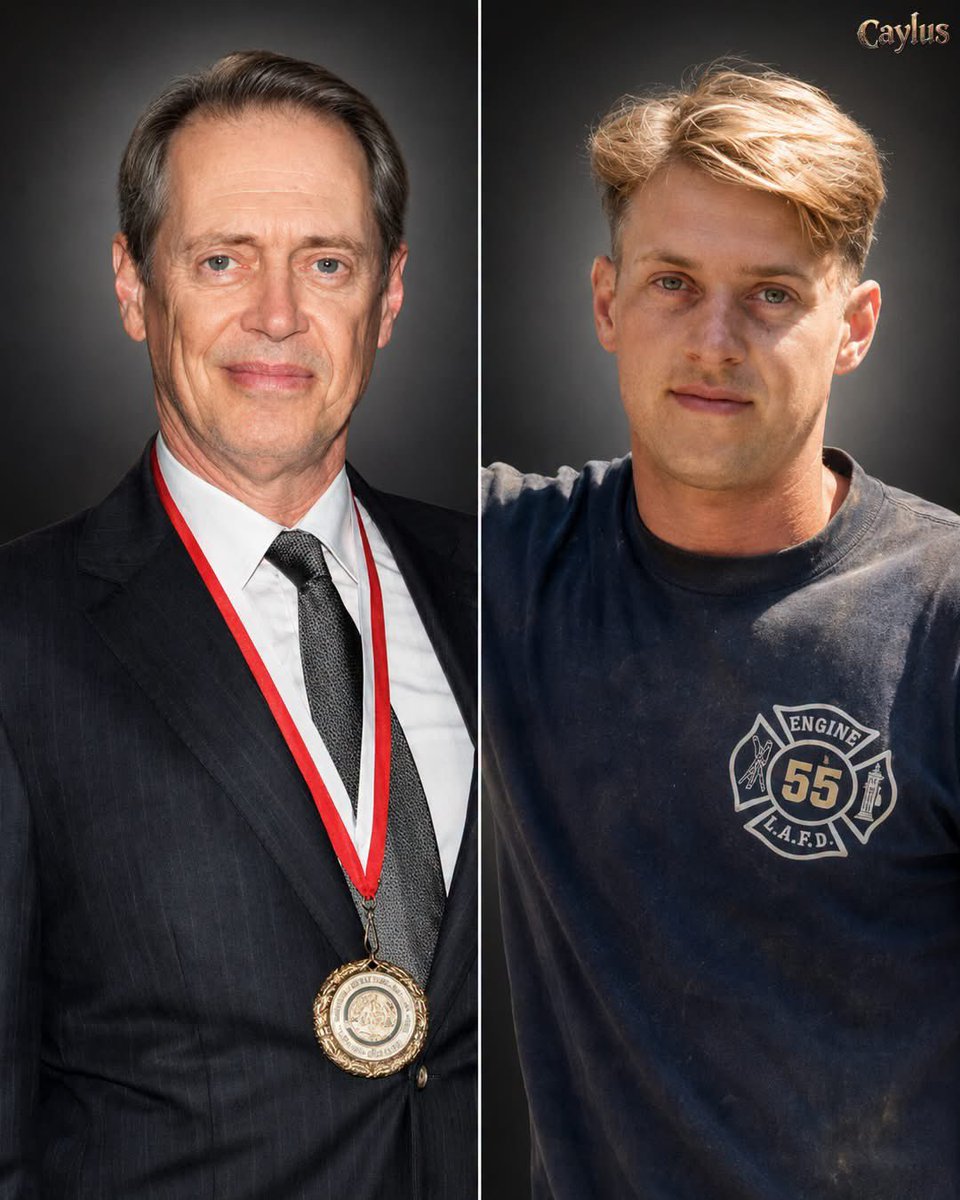
On September 12, 2001, the day after the towers fell, a man in worn firefighter gear shows up at Ground Zero and starts walking.
Smoke still filled the air. Dust covered everything.
He walked through the ruins for hours, passing exhausted rescue crews, searching for one place.
His old firehouse.
The man was Steve Buscemi.
Most people knew him as the unforgettable character actor who played crooks, gangsters, and unsettling outsiders.
Long before Hollywood, he wore a different uniform.
At just eighteen, he took the New York City firefighter exam. In 1980, he joined FDNY Engine Company 55 in Manhattan's Little Italy, spending four years running into burning buildings before leaving to pursue acting.
He never forgot where he came from.
When the Twin Towers were attacked, Buscemi tried calling his old firehouse.
Nobody answered.
He knew exactly why.
Soon came the devastating news. Five firefighters from Engine 55 were missing, including a close friend he had once served beside.
He didn't stay home.
He found his old gear, made his way to Ground Zero, and searched until he found his former company.
At first, they looked at him with surprise.
Then they recognised one of their own.
For five days, Buscemi worked twelve-hour shifts beside them, digging through twisted steel and shattered concrete, searching for survivors and helping recover those who never came home.
It was exhausting.
Heartbreaking.
Necessary.
He refused interviews. He avoided cameras and kept his face covered, wanting the mask to hide more than the dust.
He wasn't there for headlines.
He was there for his brothers.
The public learned what he had done only because a photographer captured a single image, and fellow firefighters later told the story he never intended to share.
The experience stayed with him.
Buscemi has spoken about the post-traumatic stress that followed, admitting the hardest part came after he returned home.
He never called what he did heroic.
"It was a privilege to be able to do it."
On screen, Steve Buscemi often plays the man nobody trusts.
When his city needed him most, he became the man his brothers could.
In January 1991, Norman Schwarzkopf knew the exact number of body bags the Pentagon had ordered in anticipation of the coming ground campaign. He was 56 years old, and he had been handed a responsibility no American commander had carried since the Second World War: more than half a million soldiers from 34 nations, arrayed across the Arabian desert, waiting to be pointed at one of the most battle hardened armies on the planet.
Saddam Husseins forces had spent eight years fighting Iran. They had fortified every approach into Kuwait with mines, trenches, and pre aimed artillery, all built on a single assumption: that when the Americans arrived, they would come straight through the front door.
Schwarzkopf had no intention of using the front door.
He had learned something during two tours in Vietnam that desk generals never quite grasp. He had been decorated three times with the Silver Star for gallantry under direct fire. The most famous of those moments came in May 1970, when he received word that soldiers under his command had stumbled into a minefield. He flew in by helicopter and found the men trapped, with a wounded soldier lying on the ground screaming and a very real danger that the mans panic would cause him to set off another mine. Schwarzkopf crawled across the minefield to the wounded soldier, pinning him down safely so another man could splint his shattered leg.
Believe me, it wasnt a heroic act, he said later. It was something that somebody had to do, and I was the man in charge. Because of experiences like that, he knew, in a way that cannot be taught in a classroom, exactly what he was about to ask his soldiers to do.
For six weeks before a single ground soldier moved, coalition aircraft worked methodically. They struck command centers, severed supply lines, silenced communication networks, and systematically blinded the Iraqi military, all while Iraqi generals watched the Kuwaiti border and waited for the frontal assault they were certain was coming.
It was not coming.
Instead, two hundred thousand soldiers and thousands of armored vehicles moved west, deep into the open desert. They moved at night, in total electronic silence, far away from cameras and away from every position the Iraqi army had spent months preparing to defend. All the while, the Iraqi generals kept their eyes fixed on the coast.
When the ground war finally began on February 24, 1991, coalition forces were already hundreds of miles to the west. They swept through open terrain no one had bothered to defend, drove deep into Iraq, pivoted east, and struck the Republican Guard from behind. Every escape route was already closed.
The ground war lasted just 100 hours. One of the largest armies in the world collapsed in a mere four days of combat. Kuwait was liberated, and coalition casualties were a tiny fraction of the numbers that had been feared.
The Left Hook, Schwarzkopfs famous flanking maneuver, is still studied at war colleges today, and military historians still marvel at its elegance.
Six months later, the offers poured in: Senate seats, presidential conversations, corporate boards, and television contracts. The full machinery of American celebrity was pointed directly at the man who had just won the most precisely executed military campaign in a generation.
Yet, he retired in August 1991, moved to Tampa, Florida, and went fishing. He wrote just one memoir, It Doesnt Take a Hero, published in 1992, and gave a small number of speeches. He did not spend the following decades reminding the world of what he had achieved. He had led, he had brought his people home, and the job was finished.
Norman Schwarzkopf died on December 27, 2012, in Tampa, Florida, at the age of 78, from complications of pneumonia. Veterans mourned him, and military historians wrote long assessments of his career. His ashes were buried at the West Point Cemetery alongside those of his father, another general, also named H. Norman Schwarzkopf, who had famously directed the investigation of the Lindbergh baby kidnapping in the 1930s.
The operational records of Operation Desert Storm are preserved in military archives. His name is on all of them, quietly and permanently, because a record like his doesnt require his presence to stand.
Sen. John Fetterman tells Zohran Mamdani to "fix a pothole," blasting the NYC mayoral candidate for weighing in on foreign policy:
“Now you have the mayor of a city. You’re a mayor, dude. You’re a mayor. You can fix a pothole. You can take out the trash. But you can’t order people to arrest anybody any more than I could. I couldn’t have him arrested if he came to Pennsylvania. It’s a joke, and he’s a clown. He also said that Netanyahu is not welcome in New York. You can’t say that any more than I can say, ‘Mayor, you’re not welcome in Pennsylvania.’ So sit down. I know you’re a clown, and you’re just going to pander to the fringe because that’s part of your base. I know you’re angry at Netanyahu because he killed a lot of people you admire, whether it’s Sinwar, Nasrallah, or Qaani in Iran. He’ll only criticize the prime minister of Israel, but he never criticizes Hamas. He never criticizes Hezbollah or Iran. I’ve never heard the mayor condemn Iran for killing 30,000 or 40,000 of its own young people who were simply asking for democracy in their country.”
He told his students to go to the windows.
Get out. Jump if you have to.
Then Liviu Librescu walked to the classroom door and pressed his body against it.
He was 76 years old. He weighed 140 lbs
The gunman was in the hallway.
It was April 16, 2007. A Monday morning. Solid mechanics class at Virginia Tech, Room 204. Twenty-two students, most of them 19 or 20 years old.
At 9:45 AM, gunshots echoed through Norris Hall. Room by room, the shooter was working his way down the corridor.
Liviu heard it. He understood immediately.
He had survived the Holocaust. He had survived a labor camp. He had spent decades living under Communist oppression. He knew exactly what evil sounded like.
He told his students to escape through the windows. Second floor — it was a drop, but they'd survive. Then he walked to the door and held it shut with his body.
The shooter tried to force it open. It wouldn't move.
He fired through the door. Wood splintered. Bullets came through.
Liviu stayed.
Behind him, students were climbing out the windows. Dropping to the ground. Running. One by one, all twenty-two of them got out.
The shooter kept firing through the door.
Liviu held it shut until every student was safe.
Then the bullets killed him.
When police arrived, they found his body at the door.
All 22 of his students survived. Not one was injured.
Liviu Librescu was born on August 18, 1930, in Ploiești, Romania.
He was Jewish. In 1941, when he was eleven years old, Romanian authorities sent him and his family to a labor camp. His father died there. Liviu survived. When the war ended, he was fifteen.
He went back to school. Studied engineering. Earned a doctorate from the University of Bucharest.
But Communist Romania had no interest in allowing a Jewish intellectual to succeed. He was blocked from academic positions. Passed over for jobs he deserved. He applied to emigrate. The government kept refusing.
Finally, in 1978 when Liviu was 48 years old — Israeli Prime Minister Menachem Begin personally intervened. Romania let him go.
He had spent most of his adult life trapped in a country that didn't want him.
In Israel, he taught at Tel Aviv University. Published over 300 papers. Became an international expert in aeroelasticity — the science of how air flows over aircraft wings.
In 1985, Virginia Tech offered him a position. He moved to Blacksburg, Virginia. He taught there for 22 years. His students loved him — demanding but kind, high standards, genuine care.
He was still teaching full-time at 76. Still publishing research. Still showing up every Monday morning for solid mechanics.
April 16 was the first day of Passover — the Jewish holiday celebrating liberation from slavery and oppression.
Liviu Librescu died on the day his tradition sets aside to celebrate freedom.
He spent his entire life escaping death and oppression by luck, by persistence, by the intervention of others. And on his last morning, he chose to stand at a door so that twenty-two young people could have the future he had fought so hard to reach.
He could have run. He could have hidden. He could have climbed out a window with his students.
He chose to stay.
The Virginia Tech shooting killed 32 people that day — the deadliest school shooting in American history at the time.
Room 204 had zero casualties.
Because a 76-year-old Holocaust survivor held a door with his body until every student behind him was gone.
His funeral was held in Israel. Students from Virginia Tech flew across the ocean to honor him. The Israeli government awarded him the Star of David Medal posthumously. Virginia Tech named a scholarship in his memory.
His son said his father died the way he lived — protecting others.
A man who survived everything evil threw at him for 76 years.
On his last day, he made sure 22 kids survived too.
Professor Liviu Librescu. August 18, 1930 — April 16, 2007.
Holocaust survivor. Labor camp survivor.
302 published papers. 22 years at Virginia Tech.
22 students out the window.
He held the door.
RFK Jr. reveals what HHS found when they went looking for the 375,000 migrant kids Biden lost.
"It's a huge, huge tragedy."
"One guy pretended to be the parent of 42 children. We have no idea what happened to those kids."
"We're now finding them. We found about 137,000 of them, but a lot of them you just can't find. There was about 60 kids who were sent to one address. When we looked at that address, it was a container, a steel container in the middle of a parking lot."
"A lot of them were sent to work at slaughterhouses and picking fruits in the fields. They were slaves."
"So we stopped that. Now everybody who comes in has to validate the relationship. We DNA test them to make sure they're related to that kid. Nobody gets a kid unless we know that is the kid's parent or relative."
"It's a huge, huge tragedy. My agency [under Biden] was the single biggest child trafficker in the world."
Liberals: Why do they call us retards?!?!
You can't be the party of human rights and support abortion.
You can't hate the police and call them when you need them.
You can't demand wide open borders and lock your own doors at night.
You can't love the planet and fly private jets to climate conferences.
You can't champion women's rights and erase women's sports and private spaces.
You can't preach tolerance and cancel everyone who disagrees.
You can't fight for equality and demand special treatment based on race and identity.
You can't say my body, my choice and then force vaccines and masks on everyone.
You can't be anti-fascist while using fascist tactics to silence dissent.
You can't preach body positivity and promote surgeries that mutilate healthy body parts.
There. Hope this clears it up for you.
🚨 THIS IS COMEDIC GOLD. CNN, never let Scott Jennings go, PLEASE!!
PANELIST: DOGE is not about "cutting spending." It's about making government too small to stop Trump.
JENNINGS: Why would the government stop Trump? Isn't he the head of the government? Why would they try to stop him?
PANELIST: Because he's creating a dictatorship.
JENNINGS: Your view is that Trump is shredding the constitution... it seems you guys believe the unelected bureaucracy has a responsibility to resist political leadership.
PANELISTS: My God, seriously? Do we need to give you a civics lesson? The legislative branch, the FBI, you control the military - this is what you do in a dictatorship...
JENNINGS: Are you suggesting the president is not the commander-in-chief of the military?
PANELIST: The president will put in charge someone who will contravene the constitution. Soon, this conversation will look very silly to you. Right now, you're gaslighting.
JENNINGS: Who? The president is in charge of the military, is he not?
CNN HOST: Yes, the president is in charge of the military, that is how it works.
Shaq caught wind of this 7-foot-3 kid in Kemah, Texas who powered through the police academy only to fall one point short on the state exam. His whole dream of becoming an officer looked like it was slipping away right there.
Then Shaq jumped in and covered the guy’s living expenses for the next five months so he wouldn’t have to juggle a second job and could zero in on passing that test. Because of that extra push, Jordan Wilmore got back in, nailed it, and just got sworn in as a Kemah police officer.