I'm in crypto for almost a decade
Here are my 11 biggest lessons and mistakes:
1 | Avoid high leverage:
90% lose money trading perps, and only ~5% make consistent long-term profits. Even if you think you understand the market, you probably don't. Leverage is a tool, but anything above 10x is gambling. Most wealthy people in crypto made their money with spot, not leverage.
2 | Don't trust CT:
Much of what you see is fake or misleading. Don't FOMO after seeing huge PnLs. Countertrading Crypto Twitter often works. Be greedy when others are fearful is where I made the most money.
3 | Protect your capital:
Especially early on. A 50% loss requires a 2x to recover. An 80% loss requires a 5x. Avoid big drawdowns at all costs.
4 | Don't chase hype:
Don't jump into every meta. Simply holding BTC, SOL, and earning yield often beats active trading. Time (dips) and patience are your biggest edge.
5 | Learn skills:
Big gains take time. In the meantime, build skills, grow an audience, start a side hustle, and earn more money to invest. Opportunities are everywhere.
6 | Always take profits:
No matter how small. Move profits to a hardware wallet and earn yield or put in BTC instead of round-tripping everything.
7 | Control your emotions:
Money rewards rational thinking. Only invest what you can afford to lose, so emotions won't control your decisions.
8 | Don't baghold:
Hold only 3–5 high-conviction positions. Every other trade should have a clear timeframe. Better to sell at -20% than hope until you're down -70%.
9 | Farm smart:
Only farm airdrops that generate yield or rewards along the way. Don't pay upfront for uncertain outcomes, and don't farm every airdrop.
10 | Keep ~70% in stables:
Earn yield on your stables, use that yield to buy BTC and SOL, and always keep cash ready for dips—they always come.
11 | Surround yourself with smart people:
Especially those who challenge your thinking and force you to question your assumptions.
Overall:
Patience wins. Don't get addicted to making money fast. That's how people end up gambling it all away. Wait for high-conviction opportunities, stick to your plan, and never FOMO.
Make the process your goal
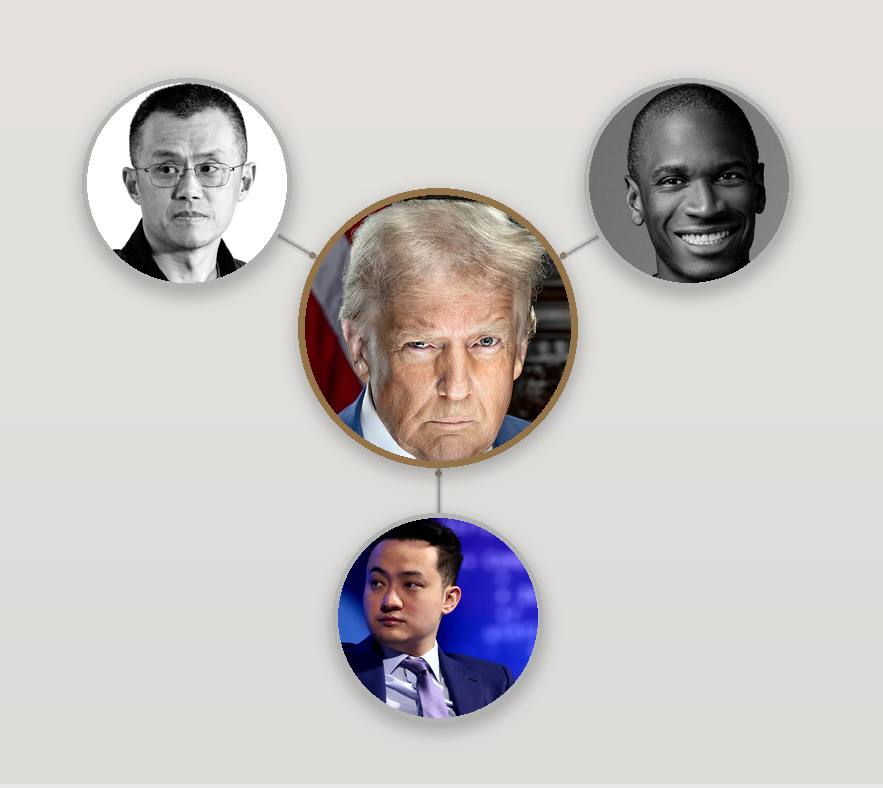
3 people. 3 crimes. 3 pardons.
All 3 had one thing in common 👇
@cz_binance (Binance & Aster)
> pleaded guilty to money laundering
> Got a presidential pardon
> That same week, his exchange listed Trump’s stablecoin
> Then settled a $2 billion deal in it
@justinsuntron (Tron/HTX)
> Active SEC fraud charges
> Invested $75M into Trump’s crypto project WLFI
> SEC dropped the case
> Sun hoped for a pardon but received SEC leniency
@CryptoHayes (Co-Founder of BitMEX)
> pleaded guilty to federal violations
> $100 million in fines
> All three got pardoned
Three different cases
Three different people
All connected to the same project (WLFI/USD1)
A project that sends 75 cents of every dollar directly to the Trump family
No capital invested by the family, No liability taken on, Just the fees
Biggest Scam of 2025
$RAVE structure update
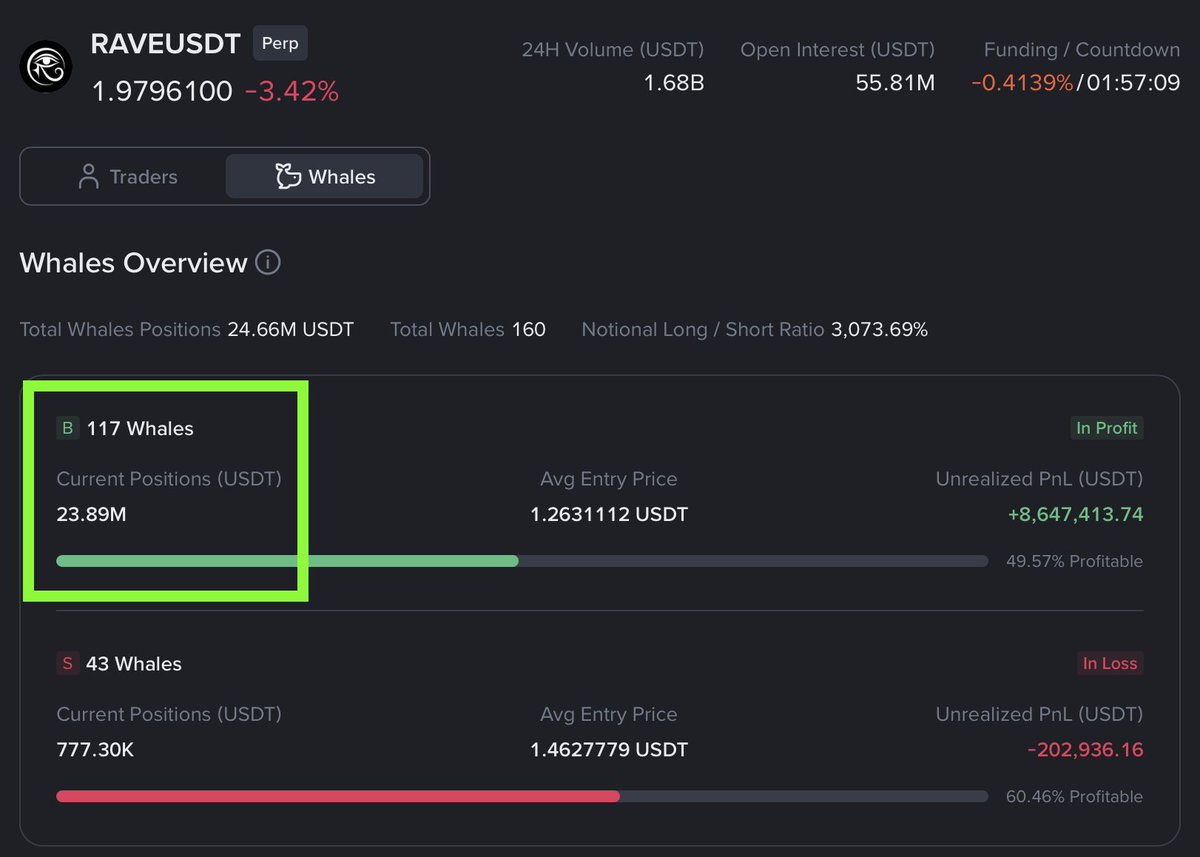
Whales remain heavily positioned on the long side.
At the same time, funding is deeply negative, which shows aggressive short positioning from the market.
This creates classic squeeze conditions.
As long as longs are not unloading, another push higher remains possible.
The real short setup appears only after short liquidations + whale long distribution.
#rave #raveusdt
$RAVE shorting here is dangerous.
Shorts are sitting deep underwater, with an average entry around $1.2.
At the same time, whales are still holding large long positions in heavy profit, which means price can dump hard at any moment.
But right now, most of the move is still driven by short liquidations.
Shorts haven’t been fully cleared yet, new ones keep getting added, and price can easily be pushed toward $3+ to finish the cleanup.
A cleaner short setup would be after a sharp squeeze higher with heavy short liquidations.
#rave #raveusdt
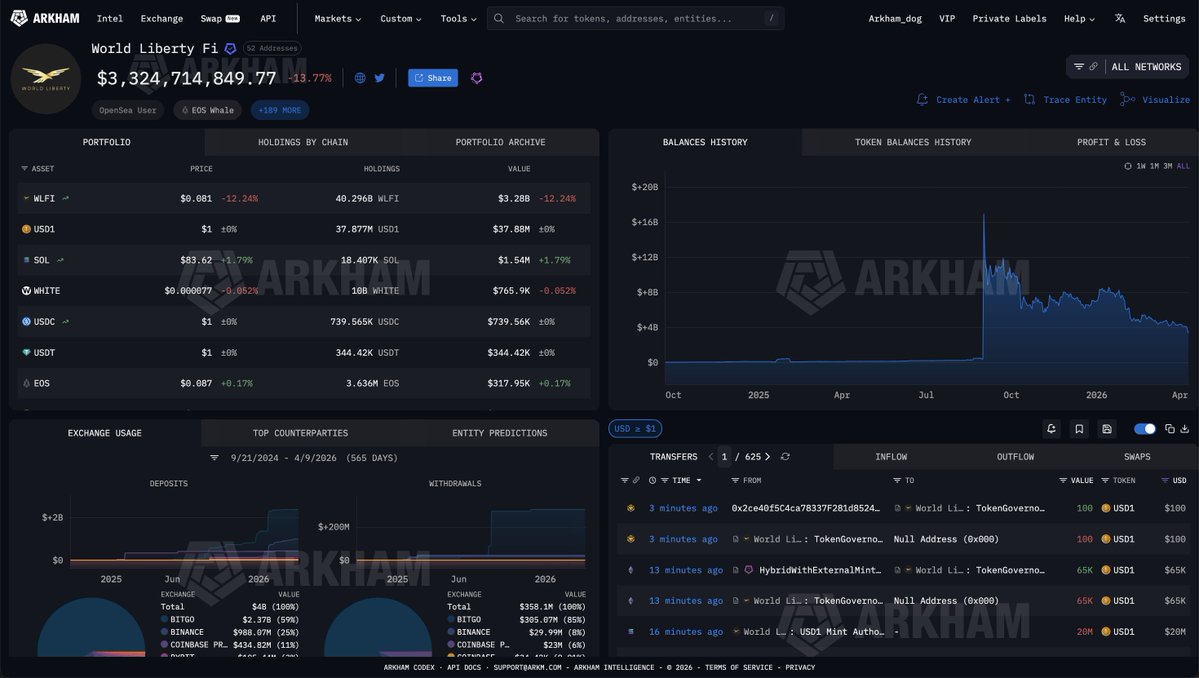
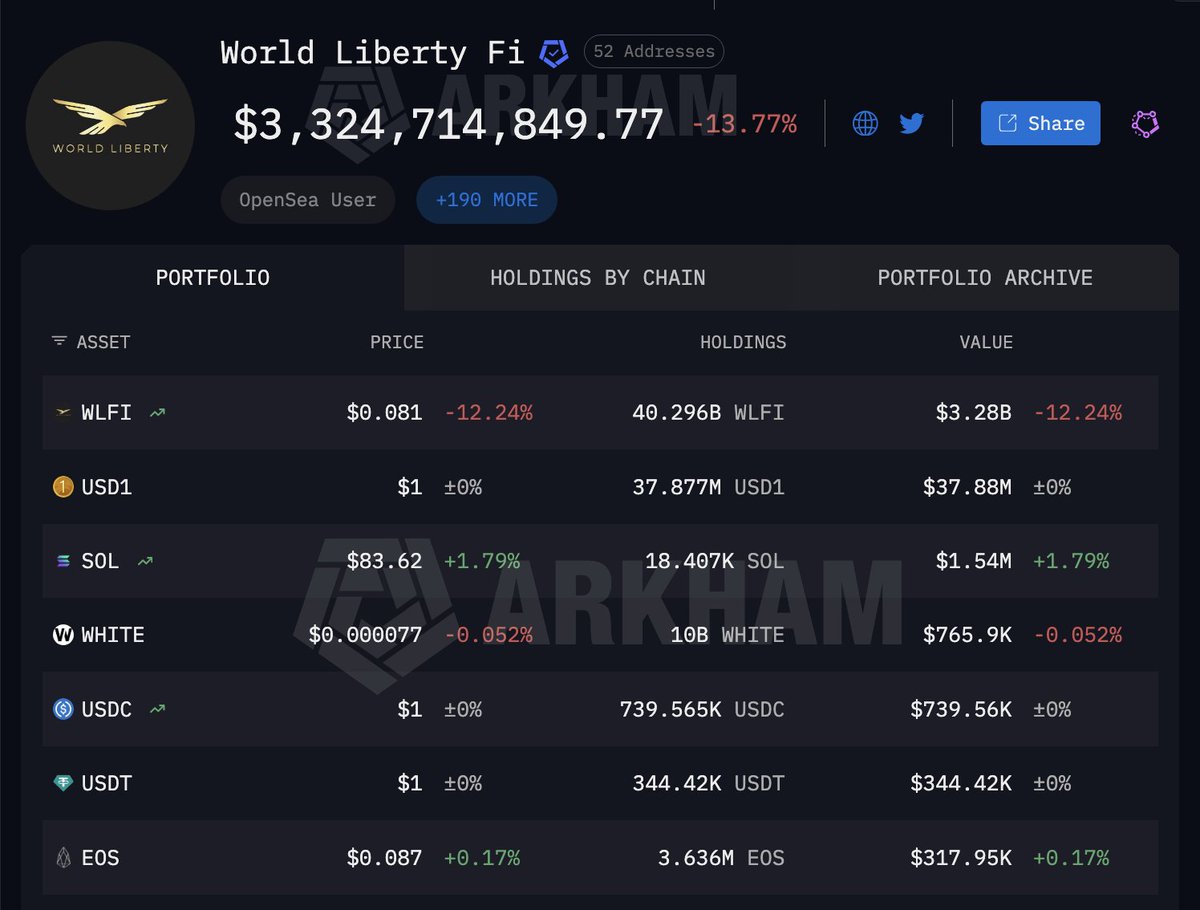
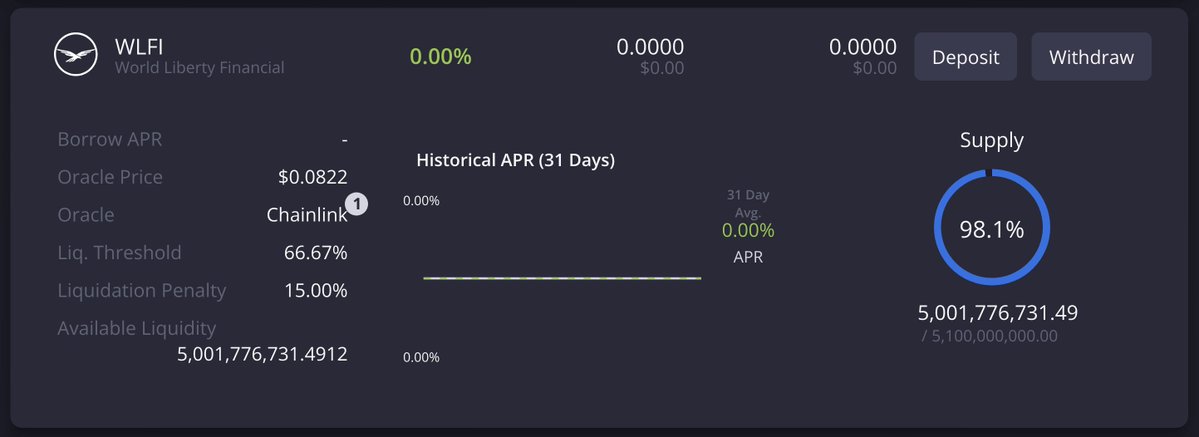
The WLFI Team is borrowing $150M USDC against $400M WLFI on Dolomite.
The WLFI Team is lending $406.23M of WLFI across 2 wallets. That is 4.99% of the supply, and 97.8% of the WLFI cap on Dolomite.
They are borrowing a total of $150M USDC against their holdings on Dolomite.
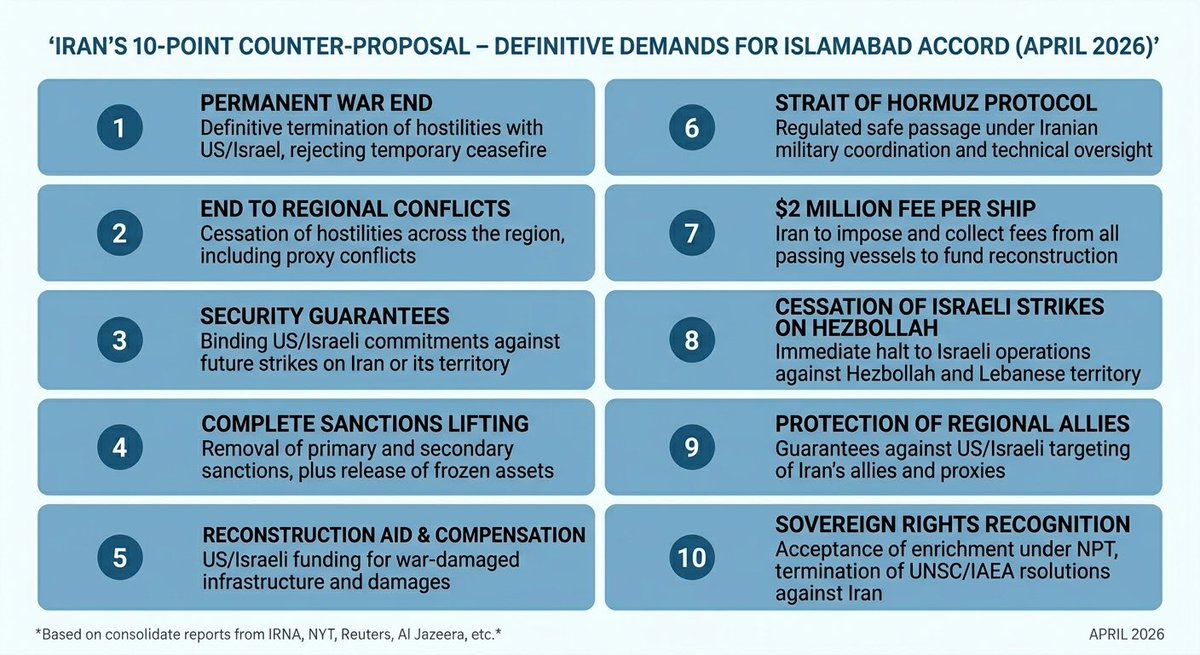
Iran did not submit a peace proposal. It submitted a post-war constitution for the Strait of Hormuz, and nobody in financial markets has read the fine print.
Point six establishes a permanent protocol for safe, regulated passage through the strait under Iranian military coordination. Point seven imposes a $2 million fee per ship. At pre-war transit volumes of roughly 120 vessels per day, that fee structure generates over $87 billion per year in toll revenue paid to a regime whose entire pre-war oil export revenue was approximately $50 billion annually. Iran is proposing to earn more from controlling the passage of other nations’ oil than it earned from selling its own.
Point four demands the complete lifting of all US sanctions. Point five demands reconstruction aid and compensation for damages. Point ten demands recognition of Iran’s sovereign rights, which multiple Tier-2 outlets, including IRNA and Reuters, interpret as acceptance of uranium enrichment under the NPT. The nuclear threshold demand is embedded inside a peace framework, presented alongside a Hormuz toll that would make Tehran the wealthiest chokepoint operator in maritime history.
Trump called the proposal a workable basis for negotiation but explicitly said it is not good enough. The White House framed the Iranian acceptance as confirmation that decades of terrorism will not continue under this president. Vance said the United States has tools in its toolkit it has not yet decided to use. The administration is not bending. It is reading the document and identifying where the leverage lies.
And the leverage lies entirely with the accomplished facts.
Over 130+ Iranian air defence systems have been dismantled. Eighty-five percent of Iran’s weapons-chemistry export capacity has been rendered inoperable. The IRGC’s intelligence chief is dead. Kharg Island has been struck. The transport network is severed. Iran’s bargaining position rests on one asset: the ability to close Hormuz again after the two-week pause expires. Every other card has been played. The military infrastructure that would support renewed escalation has been degraded to a level the IDF described as approaching the last remaining facilities. The 10-point proposal is maximalist precisely because the regime knows its kinetic options are diminishing and its only remaining leverage is the chokepoint itself.
The gap between the American position and the Iranian position is not a negotiating gap. It is a structural incompatibility. The United States will not accept a permanent Iranian toll on global commerce. It will not lift all sanctions without verifiable dismantlement. It will not guarantee the safety of Hezbollah or the Houthis. It will not fund reconstruction of facilities that produced the nitric acid used in the ballistic missiles fired at Haifa apartment buildings. These are not positions that split the difference. They are positions that require one side to abandon its core framework entirely.
Phase-2 begins Friday in Islamabad. The two-week window expires around April 21st. The US waiver on 140 million barrels of Iranian crude at sea expires April 19th. Three deadlines converge in the same week. If Islamabad produces a deal, the molecule crisis begins its multi-year recovery. If Islamabad fails, the strait closes again, the actuarial blockade reactivates, the oil spike returns, and the ghost fleet resumes yuan settlements through the same chokepoint that Iran just proposed to monetise at $87 billion per year.
The ceasefire bought time. The 10-point proposal revealed what Iran intends to do with it.
https://t.co/0fIdGsM5qH
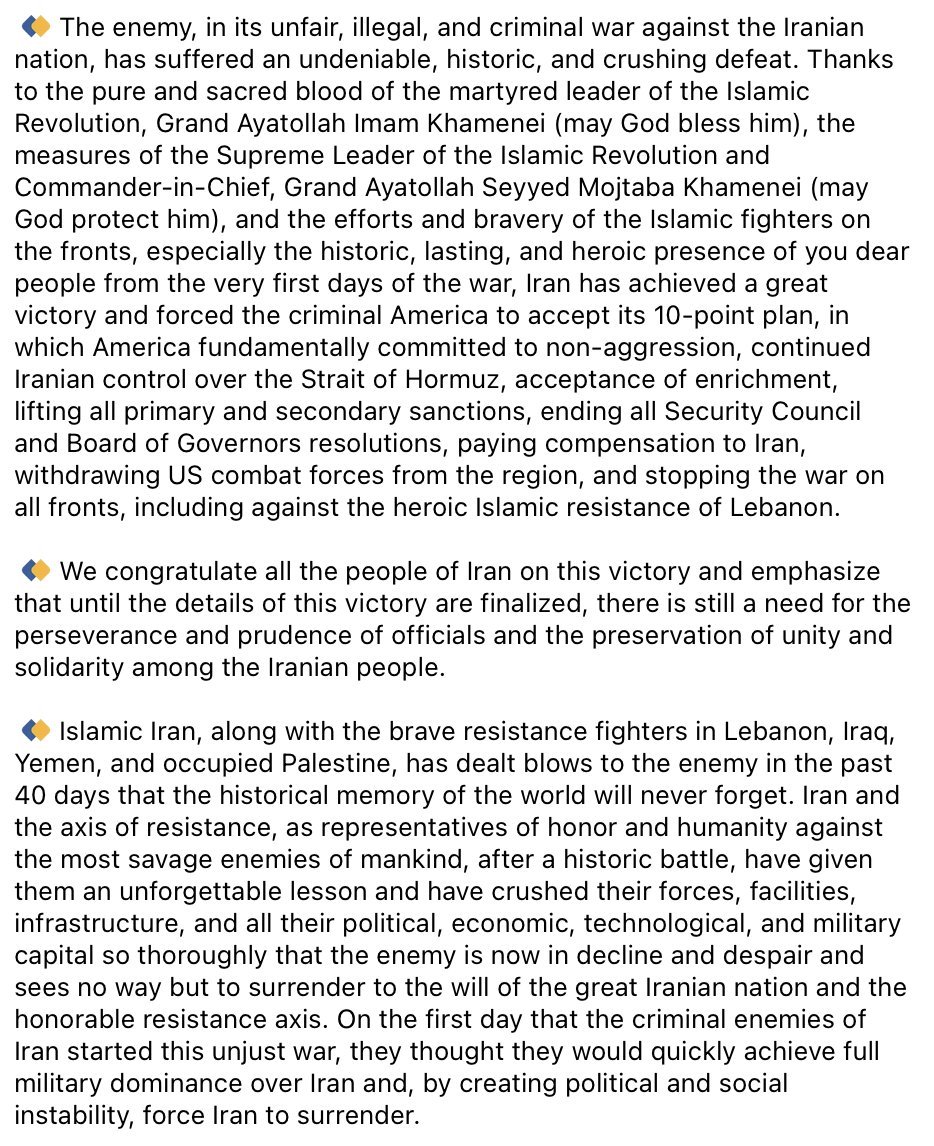
🚨🇮🇷🇺🇸 BREAKING: Iran just released its official victory declaration
The United States has agreed to Iran’s ceasefire conditions:
1. Commitment to non-aggression.
2. Continued Iranian control over the Strait of Hormuz
3. Acceptance of uranium enrichment
4. Lifting of all primary and secondary sanctions
5. Termination of all resolutions of the UN Security Council and the IEAE Board of Governors
6. Payments of compensation for Iran.
7. Withdrawal of American combat forces from the region.
8. Cessation of war on all fronts.
There is no way this is true. Something doesn't make sense...
Source: @Spectator_MENA
BREAKING: Russia just sold physical gold from its central bank reserves for the first time in 25 years. And then Putin signed a decree banning the export of refined gold bars over 100 grams.
Selling gold while banning gold exports. That sounds contradictory until you understand the mechanism.
The Central Bank of Russia sold 300,000 troy ounces in January and 200,000 in February 2026 per CBR and MinFin data reported by bne IntelliNews. Total: 500,000 ounces, roughly 15 tonnes, worth approximately 3.5 trillion rubles. Reserves dropped to 74.3 million ounces, a four-year low.
Russia is not selling gold because it is desperate. Russia is selling gold because yuan is more useful than gold when you need rubles for a war budget, and converting yuan to rubles has become nearly impossible through the banking system.
Here is the part the market has not connected.
Russia receives enormous yuan inflows. Roughly 80 to 90 percent of Russia-China bilateral trade now settles in yuan or rubles per Carnegie and Trade Data Monitor. Russian banks hold over $60 billion in yuan assets. The yuan has replaced the dollar as Russia’s primary foreign currency. But yuan cannot pay Russian soldiers or fund domestic military procurement. That requires rubles.
On March 18, the Central Bank of Russia exhausted its RMB 5 billion yuan swap facility. Demand for this facility was zero a year ago. Overnight yuan borrowing rates on the Moscow Exchange spiked above 20 percent per the Moscow Times and Sovcombank data. Chinese banks have been tightening compliance on Russian transactions due to fear of US secondary sanctions, with processing delays reaching 18 days in some cases.
Russia is drowning in yuan it cannot spend domestically.
Gold solves this. The CBR sells physical gold bars on the domestic market. Buyers pay in rubles. The rubles go directly into the federal budget. No yuan conversion needed. No printing press inflation. No dependence on Chinese banking compliance. Gold at roughly $4,400 per ounce means Russia is monetizing its reserves at record prices, extracting maximum ruble value per ounce sold.
The May 1 export ban completes the logic. Deputy Finance Minister Moiseev stated the rationale explicitly: gold bars had become a tool for capital flight and shadow economy transactions, functioning as an illicit foreign exchange substitute. The ban on bars over 100 grams keeps the physical metal inside Russia while allowing the CBR to continue domestic sales for budget liquidity. Banks are exempt.
Now connect this to the broader architecture.
China tolerates Russia’s gold sales because they stabilize a partner whose fiscal collapse would disrupt China’s primary overland energy supply. Russia stabilized by gold sales remains a reliable supplier of discounted oil and gas settled in yuan. The trade loop stays intact. The ruble bridge stays funded. The de-dollarization testbed keeps running.
This is not “Russia dumping gold in panic.” This is a sovereign state operating a dual-currency regime where yuan handles trade and gold handles fiscal liquidity, because the banking infrastructure connecting the two currencies has been deliberately degraded by the same sanctions architecture that was supposed to isolate Russia from global markets.
The sanctions created the yuan dependency. The yuan dependency created the ruble liquidity gap. The liquidity gap created the gold sales. The gold sales fund the war. The war sustains the Hormuz crisis. The Hormuz crisis accelerates yuan settlement at the strait.
The snake is eating its own tail again.
Full analysis - https://t.co/32ixeQpfif
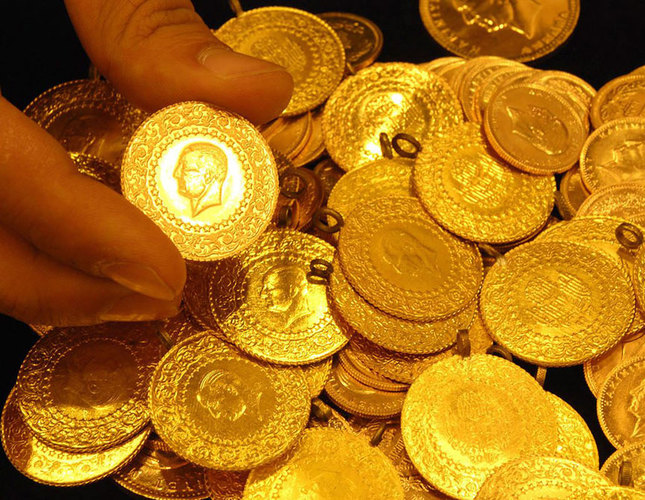
Turkey’s central bank sold and swapped about 60 tons of gold, worth more than $8 billion, in two weeks after the start of the war in Iran, adding to downward pressure on bullion prices https://t.co/Rmc6SvfQ1b
🇮🇷🇹🇷 Turkey’s central bank is now considering selling off its gold to defend the lira.
The Iran war is driving up prices so hard that even Turkey, sitting on $135B in gold, is feeling the pain.
Meanwhile, gold itself has dropped sharply from $5,419 to around $4,380 since the conflict started.
Source: Bloomberg
He joined crypto, made $30M and left...
> launched memecoin launchpad “Clout” (Believe)
> no wallet or coding needed
> launched his own token
> marketed it as the “Flywheel” alongside other famous tek bros
> pumped it to $400M
then it started...
> baits people with birkin bag for gf
> insiders sell partner tokens (e.g., $KLED)
> announce 33% supply increase
> everyone dumping $BELIEVE (incl. team)
Pasternak’s last tweet was in Oct 2025, and it seems he left crypto for good
Pasternak made over $30M with Believe
JUST IN: The UAE just shut down every Iranian institution in Dubai. The hospital. The schools. The club. Every government-dispatched Iranian staff member has been ordered to leave the country immediately. The Iranian consulate has been told to reduce operations to local staff only.
Iran International broke the story. The Iranian Hospital received Dubai Health Authority instructions to cease all activities within one month. The Knowledge and Human Development Authority revoked the licenses of at least five Iranian Community Schools, with students ordered to transfer by 16 March. The Iranian Club announced it will suspend all activities by 15 March, citing “current circumstances.” The circumstances are 1,540 drones and 293 ballistic missiles fired at the UAE in fourteen days.
Six Emiratis and expatriates are dead. One hundred thirty-one are injured. Debris from interceptions has hit Dubai Creek Harbour, 23 Marina, the Palm Jumeirah Fairmont, the Burj Al Arab facade, Dubai International Airport, Jebel Ali Port, and the Ruwais Industrial Complex in Abu Dhabi. The UAE has spent between $1.3 and $2.6 billion on air defence in two weeks, thirteen times what Iran spent on the attacks. The safe haven that Dubai built over three decades is being eroded by fragments falling from a 94% interception rate, and the 6% that gets through produces fires on the evening news every night.
The institutional closures are the diplomatic equivalent of what the insurance industry did on 5 March. The P&I clubs severed the financial relationship between Gulf shipping and global commerce. The UAE is now severing the social relationship between Iran and the Gulf’s largest commercial hub. The hospital that treated Iranian expatriates, the schools that educated their children, the club where the community gathered, all closed. Not because of what happened inside them but because of what is happening above them.
There are approximately 400,000 to 500,000 Iranians living in the UAE. Many have been there for decades. They run businesses, own property, send their children to the schools that just lost their licenses, and receive care at the hospital that just received its shutdown notice. The closures do not target combatants. They target infrastructure of normalcy. The message is not subtle: if your government fires missiles at our towers, your community loses its hospital.
The UAE closed its embassy in Tehran on 1 March, three days after the war began. It has now closed Iran’s institutional presence in Dubai. The diplomatic rupture is complete. No embassy. No consulate staff. No hospital. No schools. No club. Two countries that share a 33-kilometre waterway, $300 billion in Iranian assets on Emirati soil, and a fifty-year dispute over three islands that Iran seized in 1971 have reached the point where the only Iranian presence the UAE will tolerate is the drones it shoots down.
This is what the war looks like when it reaches the ground floor. Not Marines or airstrikes, but a school principal telling parents their children must transfer by Monday. A hospital administrator telling patients their insurance is suspended. A community club posting a notice that says “due to current circumstances” because the current circumstances are ballistic missiles aimed at the city where the club stands.
The towers burn from debris. The institutions close by letter. The community that built a life between two flags discovers that when those flags go to war, the life built between them is the first casualty that does not make the evening news.
Full analysis below
https://t.co/eMrt5qYYst