My Nobel lecture and the video of the Stockholm lecture are online.
It covers what creative destruction tells us about secular stagnation, firm dynamics, the middle-income trap, and AI as the next GPT revolution.
Paper: https://t.co/Viem3OXkiC
Video: https://t.co/9rfqTvWXMy
Thanks to @AnthropicAI and @claudeai for supporting the development of SAGE through the Claude for Open Source program. These election data will hopefully prove useful for a variety of research and policy applications.
Invito cordialmente a todos los defensores del "no con la plata de mis impuestos", esos que criticaban financiar becas estatales, a indignarse con la misma fuerza.
Casi S/ 40,000 en publicar libros de propaganda partidaria. Para esto sí hay presupuesto público; para la Beca Bicentenario y el talento nacional, "no hay caja". 🇵🇪🤦♂️
@GabrielPachecon Pero un prime no debería reducirse a solo un único partido. Si fuese así, cualquier jugador del mundo con un buen partido como prime disputaría contra Messi, Ronaldo, Neymar, etc. El primer es una temporada, un torneo largo.
What a pre-doc is for? The PhD is supposed to be the place where you learn to do research. That’s why you apply. Yet now you need a pre-doc to get in. We’ve added a two-year stage whose stated purpose is teaching what the next stage exists to teach.
The funny thing is that in practice the tasks are mechanical: cleaning data, coding, lit reviews, and all of these things AI can do way better than an RA doing them manually.
For instance, in biology or other fields, the person who runs the experiments gets co-authorship. In economics, the person who builds, cleans and runs the dataset gets a footnote acknowledgment.
If the purpose of doing a pre-doc is to learn how to do research, the surprise is that there is no guarantee you will learn how to do it.
Whether you actually learn depends on whether the PI chooses to invest in you. Nothing in the system requires them to. That’s the lottery: you need to be lucky, not just talented, to cross paths with someone who wants to teach you.
This is also related to the fact of how strong the effect of having connections in academia is in order to be successful. If you come from nowhere, it will be hard to get a good placement, either for a PhD application or in the job market.
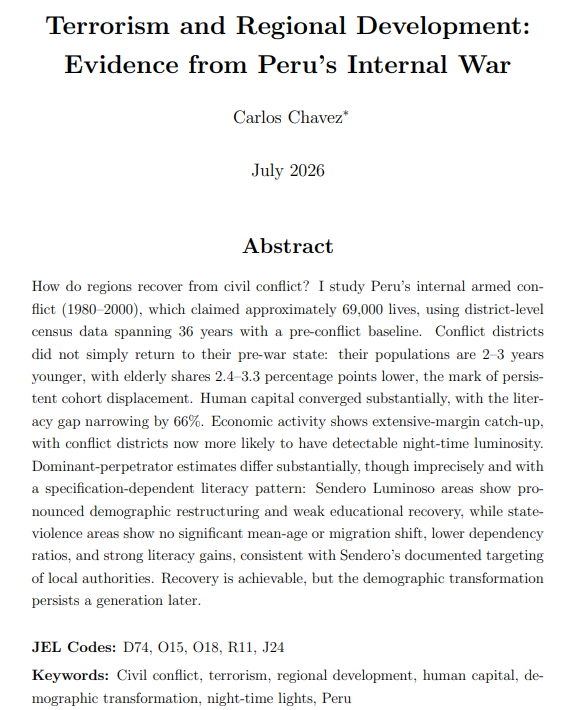
Civil wars can end long before their demographic effects disappear.
Using 36 years of census data from Peru, I find that the most conflict-affected districts recovered economically and educationally, but with younger populations and "missing generations" that remain visible decades later.
Link: https://t.co/Yo6Xq395wM
Comments are welcome.
Very valuable!
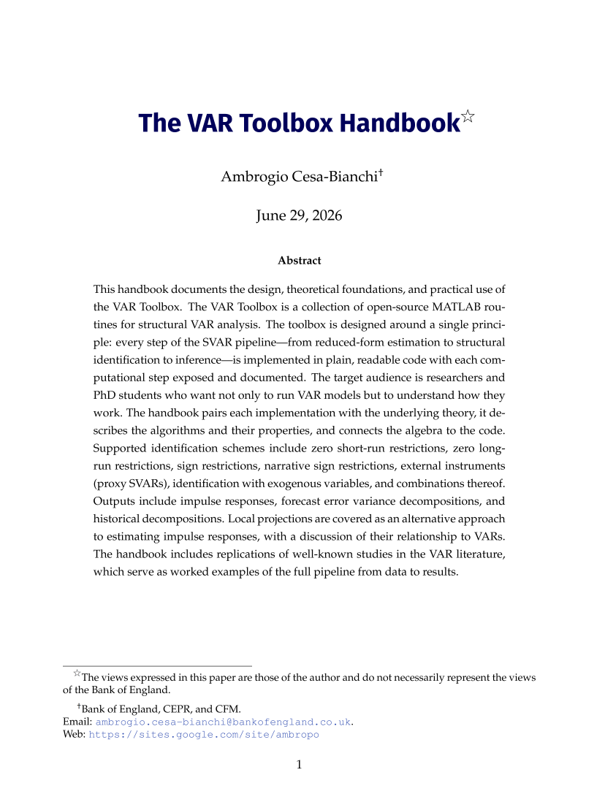
Ambrogio Cesa-Bianchi's VAR Toolbox
"The VAR Toolbox is a collection of open-source MATLAB routines for structural VAR analysis. The toolbox is designed around a single principle: every step of the SVAR pipeline—from reduced-form estimation to structural identification to inference—is implemented in plain, readable code with each computational step exposed and documented. The target audience is researchers and PhD students who want not only to run VAR models but to understand how they work. The handbook pairs each implementation with the underlying theory, it describes the algorithms and their properties, and connects the algebra to the code. Supported identification schemes include zero short-run restrictions, zero long-run restrictions, sign restrictions, narrative sign restrictions, external instruments (proxy SVARs), identification with exogenous variables, and combinations thereof. Outputs include impulse responses, forecast error variance decompositions, and historical decompositions. Local projections are covered as an alternative approach to estimating impulse responses, with a discussion of their relationship to VARs."
https://t.co/krnl3nlZJ8
If you have ever ventured outside the comfort of economics and attended a seminar in the history or sociology department (or, if brave, the English or Comp Lit departments), chances are you heard someone call an outcome “overdetermined.” I have heard it more times than I can count, most recently this morning, reading (an otherwise excellent) history book.
The first time I ran into the word, I had no idea what it meant. I had never heard it in college or in graduate school. So, I googled it (this was in the dark ages before Claude) and learned that an outcome is overdetermined when it has more causes than it needs to produce the stated effect. The classic example is two gunmen who shoot the same person in the heart at the same instant: either bullet kills them.
Ah, I shouted, I heard that example in criminal law I, when I was in law school (yes, those two incredibly boring months discussing causalism vs, finalism, for those who endured the course being taught from the German tradition)!
I also learned that the word has a distinguished pedigree. Apparently, it was Freud who coined it, Überdeterminierung, to describe how a single dream or symptom can be driven by several unconscious causes at once.
Althusser later carried it into Marxism, arguing that social contradictions are “overdetermined” because they pile up from many other contradictions rather than reduce to a single economic base. From Althusser it spread through critical theory, which embraced it because it is so handy for the project: “overdetermination” lets you deny that any social phenomenon has a single cause, and above all that the single cause is economic. You sound terribly sophisticated without the need to pay any real cost for it.
Here I had a good hearty laugh. The people who reach for “overdetermined” are often the same ones who tell you that economics is naively deterministic, that economists “believe in causality.” Yes, I have been told by my colleagues in other departments that believing in causality, or its twin brother the counterfactual, is one of the deepest sins of economics (I always wonder: if you don’t believe in counterfactuals, why did you get the COVID vaccine?).
But economics is the discipline that treats causality as an expensive medicine, to be dispensed with care. We pour enormous effort into identifying one clean source of exogenous variation, one counterfactual we can defend. We lose sleep over problems with far less glamorous names: selection bias, simultaneity, multiple equilibria, confounding, robustness. And very often we surrender and admit that we cannot identify the effect. Many times, I simply say: “I don’t know.”
We avoid “overdetermined” because if the outcome would have happened anyway through another channel, there is almost nothing interesting left to say about it, unless what interests you is rhetoric rather than substance.
In other words, the academics who accuse economists of naive causality are the ones deploying a word whose whole appeal is that everything causes everything. And they take that to be the more philosophically sophisticated position.
Well, at least “overdetermination” is not as silly as “historicizing the discipline.” Who came up with that gem?