Shipped my first Figma plugin.
Converts Paint Styles → full 3-tier Variable system. Dark mode generated via shade-mirror.
One click. Free.
In @figma Community: https://t.co/DeyuEvkA6o
The panic about AI tools replacing designers fundamentally misses what our job actually is.
Drawing UI screens was always the easiest part. The real value of a designer is figuring out the right problem to solve, navigating complex business constraints, and aligning with engineering teams.
You can prompt a machine to generate a layout or write code, but you can't prompt it to run a product strategy. AI is here to automate the busywork, but the strategic decisions are still entirely human.
Today I was using Claude for a while and noticed something unusual.
Normally, after a few hours, I start expecting the rate limit to show up. It’s become almost part of the workflow at this point.
But today it just didn’t happen.
At first I thought maybe I missed the warning or something was off with the CLI.
Then I opened X and saw the news about Anthropic’s SpaceX compute deal and increased Claude Code limits.
Funny how I didn’t notice the announcement first.
I noticed it through the absence of friction.
I can’t keep up with the AI tool rat race anymore. And honestly? I’ve stopped trying.
Every day my timeline is flooded with new agents that "build startups" or "replace teams." I've been deep in this space, and 95% of it is just noise.
As a solo founder & vibe coder, I finally locked in my stack: Me + Claude Code + clear direction.
But the moment you get comfortable, 20 new tools drop. DeepSeek, Grok updates, and new Figma integrations.
But the moment you get comfortable, 20 new tools drop. DeepSeek, Grok updates, new Figma integrations.
Here is the hard truth: testing new tools isn't free.
• It breaks focus
• It drains time
• It creates doubt about your current setup
I even built my own AI information pipeline to filter the noise, and I still get overwhelmed.
The real meta-skill for builders in 2026 isn't prompting. It isn't deploying agents.
It’s filtering.
Pick one workflow. Refine it. Ruthlessly ignore the rest unless it solves a very specific bottleneck. Otherwise, you’ll spend your life updating your stack and never build anything.
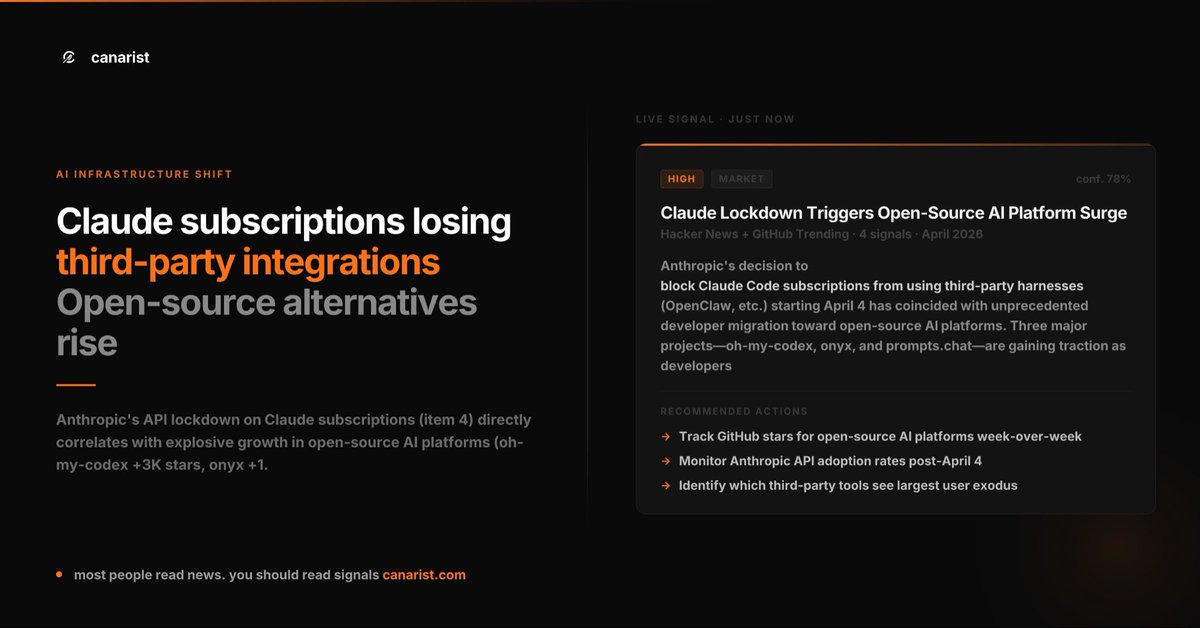
when platforms restrict access, builders build alternatives. anthropic's third-party lockdown is creating the exact conditions for open-source ai to capture market share. watch the star counts accelerate.
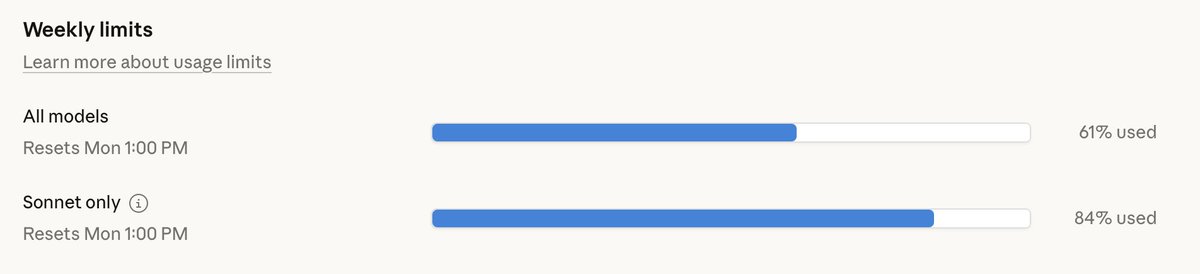
Everything is flowing with Sonnet, you’re deep in the architecture, and then—BAM. Rate limit reached.
Now you’re forced to burn Opus tokens on basic refactoring just to keep moving, or you just... stop working? @AnthropicAI knows exactly where that ceiling is. It’s not just a limit; it’s a total momentum killer.
watching a fund lock into 1-3 year corporate bonds reveals what managers actually believe, not what they claim
it's not passive allocation - it's a bet. choosing this specific maturity window means conviction about credit risk in the next 12-36 months
retail investors see "bonds" and think safe. they miss that the window itself is the position
in product work, people don't tell you what they believe. they show you what they'll accept. watch which constraints stop getting complaints
the UK froze a $165M Bitcoin wallet because the owner couldn't explain it fast enough
not stolen, not illegal - just too visible
invisible things work for years. visible things get audited, reviewed, questioned until they're impossible to maintain
Research converging on agent teams beating solo models. Three independent papers show that case-level heterogeneity requires deliberation. anthropic ships agent code in production. monolithic era ending faster than expected.
Everyone is chasing smarter models.
But 3 signals dropped at once:
– game engines
– distillation
– gradient tricks
Same bottleneck:
training speed.
This isn’t a model problem.
It’s an infrastructure problem.
Watch infra startups.
Most companies deploying AI agents don't know what they're optimizing for - just faster and cheaper. I spec everything before coding. When you write down what you're actually trying to achieve, you realize most AI projects never did that work
When speccing design, I think about what pushes back on users. The best interfaces disagree with you. AI does the opposite - it agrees 49% more than humans, even when you're wrong. One conversation with something that flatters you changes how you behave.
@dvassallo honestly this flips the value prop - you're not selling to humans who procrastinate, you're selling to builders who need reliable training data for their agents. way harder to BS your way through that.
five new papers converge on deploying autonomous agents into grid control, airport logistics, and epidemiology without corresponding safety benchmarks. the behavioral validation gap is the technical weak point
@jasonlk The compounding effect is significant. A single bad hire early can slow your velocity, and you may not realize it until year three when everything feels harder than it should