@slowcargofast A prior is built-in knowledge — an assumption baked in before any data arrives. Here, the brain's rhythm is that assumption: it expects speech to ebb and flow at a certain rate, so it's ready for speech before it even hears it
[1] Speech has a rhythm. So does your brain. We found that's not a coincidence — it's a built-in prior for recognizing speech 🧠🌊
Excited to share recent work with Nabil Imam: "Neural rhythms as priors of speech computations"
[1/6]
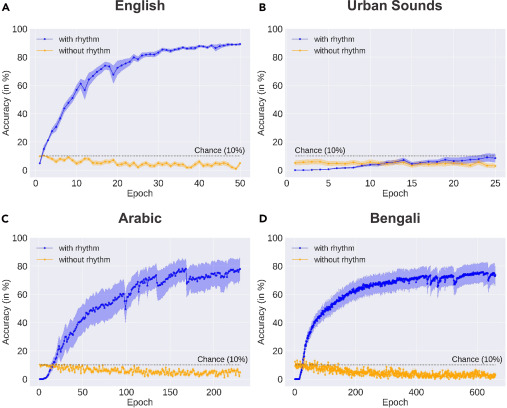
When we gave those same networks urban sounds — car horns, jackhammers, sounds with no real rhythmic structure — the advantage just disappeared. The rhythm isn't a generic trick; it's a prior tuned to speech, with the brain's rhythms encoding knowledge of speech structure itself.
[5/6]
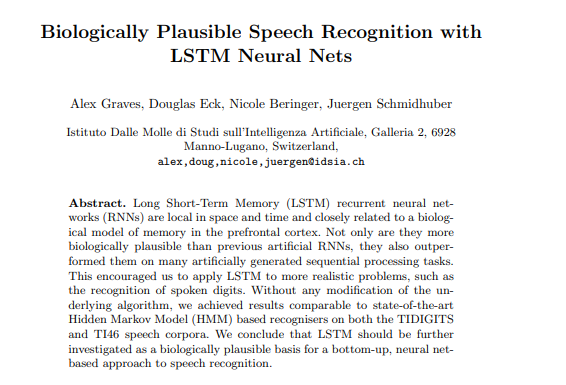
this paper, "Biologically Plausible Speech Recognition with LSTM Neural Nets" was written in 2004...talk about being incredibly prescient @SchmidhuberAI
@GrantStenger interesting. the first plot looks an action potential in a neuron (e.g., spike) and red trace looks like the raw neural trace (with the spikes)
@__paleologo "Simple Model of Spiking Neurons" (by E. Izhikevich). A relatively simple model, but captures a wide variety of qualitative (brain) dynamics