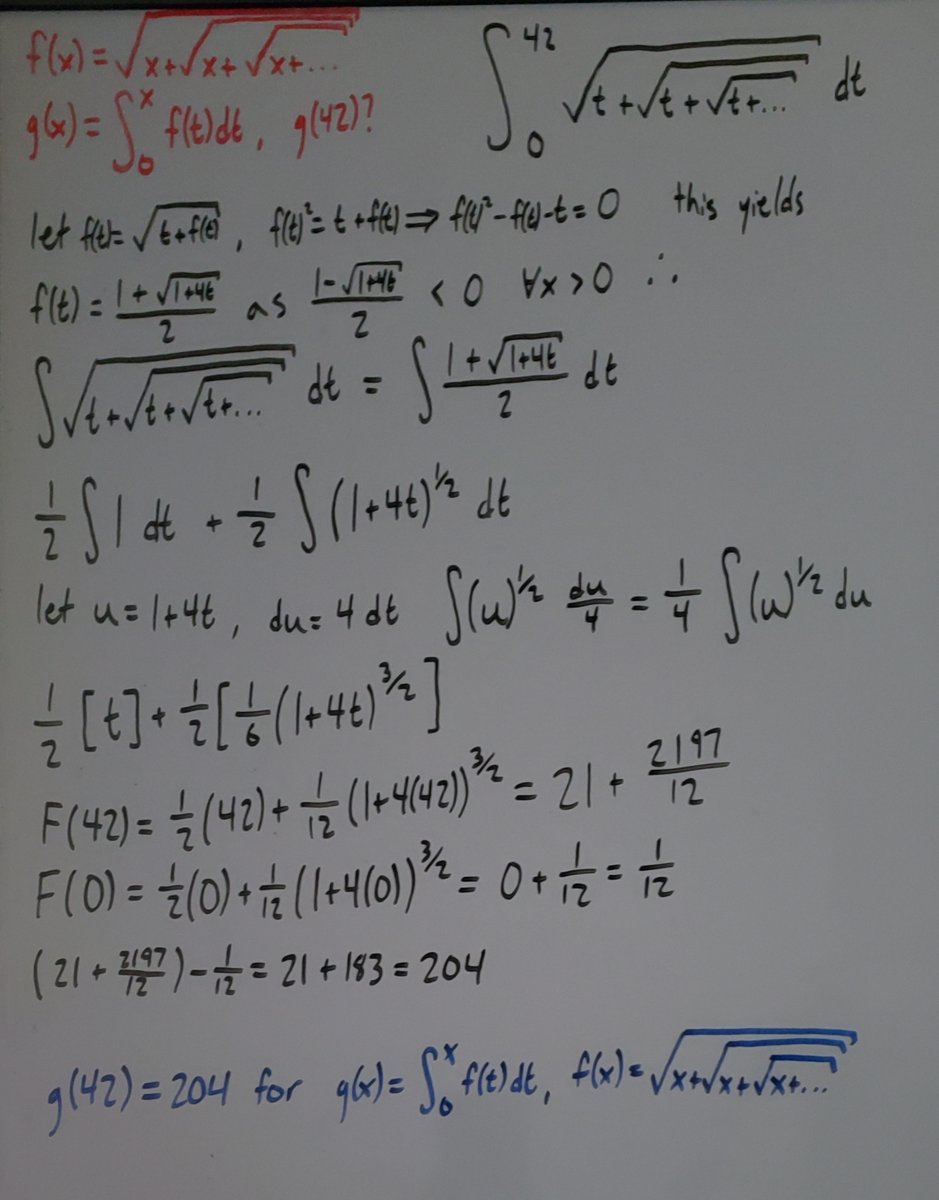
First, we expand to see the structure. We have the optimal structure for u-substitution because we have a term and the derivative of that term in the integrand. Next, we can adjust the bounds and evaluate.
@Hajuulol To my knowledge we believe by the uncertainty principle that a vacuum is still non-empty and fluctuations in energy causes particle-antiparticle pairs to pop into existence into and out of existence. Baryogenesis occurred after the cosmic inflation epoch and this created matter.
The nested radical self similarity principle allows us to reduce then solve with the quadratic formula. Then we can split into a constant integral and a u-substitution integral. Then we can evaluate the sum of those integrals over the interval to get our answer.
@Hajuulol Earth formed about 4.5 billion years ago from the disk of gas and dust left over after the Sun was formed. Life appeared within the first billion years or so, probably from abiogenesis, though exactly how is still an open question.
We notice the logarithmic derivative after dividing by x^2, this allows us to condense the integrand to a form where we can fully substitute the denominator and numerator to get -ln|u|. Next we can use the squeeze theorem to evaluate the limits and get the results with the FTC.
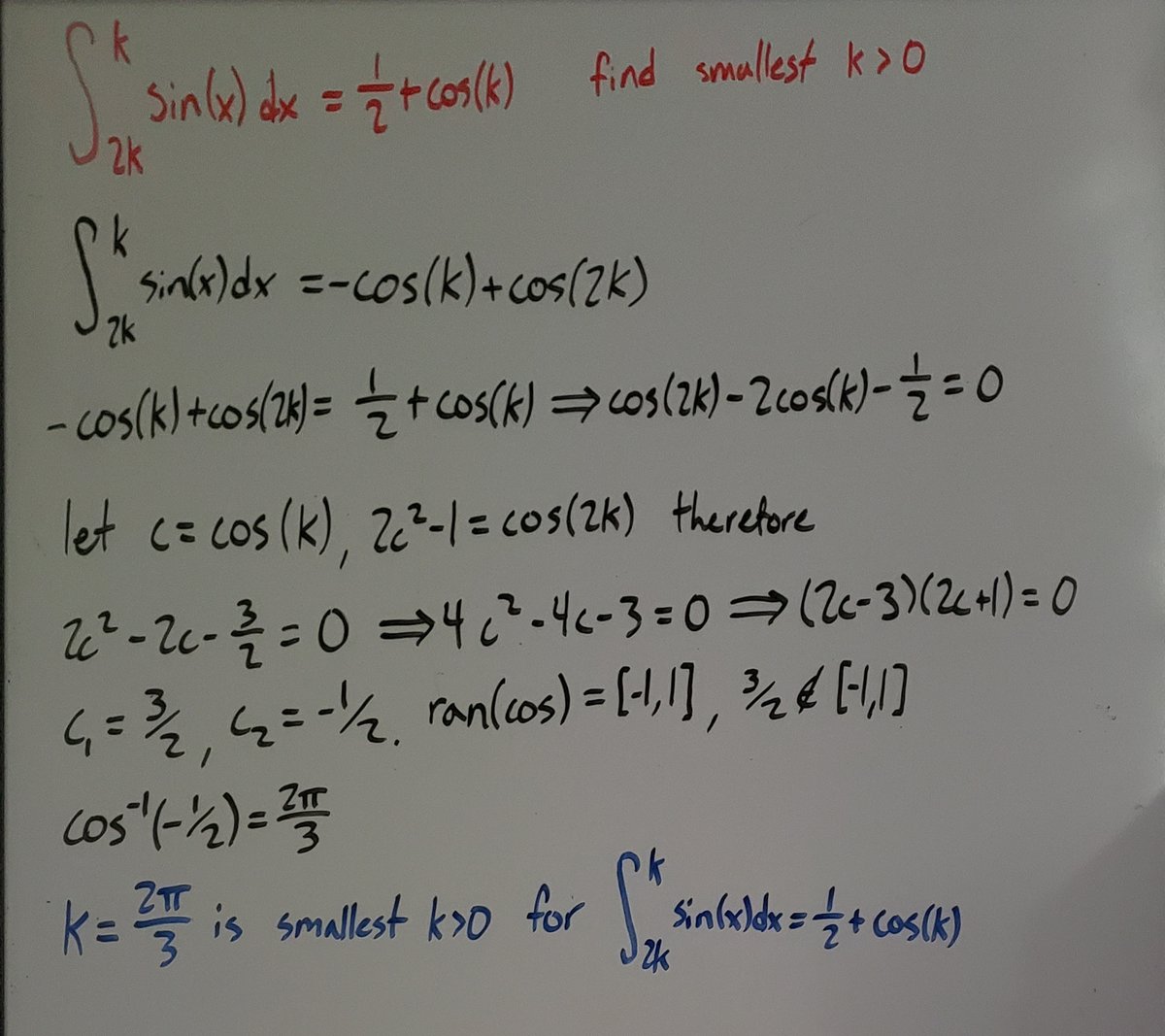
We evaluate the definite integral from 2k to k, then use the double-angle identity to turn the equation into a quadratic. Solving it gives the possible outputs of cos; we reject the one outside [−1, 1] and apply inverse cos to the root to get the smallest positive input k.
The nested radical self similarity principle allows us to reduce the infinite series to a finite algebraic equation after finding a full copy of the expression embedded inside the expression. Then the natural log allows us to get a power rule integral.