2024-2025 I was editing 66 videos a month for this client and being paid $3,500 Monthly. Some months I get an extra $500 bonus, And this was one client I had other clients, Someone is arguing 100 videos monthly for $700+ is fair lol. I didn’t have to leave Africa
My second app just hit $6,000 MRR (across both app and web).
I’m still sticking to my thesis: build 10 apps that each reach $5k/month, then automate everything so they generate income even while I sleep.
Right now, if I exclude Apple fees, my profit margin is around 92% across all my apps.
As I’ve said, I’m an indie hacker and solo founder, so I optimize for profit because I’m not VC-backed.
$6600 in one day🤣
+Didn't include 30 smaller channels that piss me off but make probably $700-800
This is peanuts tho.
I got cooking something really, really insane that will soon be doing 30k days on the regular.
Stay tuned i'm about to break your understanding of this shit
@HuuVanTran I have around this range also and I even used to think it's not enough 😂. one more question If you don't mind please, how frequent do you create another pin for each url? once per week? two weeks? or you only link to a url once in a month? thanks
I made $10,457.97 from 237,891 sessions & FB Content Monetization (CM) in March 2026.
The good:
Traffic only went from 213K → 237K sessions (~+11%), but revenue almost doubled. The difference came from Facebook CM coming back, not from traffic growth.
The shift:
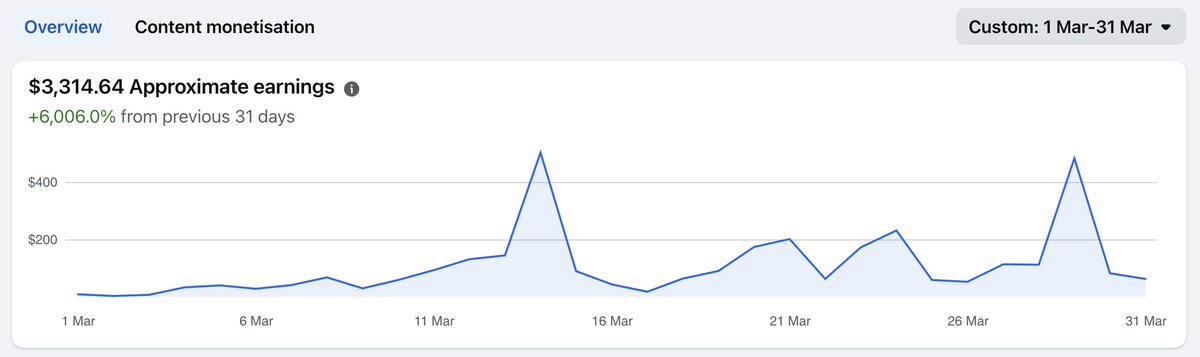
Facebook CM came back in a big way. We currently have CM on 3 pages: one fandom page, one partnership page in the same fandom niche, and one animal page.
The first two pages performed incredibly well, with more than $5K revenue combined (~$1.7K and ~$3.3K respectively).
We’re still producing Facebook posts about hidden gems, stories, and news in the niche. No reels. Just photos. No more copyright headaches. In case you don’t know, reels didn’t work for us due to copyright issues.
The real change came from how we create content now: each team member manages at least one page and runs it independently, without me approving posts before publishing. This made a huge difference in both my workload and overall performance, since they’re free to test more creatives with my guidance. I still review everything after it’s published. It’s a bit risky, but worth it so far.
Looking back, I think I was wrong to take over Facebook posting a few months ago. The team is simply better at it when they have ownership.
Where the money actually came from in March:
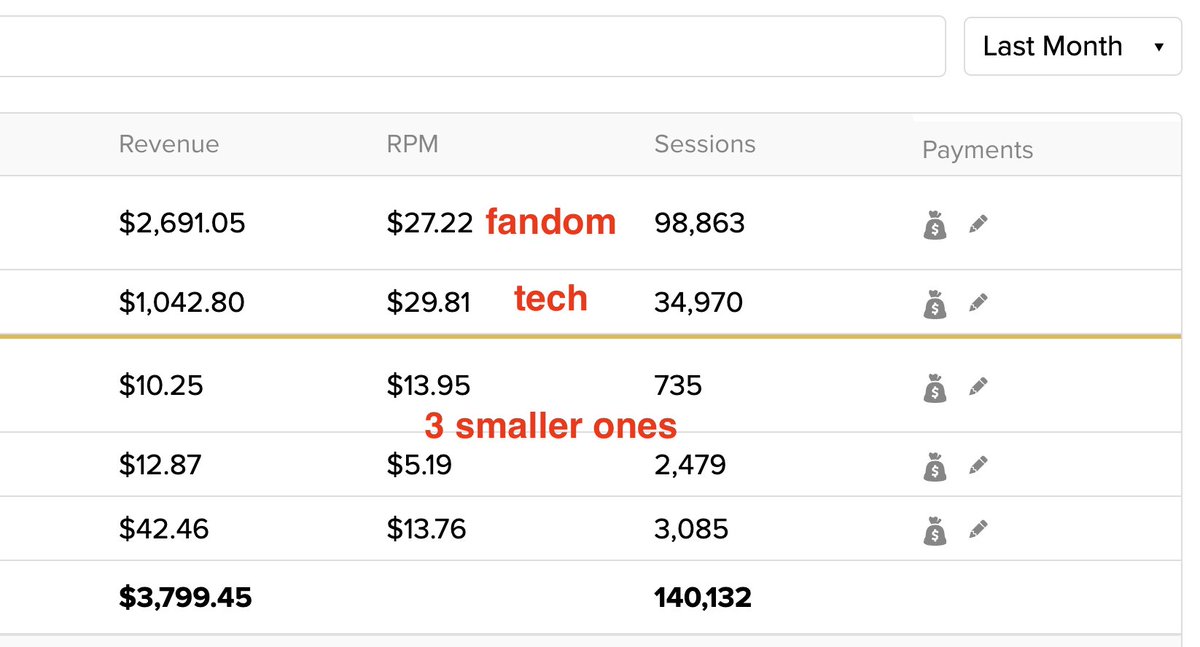
- Fandom site (FB traffic + MV ads): $2,691.05 from 99,119 sessions
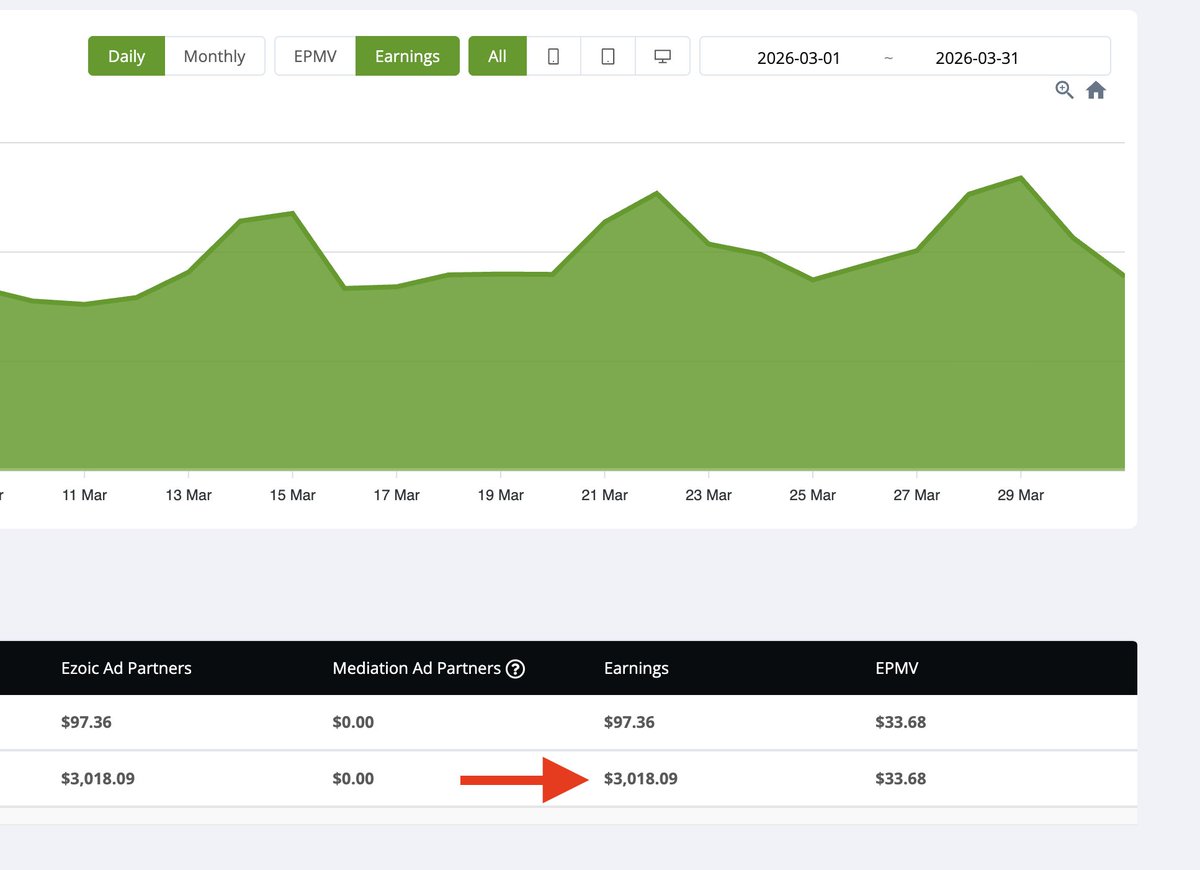
- Home décor site (Pinterest traffic + Ezoic ads): $3,018.09 from 97,759 sessions
- Tech site (Organic + Pinterest traffic + MV ads): $1,042.80 from 36,252 sessions
- Facebook CM: $3,512.26 (after US tax deduction and partnership shares)
- Smaller sites (Mixed traffic + MV ads): $110.84 from 4,761 sessions
- Amazon affiliates: $82.93
Total: $10,457.97
A few quick observations:
- Facebook CM is now a major revenue driver.
- Decor site remains the top earning site, quite consistent now.
- Fandom traffic is still the same as previous months, but revenue held up.
- Tech continues to be stable and predictable.
This month feels different. Not because traffic is back. But because monetization is working again for us.
@sneakypetegg@roi_hacks thanks for your response. i do around 10 - thats nice! just one more question if you don't mind. how do you optimize your pins for keywords - i usually just make sure the keyword i'm targetting appears close to the beginnng of the title and twice in description, what about you??
You’re watching a game that took 2,000 people eight years to build. Some of them are still dealing with what it cost them.
Red Dead Redemption 2 started production in 2010, right after the first game came out. Rockstar merged every studio it owned across five countries into one team. By the end, roughly 2,000 people had touched the project, and the budget landed somewhere between $370 million and $540 million, making it one of the most expensive entertainment products ever created.
The numbers inside the game are hard to process. 300,000 individual animations (every hand movement, every horse gallop, every raindrop reaction). 500,000 lines of voiced dialogue spread across 1,200 actors. Recording those performances took 2,200 days in a motion capture studio, where actors wear sensor suits so their movements translate directly into the game. The main story script was about 2,000 pages. Dan Houser, Rockstar’s co-founder, said if you stacked every script in the game, including random people walking around town, the pile would be eight feet tall. Even background characters you’d never talk to had 80-page scripts each, about the length of a short film screenplay for a character with zero plot importance. The composer wrote 60 hours of original music. Most players hear about a third of it.
The level of detail borders on insane. Horse testicles shrink when the weather gets cold. Your character gains weight if he eats too much, loses stamina if he doesn’t eat enough. Guns degrade without cleaning. Rockstar’s studio co-head Rob Nelson explained the logic: every tiny detail you don’t consciously notice makes you forget you’re inside a game. Stack enough of those moments and you get something no other studio has matched.
That immersion had a price. In October 2018, Dan Houser told New York Magazine the team had been working “100-hour weeks” multiple times that year. He later clarified that was four senior writers over three weeks. But when Kotaku’s Jason Schreier interviewed 77 current and former Rockstar employees, the picture was wider. Nobody hit 100 hours, but many averaged 55 to 60 per week for months at a time. That’s six 10-hour days, often with weekend shifts too. Most were salaried with no overtime pay, their only extra compensation tied to year-end bonuses that depended on how well the game sold.
Multiple developers described depression and anxiety during and after production. One told Kotaku they’d been “pushed further into depression and anxiety than I had ever been.” Others reported breakdowns and heavy drinking. Kotaku noted some of the worst stories couldn’t be published because the people involved would’ve been identifiable.
The game made $725 million in three days, the second-biggest entertainment launch in history. It has now sold over 82 million copies, won more than 175 Game of the Year awards, and is the fourth best-selling video game ever made. Every frame of that clip was paid for, one way or another.