Thinned Mean Field Langevin Dynamics
Zonghao Chen, Heishiro Kanagawa, François-Xavier Briol, Chris J. Oates, Lester Mackey
https://t.co/nFRkJK6giU [𝚌𝚜.𝙻𝙶]
🚀 New paper at ICML 2026!
For Wasserstein gradient flows with N particles, the cost is N^2 due to interactions.
We reduce the cost from N^2 to N^{1.5}, without sacrificing the quality simulated until convergence.
The key idea is kernel thinning! ✨
📄 https://t.co/zXfflTfxLt
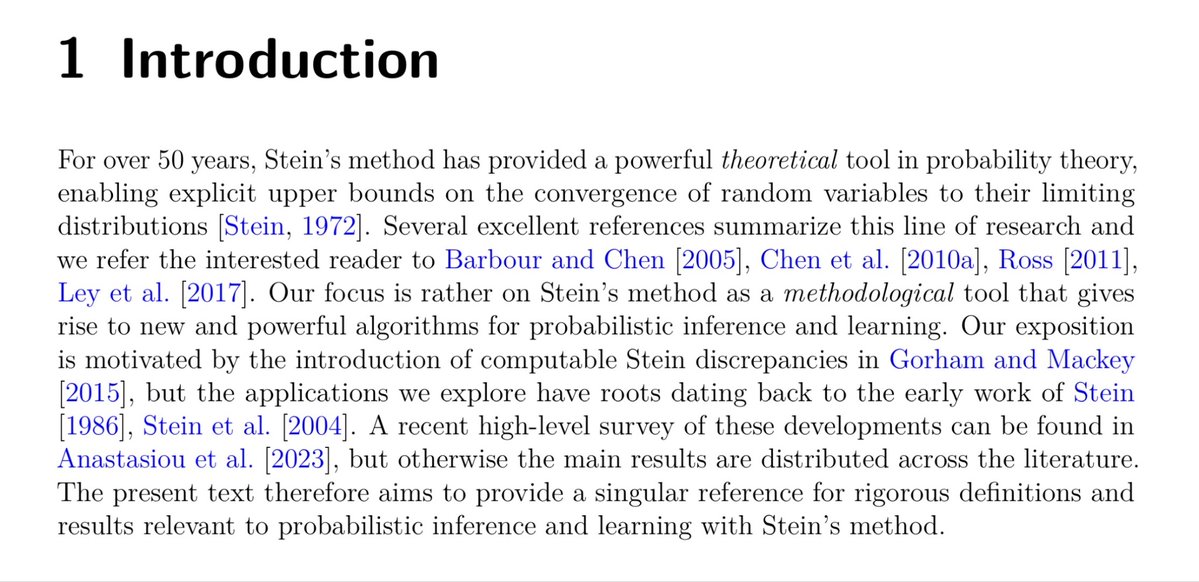
Qiang Liu, Chris Oates, and I are writing a monograph on Probabilistic Inference and Learning with Stein’s Method, and we’d love to get your feedback on the first draft
Our paper on KSD-Wasserstein convergence was published in Annals of Applied Probability.
Grateful to my co-authors (Alessandro Barp, @ArthurGretton, @LesterMackey ) and editors/reviewers for the helpful feedback.
https://t.co/kYxpt0PuMP
This is joint work between two teams:
• Clémentine Chazal and @Korba_Anna (@ENSAEparis)
• Heishiro Kanagawa, @zheyangshen, and Chris Oates (@uniofnewcastle)
Part of this work was carried out during Clémentine’s (the student author!) visit to Newcastle as a visiting fellow.
In optimisation, gradients guide convergence.
But when the objective is over probability distributions, what’s the analogue?
This paper introduces a way to evaluate sample approximations to optima for entropy-regularised objectives:
https://t.co/ztO3QRG5xf
At the end of the day, we obtain and use sample approximations, but their KL is undefined (objective cannot be computed).
This work thus presents a computable alternative termed 'gradient discrepancies', which turns out to generalise the kernel Stein discrepancy!