You're doing research, scripting, voiceover, editing, thumbnails, and uploading, alone.
And you've hit a wall: 1-2 videos a week, max, no matter how many hours you add.
This isn't a discipline problem. It's a structural one. A single person doing every role in the pipeline will always cap out around the same output ceiling, regardless of effort.
Most people respond by working longer hours. That doesn't fix a structural bottleneck, it just delays burnout by a few weeks.
The partial fix: the pipeline needs to split into parallel roles, not sequential ones, before output can scale past 2 videos a week.
But there's a specific order to hand off tasks, the wrong first hire actually slows a channel down instead of speeding it up.
Comment "SCALE" and I'll tell you which role to hand off first.
Month 1: ideas flowing, uploads consistent, momentum building.
Month 3: staring at a blank script document, recycling the same 4 angles.
This is the point where most automated channels quietly die, not from lack of views, but from running out of things to say.
The real issue: most people research content ideas the same way they research once, a burst at the start, then nothing, assuming inspiration will keep showing up on its own.
The partial fix: build a repeatable research system, not a one-time idea list. Certain source types (competitor comment sections, niche-adjacent subreddits, trending search terms) refill themselves constantly if you check them on a schedule.
But there's a specific weekly research routine that keeps a 3-person content team stocked with 90 days of ideas at any given time.
Comment "IDEAS" and I'll break it down.
Worked as both editor and scriptwriter for a client, a combo that changes the whole workflow.
When you write the script yourself, you already know exactly where the emotional beats land before you ever touch footage. Editing becomes execution of a plan, not reaction to one.
Client came back across two separate projects. That's the real signal.
Most niche channels compete on depth, better research, better analysis, slower and more thoughtful.
Meanwhile this one built its entire identity around the opposite: "fast, factual, direct." A logo styled like a breaking-news alert, not a creator brand.
It's not trying to be the smartest channel in the space. It's trying to be the fastest.
Same niche, two directions, depth or speed. Pick the wrong one and you're competing with the wrong channels entirely.
Want to know which lever your niche should pull? Follow + comment "SPEED"
4 months in. 3,200 hours of watch time. 1,000 subscribers away from monetization.
Most people grind toward these two numbers like they're the finish line. They're not, they're just the entry ticket.
Here's what nobody explains: hitting the threshold doesn't guarantee real revenue. RPM (what you actually get paid per 1,000 views) varies wildly by niche, and most beginners pick their niche based on interest, not RPM, then wonder why 500K views barely covers a nice dinner.
The partial fix: research RPM by niche before you pick a topic, not after you've already built an audience around the wrong one.
But there's a specific niche category most automation creators overlook entirely that pays significantly more per view than the "popular" niches everyone rushes toward.
Comment "RPM" and I'll tell you which one.
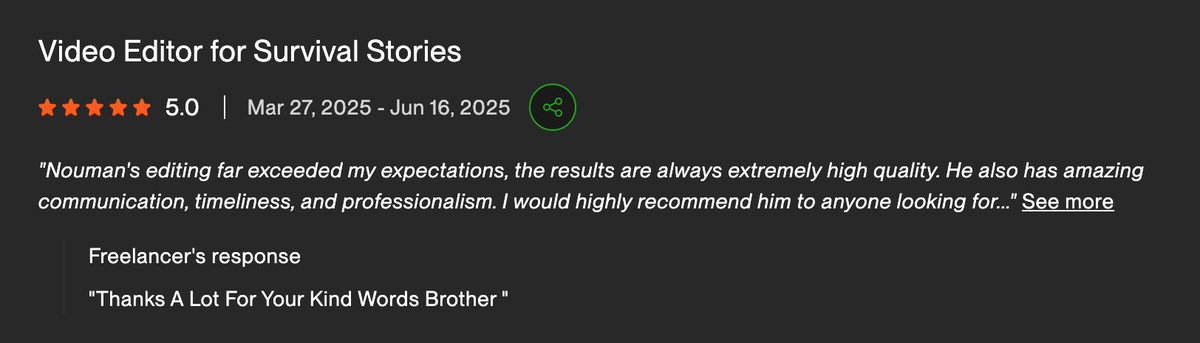
Worked with a client on a survival stories channel, a niche that lives or dies on tension pacing.
Too fast, and the danger doesn't register. Too slow, and viewers check out before the resolution.
Client's feedback centered on exactly that: results consistently exceeding expectations, video after video, not just once.
Full review below. 👇
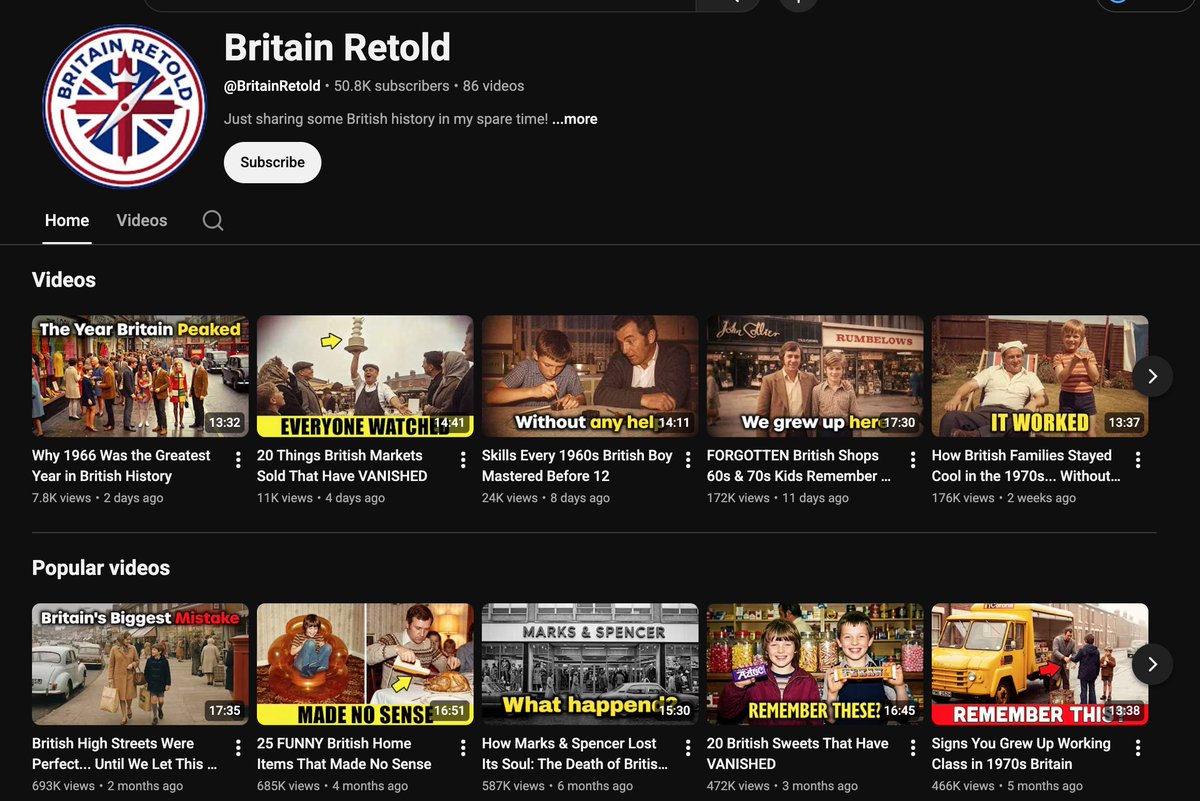
Most channels try to look as professional and monetized as possible.
Meanwhile this one's entire description says: "Just sharing some British history in my spare time."
That single line does more trust-building than any logo could, audiences believe hobbyists faster than they believe brands.
Sometimes the smartest positioning move is sounding like you're not positioning at all.
Want to see how "amateur" framing outperforms polished branding? Follow + comment "HOBBY"
Your script is solid. Your research is solid. And people bounce 20 seconds in because the voiceover sounds like a robot reading a Wikipedia page.
AI voice tools have gotten good. Most people still use them badly.
The mistake: pasting your script straight into a TTS tool and hoping tone comes through automatically. It doesn't. Flat delivery kills retention even when everything else is right.
The partial fix: script formatting (punctuation, pacing, emphasis markers) changes AI voice delivery dramatically, most people never touch this setting.
But there's a specific combination of voice model + script formatting that gets you close to human-sounding delivery without paying for expensive custom voice cloning.
Comment "VOICE" and I'll share the combo.
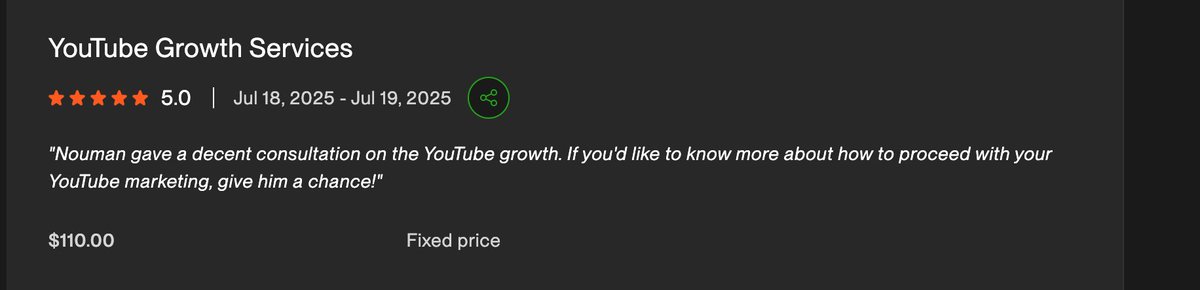
Ran a YouTube growth consultation for a client last month, not editing, just strategy.
Sometimes the highest-leverage thing isn't more content. It's one conversation that names the actual problem, wrong niche width, broken posting schedule, a thumbnail strategy fighting itself.
$110, one session, and the client walked away with a completely different growth plan.
Full review below. 👇
Just completed a 200-edit contract for a client running a streamer niche channel.
At that volume, the real test isn't producing one great edit. It's holding the exact same standard on video 180 as video 1, when fatigue would normally cause quality to drift.
Client's takeaway: consistency, not one standout moment.
Full review below. 👇
Most people think a bad niche is why a channel fails.
Meanwhile this channel proves it's usually not the niche it's a generic stock icon, a default name, zero specific angle, competing on nothing but algorithm luck.
A bad logo isn't the real problem. It's just proof the positioning work never happened.
Before you touch a thumbnail, answer one question: why you, over every other channel in this niche.
Want the 1-sentence positioning test every channel should pass first? Follow + comment "POSITION"
10,000 impressions. 180 views.
Your content isn't the problem.
Your thumbnail is failing before anyone even reaches your content.
A 1.8% click-through rate tells YouTube one thing:
"nobody wants this," and it starts showing your video to fewer people, regardless of how good it actually is.
Most people think a "good" thumbnail means visually appealing. That's not what drives clicks. What drives clicks is an unresolved question — something the viewer needs the video to answer.
The partial fix: your thumbnail and title should never say the same thing. If your title states the fact, your thumbnail should raise the question.
But there's a specific gap size between "curious" and
"confusing" that most beginners get wrong in one direction or the other.
Comment "CTR" and I'll walk you through it.
Wrapped up a straightforward YouTube editing project recently. No revision rounds needed, first version delivered was the final version.
That's the metric that actually matters in this work. Not "it looked nice." Whether the first cut already matched what the client had in their head.
That only happens when you understand the brief before touching the timeline, not after.
Full review below. 👇
Most exposé channels get demonetized the moment a brand threatens legal action.
Meanwhile this one cites an actual government regulator in its channel description and states upfront that nothing is medical, legal, or dietary advice.
It didn't just build a content format. It built a legal shield around it.
Everyone copies the hook. Almost nobody copies the protection underneath it.
Want the disclaimer structure that keeps channels like this alive long-term? Follow + comment "SHIELD"
Your video has a great topic. Solid research. Decent voiceover.
And 70% of viewers are gone by second 15.
This isn't a content problem. It's a structure problem, most new creators front-load context ("Hey guys, welcome back, today we're talking about...") before delivering anything worth staying for.
YouTube's algorithm reads this drop-off as "this video isn't good," even if everything after second 15 is excellent. It never gets the chance to prove that.
The partial fix: the first line of your script should be the most interesting sentence in the entire video, not an introduction.
But there's a specific structure to build that opening line so it doesn't feel like clickbait, and getting it wrong tanks retention just as fast as having no hook at all.
Comment "HOOK" and I'll share it.
I worked with a client on a movie recap channel, the kind of project that looks simple until you're actually inside the timeline.
Recap content lives entirely on pacing. Cut an emotional beat a second early, the payoff never lands. Cut it a second late, retention bleeds out across a 15-20 minute video.
What the client kept coming back to in their feedback wasn't the visuals, it was that every note they gave actually got acted on, every time, no exceptions.
Most people search for a niche nobody's touched yet.
Meanwhile channels like DeCode enter categories that are already proven, megaprojects, skyscrapers, where other channels are already winning at scale.
They're not gambling on demand. They're only competing on execution.
Proven niche + better execution beats original niche + unproven audience, every time.
Want the framework for picking a "safe" niche with built-in demand? Follow + comment "PROOF"
Week 1: 4 videos uploaded. 6 views total. 3 of them are you.This is where 90% of people quit , and it has nothing to do with your content https://t.co/AKKA7cvybf doesn't trust new channels.
It has no data on you yet, so it shows your videos to almost nobody until it sees a pattern worth trusting.
The partial fix: consistency signals trust faster than quality does in the first 2 weeks.
Same upload time, same format, same thumbnail style, every single video, no exceptions.But there's a specific number of uploads where the algorithm actually starts testing you to a wider audience, and most people quit exactly 3 videos before hitting it.
Comment "ZERO" and I'll tell you the number.
Most people building a "truth" channel pick one category and run dry in 12 weeks.
Meanwhile this one built four rotating categories into its channel description from day one, food, cosmetics, toothpaste, alcohol,so when one well dries up, it just shifts aisles.
The format never changes. Only the target does.
That's not a niche. That's a franchise.
Want the exact rotation model channels like this run on? Follow + comment "ROTATE"