Here is a link to my new paper published recently on the coming AI-driven secular boom, why Tech Trumps Tariffs, why American Exceptionalism is not over and thus the stock market is not in an AI bubble, and why the Exorbitant Privilege of the US Dollar isn’t over and thus US dollar weakness is temporary. https://t.co/FoDrz2twxi
INSTEAD OF WATCHING AN HOUR OF NETFLIX TONIGHT.
This 60-minute Cambridge lecture by Demis Hassabis will teach you more about the future of AI than most people will learn in the next 5 years.
Bookmark it and give it an hour, no matter what.
INSTEAD OF WATCHING AN HOUR OF NETFLIX TONIGHT.
This 60-minute Cambridge lecture by Demis Hassabis will teach you more about the future of AI than most people will learn in the next 5 years.
Bookmark it and give it an hour, no matter what.
The Iranian regime knows that it can withstand economic pain for far longer than @realDonaldTrump can, given the looming US midterm elections, @Nouriel writes.
https://t.co/SUjf0wufqu
I hope these messages sink in within the administration:
A. Iran does not believe it lost this confrontation. On the contrary, from Tehran’s perspective, it proved resilience and strategic staying power.
B. Iran has no intention of capitulating or accepting Washington’s demands, not now, and not in the foreseeable future.
C. No matter how much Trump threatens “the end of civilization,” Iran is unlikely to back down. Even if military confrontation resumes, Tehran is not expected to reverse course under pressure alone.
D. The only realistic paths to an agreement are either:
compromising on key Iranian demands, or pursuing regime change in Iran.
If the administration is unwilling to commit the enormous military, political, and economic resources required for regime change, then it likely lacks the leverage to force Tehran to accept maximalist terms.
E. Neither sanctions, blockades, nor other “silver bullet” pressure tactics are likely to compel Iran to fundamentally alter its negotiating position. Claims otherwise are increasingly detached from reality.
F. Iran and its regional proxies retain significant capacity to inflict economic and strategic pain on Gulf states, particularly in the energy and maritime domains.
G. Any agreement with Iran is unlikely to include meaningful restrictions on its missile program or regional proxy network, and will almost certainly acknowledge, at least implicitly:
Iran’s right to enrich uranium, and its Hormuz straits control.
H. Most Gulf states are deeply concerned about escalation and understand that toppling the Iranian regime would be extraordinarily difficult and destabilizing.
I. The United States did not achieve a decisive strategic victory. Despite operational successes by both the U.S. and Israel, the broader strategic balance in the region has not fundamentally changed.
J. Iran is not Venezuela. It is a far larger, more institutionalized, ideologically committed, and strategically resilient state with deep regional networks and a much higher tolerance for prolonged confrontation.
The bottom line us simple: There is an illusion in Washington that Iran emerged weakened, isolated, and ultimately cornered by military pressure, sanctions, and the threat of escalation. From Tehran’s perspective, the recent confrontation did not end in defeat. Quite the opposite. The Islamic Republic believes it demonstrated resilience, survivability, and an ability to absorb enormous pressure without surrendering politically. In the eyes of Iran’s leadership, simply enduring against the combined pressure of the United States and Israel reinforces the regime’s central narrative: that resistance works.
The administration must recognize an uncomfortable reality: coercion has limits. If the United States truly seeks to compel Iran to abandon its core strategic doctrine, there are only two possible paths. The first is compromise, meaning accepting that any sustainable agreement will have to accommodate at least some Iranian red lines. The second is regime chang. No more no https://t.co/1AnXeabG2T middle ground.
#Iran
#IranWar
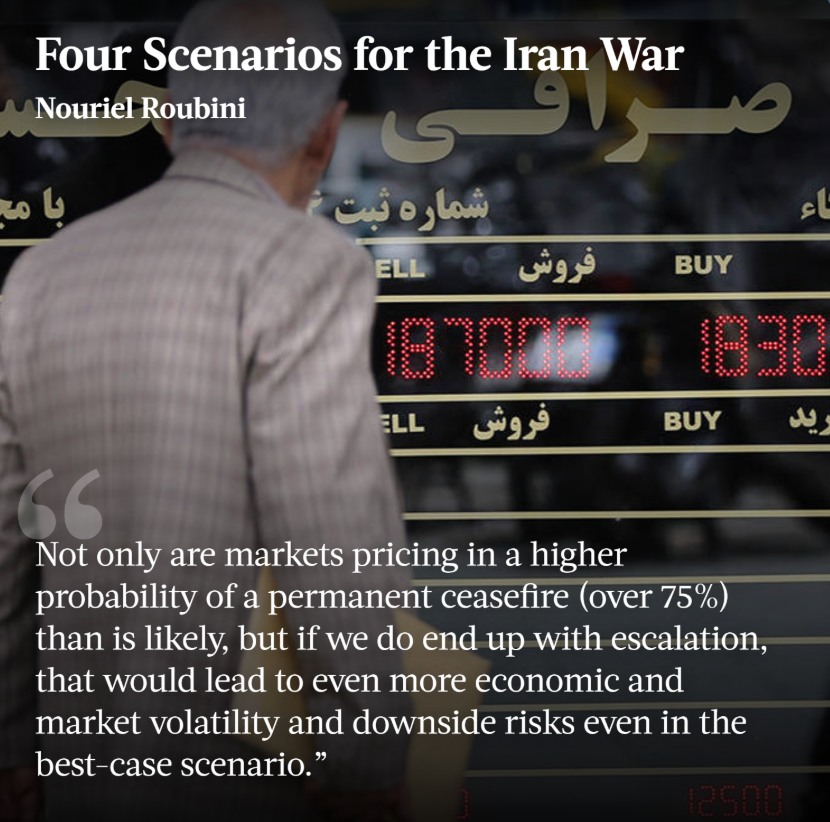
Four Scenarios for the Iran War by Nouriel Roubini
After failing to clinch a decisive victory against Iran, US President Donald Trump is now facing deteriorating macroeconomic conditions ahead of November's midterm elections. With his options limited, he has been left to choose between wishful thinking and a high-risk re-escalation of hostilities.
@ProSyn https://t.co/uyJsfbb0jc
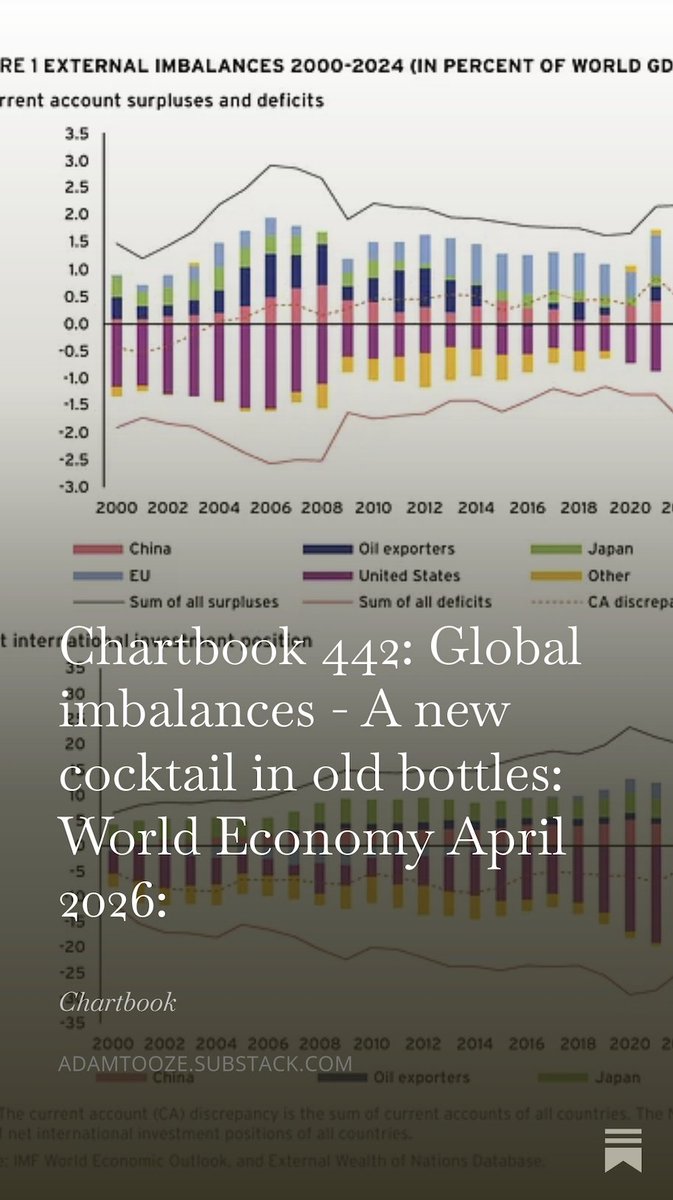
Global imbalances - April 2026. A new cocktail in old bottles.
The latest Chartbook newsletter just dropped.
Check it out here:
https://t.co/mMfEDcYvoJ
دقة العمل... عنوان التقدير.
عبّر نوريال روبيني، أستاذ فخري لعلوم الاقتصاد وإدارة الأعمال الدولية في كلية ستيرن للأعمال بجامعة نيويورك، في ختام مشاركته في ملتقى "الاستثمار بحر من The Family Office"، عن ثناءه على التجربة بأكملها.
@Nouriel
Perhaps useful to point out that history rhymes: this is effectively what happened with telephone operators, 100 years ago. Young, entry-level operators, whose work was mainly connecting local calls--the simplest version of the job--and not much else, were wiped out by automatic call switching. More senior operators, who had a wider range of tasks and did more complicated work like information service, emergency service, and long distance calls, were not as affected. Even when local telephone operators were effectively eliminated across AT&T's network, the others remained. Much had to do with the complexity of the work and how entangled it was with the rest of the organization.
Extended discussion in work with @jamesfeigenbaum in @QJEHarvard and Management Science: https://t.co/ZKkH3DyuiR, https://t.co/EJTBbX0nkp
Lots of credit to @joshgans for helping us sharpen some of these ideas in this work as editor of the ManSci paper
1/10 The U.S. naval blockade of the Strait of Hormuz would cost Iran approximately $276M/day in lost exports and disrupt $159M/day in imports, a combined economic damage of ~$435M/day, or $13B/month.
Over 90% of Iran's $109.7B in annual trade transits the Persian Gulf. Oil/gas accounts for 80% of government export earnings and 23.7% of GDP. Kharg Island alone generates ~$53B/year, or as I noted to @TIME, "$78 billion a year in energy revenue.
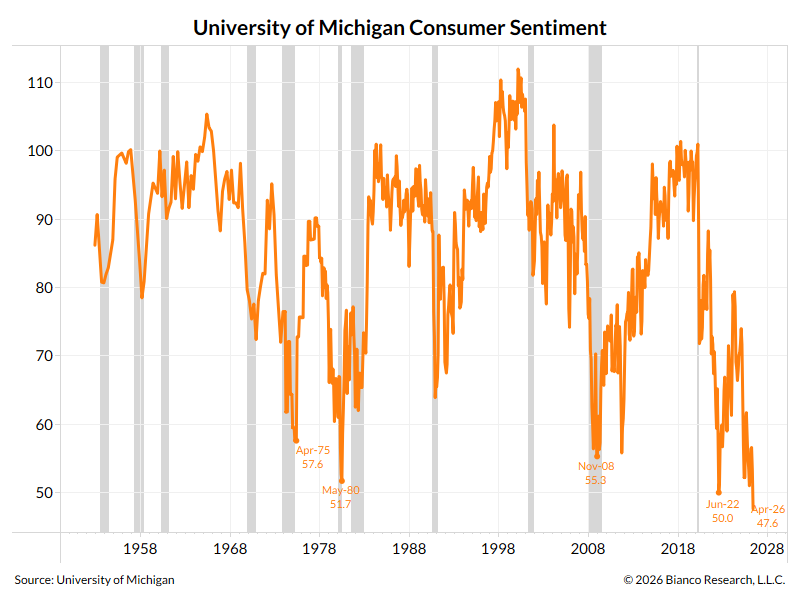
The University of Michigan has been conducting a consumer confidence survey for 74 years (starting in 1952). The lowest reading in this history is the number out today for April 2026 at 47.6.
The commentary from the University of Michigan attributes it solely to the war, since 98% of their surveys were conducted before the April 7th ceasefire announcement.
I find this explanation wanting.
Since 1952, we've had our share of wars and 9/11. Yet the conflict has produced a 74-year low among consumers, but only a 3% correction in the stock market. Does this make sense?
Regarding the current conflict, is it worse than the Korean War, the historic protests over the Vietnam War in the 1970s, or the never-ending quagmire in Iraq? This was the conflict that drove us to a 74-year low?
Maybe it is the affordability crisis, which is really the cumulative increase of inflation over the last five or six years, which is being missed by economists who look at the year-over-year rate and try to say it is "well anchored."
This would be my guess.