lmao, Epoch III for @primus_labs it is. honestly, at this point i won't even be surprised if we get Epoch IV, V and VI too.
if you check the @KaitoAI content page, you'll notice that an Epoch 4 period has already been added.
and who knows, maybe primus will finally TGE when BTC decides to get back to $100k.
anyway, what can we do? we're already here, so might as well keep posting and stay active.
but imagine spending 4 months creating content, yapping every day and showing up for every epoch, only to end up with peanuts as a reward.
i'm still enjoying the journey, but please don't make us go through another 4 months just for that haha.
InfoFi is already fighting for its life. one more disappointing reward season and we'll be back to saying it's dead again.
FHE is moving from cryptographic theory toward practical infrastructure.
Primus is attacking that bottleneck with AutoHoG.
~90ms per confidential transfer. 210+ transfers per second across 8 NVIDIA RTX 5090 GPUs.
#FHE#PrimusLabs#ZeroKnowledge https://t.co/ywPZyKb7N9
lmao, Epoch III for @primus_labs it is. honestly, at this point i won't even be surprised if we get Epoch IV, V and VI too.
if you check the @KaitoAI content page, you'll notice that an Epoch 4 period has already been added.
and who knows, maybe primus will finally TGE when BTC decides to get back to $100k.
anyway, what can we do? we're already here, so might as well keep posting and stay active.
but imagine spending 4 months creating content, yapping every day and showing up for every epoch, only to end up with peanuts as a reward.
i'm still enjoying the journey, but please don't make us go through another 4 months just for that haha.
InfoFi is already fighting for its life. one more disappointing reward season and we'll be back to saying it's dead again.
yesterday, or today early morning according to asian time zone to be exactly @primus_labs epoch2 has officially ended.
epoch3 has started with showing epoch4 on the pipeline after this ends.
why am i positive about this project?
community is talking about just secutity, privacy identity verification and data protection, in real if you are already using @KaitoAI pulse extension which is mandatory now is powered by primus labs.
on kaito website when you go in my credentials section we can see re verify option.
it is used for updating X impression ongoing data into kaito pulse API.
this data updation as well as process is already powered by primus labs.
you can see clear written in bottom of the kaito api update section popup.
onchain activities are also growing in large numbers. as more community is verifiying points by linking various platforms to it.
i am focuing on quality control on my posts as well as working on aura points as well. for small creator like me i think improving myself will help me in orignal networking, X algo readjusting for better results.
so if you are working on kaito start improving your quality.
what if you could move money on-chain without ever revealing your balance, while the network still processes the transaction in milliseconds?
that's the promise of FHE, and @primus_labs is working on making it practical.
Fully Homomorphic Encryption allows applications to compute on encrypted data without exposing what's inside it.
but there's been one major problem holding it back, computation speed.
plenty of protocols talk about FHE, but making encrypted transactions fast enough for real financial activity is a completely different challenge.
this is where Primus comes in with AutoHoG.
according to Primus, AutoHoG can process a confidential transfer involving fully encrypted 64-bit balances in around 90 milliseconds.
with 8 NVIDIA RTX 5090 GPUs, the system reportedly delivers more than 210 confidential transfers per second.
your financial data stays encrypted, computations still happen, and transactions can be processed at a speed that starts making private on-chain finance feel practical.
FHE has always had huge potential. the real question was whether it could become fast enough to use beyond experiments.
AutoHoG is an interesting step in that direction.
the next breakthrough in on-chain finance might not be making transactions faster to see, but making them faster without seeing the data at all.
Primus Points: https://t.co/LCEA8aSfb7
Kaito: https://t.co/h6Yaw2AYoR
#Primus #Kaito #zkTLS #FHE #BASEChain #DeFi #Privacy #Web3Gaming
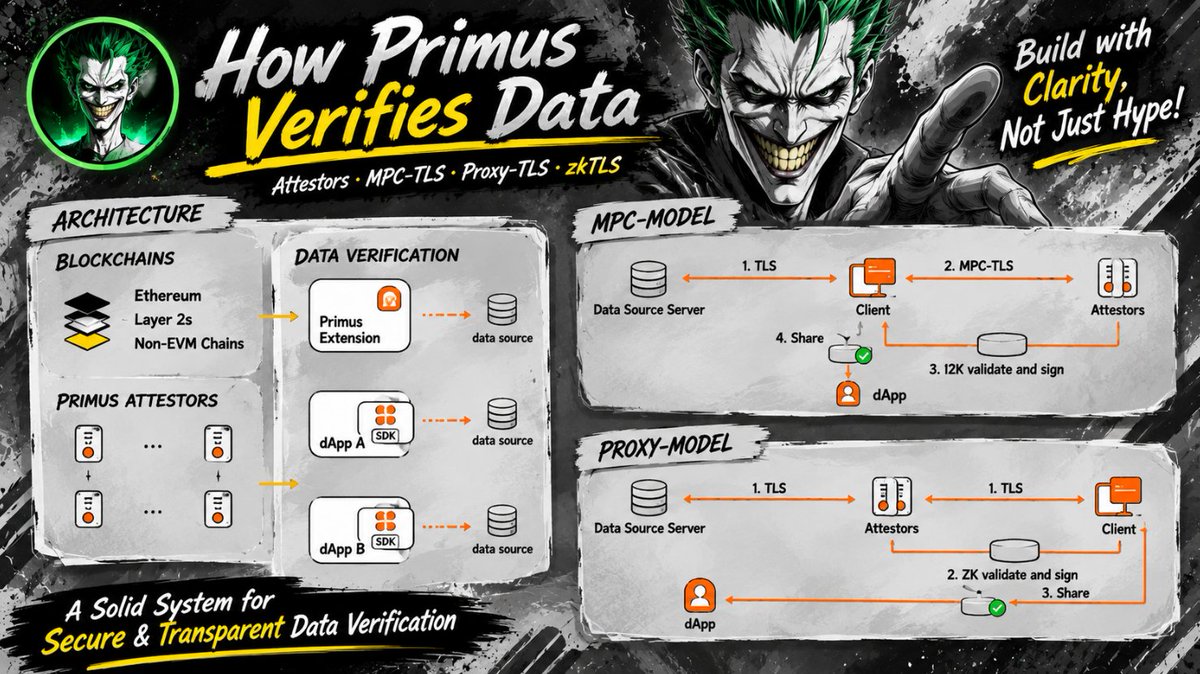
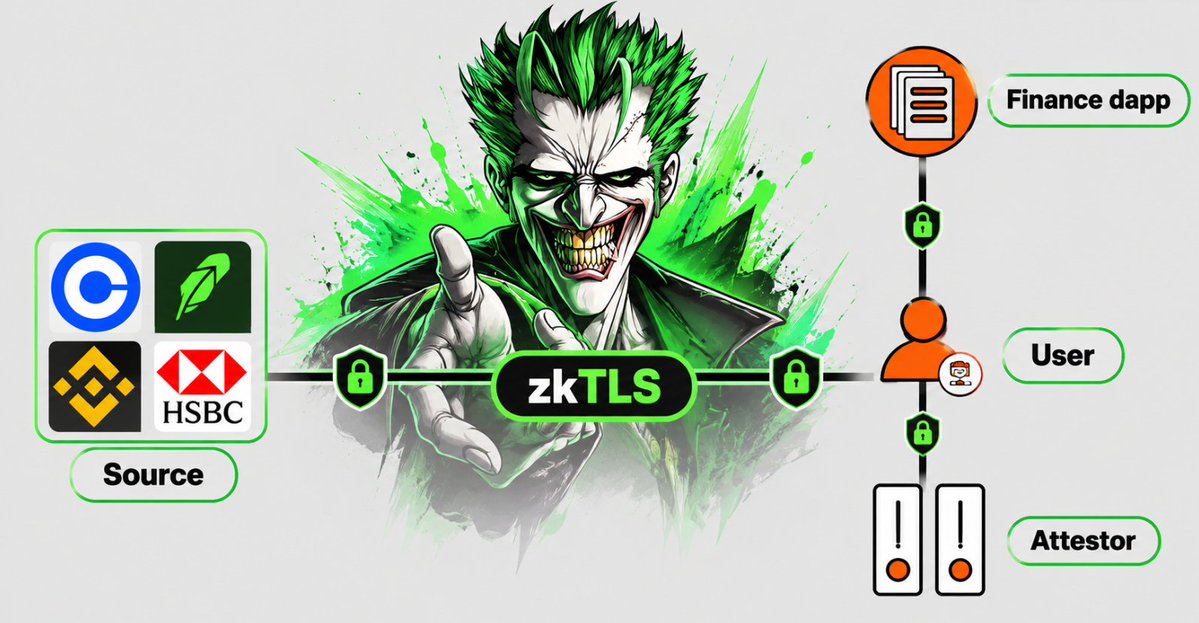
been looking more into why @primus_labs uses zkTLS, and the idea is actually pretty interesting.
think about how much of our real information is still sitting on regular websites. bank balances, KYC records, exchange activity, social data and more.
now imagine a Web3 app needs to verify something from that data, but you don't want to hand over your entire account history or expose all your personal details.
Primus supports two ways to do this:
MPC Mode
you and the verifier work together to establish a secure connection. the process is designed to prevent either side from secretly changing the data before the proof is generated.
Primus uses its QuickSilver technology to make this process more efficient.
Proxy Mode
here, a proxy helps relay and record the encrypted communication. you can then generate a proof based on the original messages without exposing the private information itself.
the interesting part is that developers can choose between these approaches depending on what they need, whether that's stronger security or a faster experience, through one API.
to me, this is one of the more useful directions for zkTLS.
Web3 doesn't need every piece of our data to live on-chain. sometimes it just needs a reliable way to verify information that already exists in Web2.
that's the bridge Primus is working on: bringing real-world data into Web3 while keeping privacy in the picture.
especially interesting for institutional finance, confidential finance, identity and verification use cases, and the growing BNB ecosystem.
privacy and verification need to work together. that's what makes this worth watching.
@KaitoAI has already adding Aura to the Katalyst campaign reward formula.
until now, most creators were focused on mindshare, but things are getting a little different.
verified followers, actual reach, and Aura are now part of the picture too.
i think this is an interesting move because impressions alone don't tell the whole story. someone can post all day, but that doesn't necessarily mean they're building influence or a real community.
now there's more to pay attention to than just posting consistently.
if you're participating in Katalyst, don't overlook your Aura. it might matter more than you think.
Primus Points: https://t.co/LCEA8aSfb7
Kaito: https://t.co/h6Yaw2AYoR
#Primus #Kaito #zkTLS #FHE #BASEChain #DeFi #Privacy #Web3
as the world moves forward rapidly with technological innovations, progress, and development, keeping records of everything requires enormous resources to collect, manage, and preserve data in this digital era.
data is being taken more seriously than ever before. the thieves and robbers of modern times don't just break into vaults using traditional tools. they have also evolved and learned to exploit technology.
in the past week, we witnessed one of the biggest exchange hacks, reportedly costing the community almost $6.35 billion.
it's not just technology that's progressing. the financial sector is also heavily adopting these innovations to improve security, protect users' privacy, and uphold their fundamental rights. in the crypto ecosystem, the security and safety of user data can sometimes depend on just a few clicks, creating enormous risks.
every day, millions of community members face these risks, knowing that one wrong click could wipe out their entire life savings and years of hard work.
at a recent Devcon event in Mumbai, Ethereum founder Vitalik Buterin gave the audience a clear message about data:
"we should treat data as toxic waste."
this means developers should make data protection a top priority before launching any project that will serve millions of users around the globe.
@primus_labs is a verification layer and a platform focused on maintaining security and privacy. It brings zkTLS and FHE technology into users' everyday crypto activities.
Primus is built around an attestor node infrastructure that focuses on financial transactions across Web3, including dApps, applications, and software.
in today's highly competitive tech environment, developers often prioritize launching products as quickly as possible and testing them at scale. unfortunately, security concerns sometimes receive secondary attention, which can lead to vulnerabilities.
Primus aims to address this problem while minimizing unnecessary processes that can slow down transactions or create network congestion, making verification more accessible with just a few clicks.
its main goal is to keep sensitive data private while processing verification onchain.
if you're checking out Primus, take a look at the points tasks too. easy to overlook, but worth exploring while you're there.
Primus Points: https://t.co/LCEA8aSfb7
Kaito: https://t.co/h6Yaw2AYoR
#Primus #Kaito #zkTLS #FHE #DeFi #Privacy #Web3
what if you could move money on-chain without ever revealing your balance, while the network still processes the transaction in milliseconds?
that's the promise of FHE, and @primus_labs is working on making it practical.
Fully Homomorphic Encryption allows applications to compute on encrypted data without exposing what's inside it.
but there's been one major problem holding it back, computation speed.
plenty of protocols talk about FHE, but making encrypted transactions fast enough for real financial activity is a completely different challenge.
this is where Primus comes in with AutoHoG.
according to Primus, AutoHoG can process a confidential transfer involving fully encrypted 64-bit balances in around 90 milliseconds.
with 8 NVIDIA RTX 5090 GPUs, the system reportedly delivers more than 210 confidential transfers per second.
your financial data stays encrypted, computations still happen, and transactions can be processed at a speed that starts making private on-chain finance feel practical.
FHE has always had huge potential. the real question was whether it could become fast enough to use beyond experiments.
AutoHoG is an interesting step in that direction.
the next breakthrough in on-chain finance might not be making transactions faster to see, but making them faster without seeing the data at all.
Primus Points: https://t.co/LCEA8aSfb7
Kaito: https://t.co/h6Yaw2AYoR
#Primus #Kaito #zkTLS #FHE #BASEChain #DeFi #Privacy #Web3Gaming
buying crypto with fiat shouldn't force you to choose between waiting on slow escrow or handing over your entire bank statement just to prove you made a payment.
that's the problem @primus_labs is trying to fix with zkTLS.
and honestly, this is one of the more interesting real-world use cases for zero-knowledge technology.
Primus Labs, formerly PADO Labs, was founded in Hong Kong in 2022. the team is building a verification layer that connects everyday Web2 data with on-chain applications.
they've raised $6.5M from investors including VanEck, Samsung Next, Dispersion Capital and Alchemy. according to their reported figures, they also have 1M+ users, 10+ paid enterprise customers and over $72M in Proof-of-Reserves TVL.
but let's look at the part that actually matters.
how does zkTLS make P2P fiat-to-crypto payments better?
normally, when you buy crypto through P2P, you send money using PayPal, Venmo, Revolut, Wise, Zelle, Cash App or a bank transfer.
then comes the annoying part: proving you actually paid.
screenshots, receipts, personal details and sometimes way more financial information than anyone needs to see.
with Primus, the idea is different.
you make the payment normally. zkTLS then generates a zero-knowledge proof from your TLS session, confirming only the required details:
> payment was completed
> the amount is correct
> the recipient matches
> the timestamp is valid
the proof goes to an on-chain escrow contract, and once the payment is verified, the crypto can be released automatically.
no need to expose your full transaction history, account balance or login credentials just to prove one payment.
and Primus isn't stopping at P2P.
some of the use cases already reported include:
- Unitas Labs: real-time Proof of Reserves for its gold-backed XGLD asset.
- BNB Chain: zkTLS verification has been live since June 23, 2026.
- ZKredit: working with BNB Chain and Brevis to bring privacy-preserving credit data into DeFi, including Binance tenure, payment records and balance proofs.
- Kaito Pulse: launched August 18, 2026, allowing users to prove Binance and Polymarket positions on X without sharing passwords.
- AllScale: confidential payroll validation using FHE on BNB Chain, keeping salary information encrypted while enabling on-chain settlement.
there's also an interesting technical question people should be asking.
what happens when PayPal, a bank or another Web2 platform changes its website layout or response structure?
Primus doesn't simply depend on screenshots. it uses attestation templates designed for specific API responses and page structures.
if a provider changes something, the relevant template needs to be updated through its attestor network, AlphaNet.
previously generated proofs remain valid, but generating new proofs may require an updated template.
that's an important tradeoff to understand. zkTLS can verify data without exposing the underlying information, but the connection to Web2 services still needs maintenance when those services change.
still, think about what this could mean for everyday P2P trading.
less dependence on screenshots. less unnecessary sharing of personal financial information. and a way to make payment verification work directly with on-chain escrow.
this is the kind of practical problem zkTLS should be solving.
your payment data should prove what happened, not reveal everything about you.
that's the direction i want to see crypto onramps moving towards.
Primus Points: https://t.co/LCEA8aSfb7
Kaito: https://t.co/h6Yaw2AYoR
#Primus #Kaito #zkTLS #FHE #BASEChain #DeFi #Privacy #Web3
the L2 race is changing, and I don't think every chain is ready for what comes next.
i've been thinking about where the L2 space is heading, and honestly, i don't think launching another chain is enough anymore.
we've seen so many L2s launch with big promises, cheap transactions and incentive campaigns. but once the hype settles, a much harder question comes up: are people actually using these chains because they need them, or just because there's something to farm?
that's where i think the next phase will be different.
not every L2 needs to survive. the ones without real users, active developers, liquidity or something unique to offer will eventually struggle. having your own chain doesn't mean you've built an ecosystem.
another thing that needs serious improvement is how these networks work together. users shouldn't have to think about bridges, gas tokens or which network their assets are sitting on. using crypto across different chains should feel simple, not like a technical exercise.
i also think we'll see more focus on infrastructure built for specific use cases. DeFi, gaming, payments and AI have different needs. there's room for specialized networks, but only if they're actually making something better.
and honestly, i'm more interested in real usage than impressive dashboards. TVL and transaction numbers don't tell the whole story. what happens when incentives stop? do users stay? are developers still building? is there enough organic activity to support the network?
this is one reason i'm keeping an eye on Arbitrum.
Arbitrum has already built a strong place in the Ethereum ecosystem. but being an established L2 isn't a guarantee of long-term success. the real test is what comes next.
can it keep attracting builders? can it bring more useful applications and liquidity into its ecosystem? can it make the experience better for people who don't want to think about the technical side of blockchain?
that's what i'd like to see from Arbitrum going forward.
i don't believe the winner will be whichever L2 has the biggest marketing budget or the highest transaction count.
it'll be the network people keep building on and using even when there are no points, airdrops or incentives involved.
Ethereum can have dozens of L2s, but only a few may end up building ecosystems that really last.
the L2 race isn't just about who can scale Ethereum anymore. it's about who can build something people actually want to use.
Arbitrum has an interesting role to play in that future.
what if you could move money on-chain without ever revealing your balance, while the network still processes the transaction in milliseconds?
that's the promise of FHE, and @primus_labs is working on making it practical.
Fully Homomorphic Encryption allows applications to compute on encrypted data without exposing what's inside it.
but there's been one major problem holding it back, computation speed.
plenty of protocols talk about FHE, but making encrypted transactions fast enough for real financial activity is a completely different challenge.
this is where Primus comes in with AutoHoG.
according to Primus, AutoHoG can process a confidential transfer involving fully encrypted 64-bit balances in around 90 milliseconds.
with 8 NVIDIA RTX 5090 GPUs, the system reportedly delivers more than 210 confidential transfers per second.
your financial data stays encrypted, computations still happen, and transactions can be processed at a speed that starts making private on-chain finance feel practical.
FHE has always had huge potential. the real question was whether it could become fast enough to use beyond experiments.
AutoHoG is an interesting step in that direction.
the next breakthrough in on-chain finance might not be making transactions faster to see, but making them faster without seeing the data at all.
Primus Points: https://t.co/LCEA8aSfb7
Kaito: https://t.co/h6Yaw2AYoR
#Primus #Kaito #zkTLS #FHE #BASEChain #DeFi #Privacy #Web3Gaming
been looking more into why @primus_labs uses zkTLS, and the idea is actually pretty interesting.
think about how much of our real information is still sitting on regular websites. bank balances, KYC records, exchange activity, social data and more.
now imagine a Web3 app needs to verify something from that data, but you don't want to hand over your entire account history or expose all your personal details.
Primus supports two ways to do this:
MPC Mode
you and the verifier work together to establish a secure connection. the process is designed to prevent either side from secretly changing the data before the proof is generated.
Primus uses its QuickSilver technology to make this process more efficient.
Proxy Mode
here, a proxy helps relay and record the encrypted communication. you can then generate a proof based on the original messages without exposing the private information itself.
the interesting part is that developers can choose between these approaches depending on what they need, whether that's stronger security or a faster experience, through one API.
to me, this is one of the more useful directions for zkTLS.
Web3 doesn't need every piece of our data to live on-chain. sometimes it just needs a reliable way to verify information that already exists in Web2.
that's the bridge Primus is working on: bringing real-world data into Web3 while keeping privacy in the picture.
especially interesting for institutional finance, confidential finance, identity and verification use cases, and the growing BNB ecosystem.
privacy and verification need to work together. that's what makes this worth watching.
@KaitoAI has already adding Aura to the Katalyst campaign reward formula.
until now, most creators were focused on mindshare, but things are getting a little different.
verified followers, actual reach, and Aura are now part of the picture too.
i think this is an interesting move because impressions alone don't tell the whole story. someone can post all day, but that doesn't necessarily mean they're building influence or a real community.
now there's more to pay attention to than just posting consistently.
if you're participating in Katalyst, don't overlook your Aura. it might matter more than you think.
Primus Points: https://t.co/LCEA8aSfb7
Kaito: https://t.co/h6Yaw2AYoR
#Primus #Kaito #zkTLS #FHE #BASEChain #DeFi #Privacy #Web3