Associate Professor at International University of Sarajevo. Energy security & sustainability. Proud Northern Arizona University alumnus. Friend to all cats.
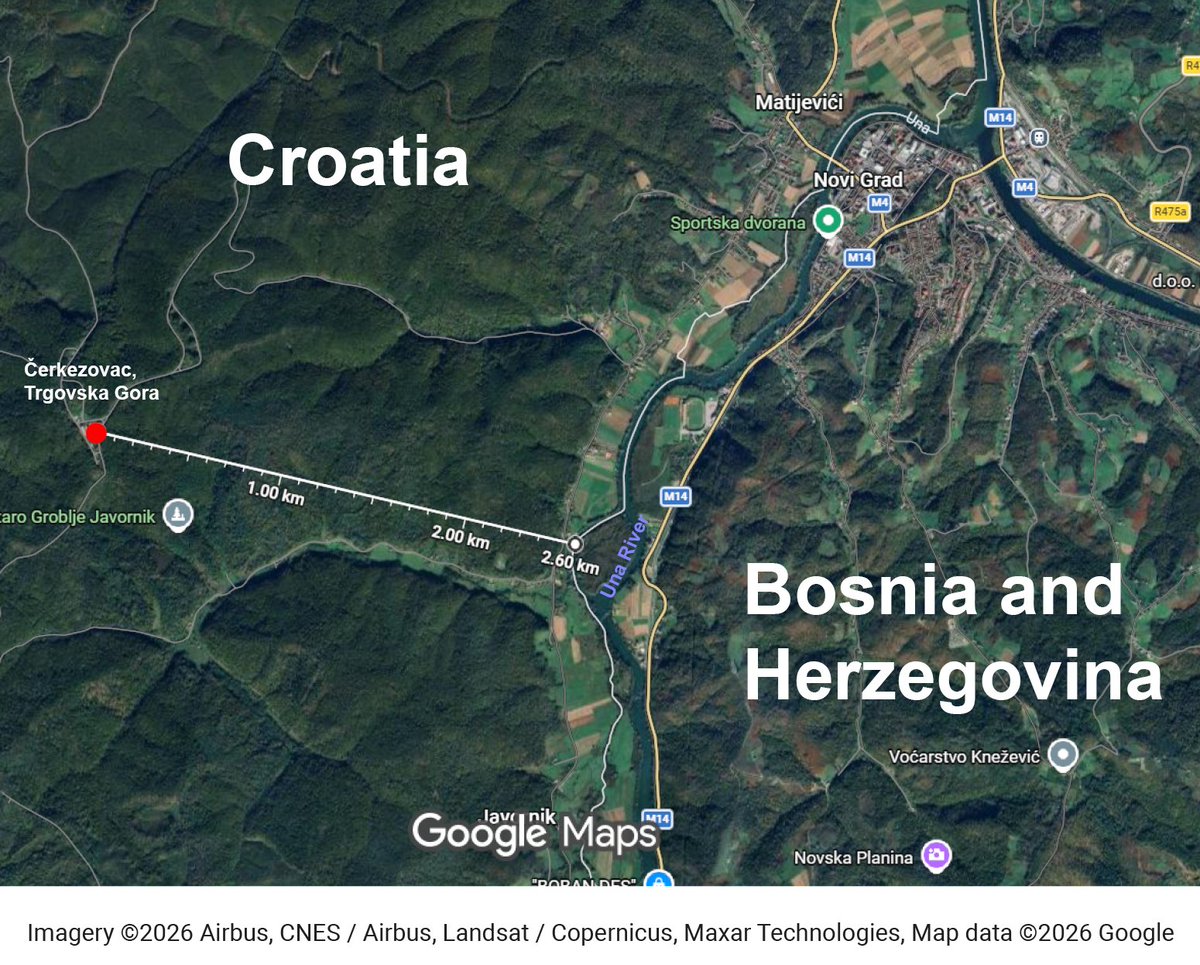
Croatia is preparing to build its national centre for radioactive waste at Čerkezovac, a former Yugoslav army storage complex on Trgovska Gora. The site sits on the border with Bosnia and Herzegovina, just above the Una River. More than 300,000 residents of Bosnia and Herzegovina live within 50 kilometers of it, compared with fewer than 5,000 Croatians.
An environmental impact assessment is still pending, but the decision is being treated as settled. The site has been handed over to the fund responsible for Krško's waste, storage containers have been delivered, and demolition of old military buildings has begun.
Most of the radioactive waste would come to Trgovska Gora from Krško, the Yugoslav-era nuclear power plant in Slovenia that Croatia co-owns 50/50. The original Krško agreements made no clear provision for nuclear waste, and the question was still unresolved when Yugoslavia dissolved. Talks on a joint facility failed, and Slovenia is now building its own repository at Vrbina. Krško's on-site temporary storage was nearing capacity, and in 2020 the European Commission opened an infringement procedure over Croatia's waste program. Zagreb needed a site.
Croatia is obliged to take over its half of the plant's low- and intermediate-level waste, from both operation and eventual decommissioning. The centre at Trgovska Gora would also hold Croatia's own institutional waste and disused radioactive sources from medicine, industry and research. The waste would arrive already conditioned, in reinforced-concrete containers. The takeover from Krško is scheduled to begin in 2028, with storage at Čerkezovac for up to 40 years.
Officially, spent nuclear fuel will not be stored there – it remains in dry storage at Krško. Croatia presents Čerkezovac as interim storage. Bosnia and Herzegovina fears it could become a long-term site including for spent fuel and high-level waste.
The distribution of costs and benefits is strong. Croatia receives its share of Krško's electricity and its EU compliance. Bosnia and Herzegovina receives none of the benefits – only the long-term risk.
The terrain of Trgovska Gora is limestone over alluvial sands, and both are highly permeable. Streams from the slopes drain directly into the Una and Žirovnica rivers, and from there into the Sava and the Danube. These short pathways mean that even small releases could reach downstream communities quickly.
The site lies in seismic intensity zone VII, 3.5–4 km from the active Glina–Prijedor fault. The magnitude 6.4 Petrinja earthquake of December 2020 struck the same region. Preliminary engineering assessments conclude that the site meets regulatory seismic criteria. The regional tectonic setting nonetheless remains a long-term risk for a facility that must contain radionuclides for decades.
On paper, Bosnia and Herzegovina was consulted. In practice, it had little real influence over the decision-making process.
Bosnia and Herzegovina's opposition to the project has been largely ineffective, and two constraints limited the response. First, EU candidacy status discourages open confrontation with a member state, so objections tend to be framed cautiously and technically. Second, the fragmented institutions created by the Dayton Agreement complicate prospects for a unified state-level response.
In our new article in Energy Research & Social Science, we analyze Trgovska Gora as a case of multinational energy injustice.
Free access until 6 November 2026:
https://t.co/yYkgKk7CJk
The Southern Gas Interconnection (SIC) is finally moving toward implementation phase in Bosnia and Herzegovina.
For decades, Bosnia and Herzegovina has depended on a single Russian natural gas supply route through the old Soyuz pipeline, now rerouted via TurkStream. With virtually no domestic gas production and zero storage facilities, any disruption – technical, commercial or geopolitical – immediately hits industry and heating across the country.
From 2020 through 2026, the US Embassy Sarajevo was actively involved in advocating for the project. The major political breakthrough came in 2025 when the Law on the Southern Interconnection was passed after years of deadlock. In 2026, we are entering the implementation phase. American private-sector companies have stepped in to develop, build and manage the pipeline and construction could begin as early as this year.
That is why the Southern Interconnection matters.
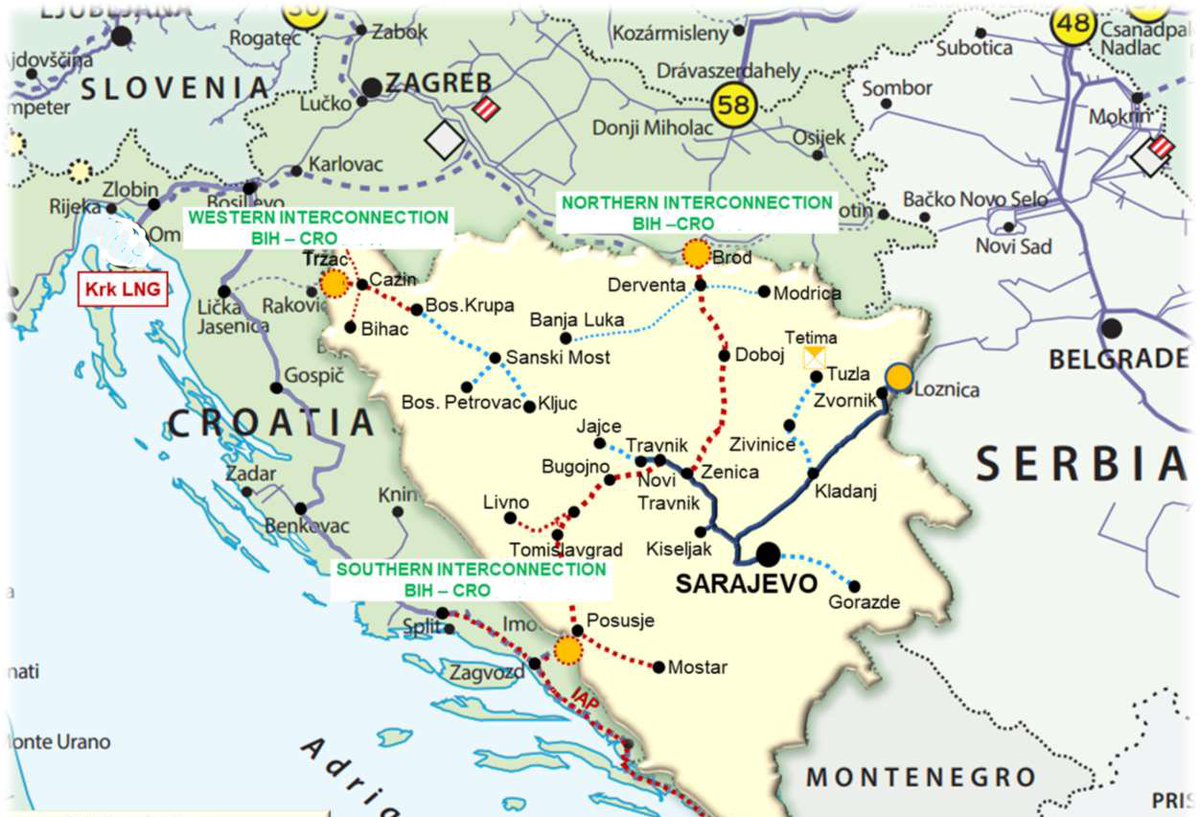
The project will deliver a brand-new 169 km pipeline on BiH territory (total route 243 km including the Croatian section) from Croatia’s Krk LNG terminal straight into Herzegovina and onward to Central Bosnia. Designed capacity: up to 1.5 bcm per year — roughly six times current Bosnia and Herzegovina's consumption. For the first time the country will have direct access to global LNG markets, with the future option of natural gas from Azerbaijan via the Ionian-Adriatic Pipeline. It will also finally bring natural gas to large parts of the Herzegovina region.
The strategic benefits are clear: genuine diversification of energy types and suppliers and, a result, stronger energy security for the country.
Challenges remain, however. The project cost is now estimated at around $200 million, global LNG prices are volatile, and key steps such as land acquisition, urban planning approvals and the final Bosnia and Herzegovina-Croatia intergovernmental agreement are still on the critical path.
More in-depth analysis of the political dynamics and external pressure behind Southern Gas Interconnection in my article co-authored with Ismet Fatih Čančar and recently published in European Politics and Society.
https://t.co/mOsRhs1CsW
@CheckFacter Статистическая закономерность это именно закономерность, вероятностное обобщение, а не правило, ибо в логике правило это универсальное утверждение, и оно опровергается единственным контрпримером.
@CheckFacter В элементарной логике, тест на которую вы предлагаете пройти, под правилами понимаются именно универсальные, а не статистические или бытовые утверждения. "Все простые числа нечетные" - тоже плохо сформулировано?
@matthewstoller I'm wondering, is there an English word, say, for getting a leg up on admission to an elite university simply because your parent is a mega-rich donor, an ifluencial politician, or a university insider? Because that's pretty much what the oh-so-exotic Soviet "blat" meant.
@matthewstoller In capitalist economies, the equivalent roles are filled by "procurement managers," who routinely leverage personal networks and favors to secure supplies, win contracts, negotiate better prices, or gain priority access for their companies.
As with the large number of 'blatniks' in the Soviet era who made sure their factories got what they needed outside the formal state procurement process They were not called "blatniks." These mid-level lobbyists were known as "tolkachi" (pushers)/"snabzhentsi" (suppliers). ->
My commentary to @Oslobodjenjeba newspaper on Serbia's oil company NIS takeover by Hungary's @MOL_Group and its impact on the energy market in Bosnia and Herzegovina:
Although a completed acquisition of NIS would alter the equilibrium between primary competitors in Bosnia and Herzegovina's petroleum market, this transition involves companies already under extensive foreign corporate control. Thus, while the corporate landscape could change significantly, the country's structural dependence on foreign petrol products and companies would remain largely unchanged.
Even though the emergence of a single corporate actor controlling a vast retail and wholesale petrol network in Bosnia and Herzegovina could lead to higher prices and reduced consumer choice, a completed transition of NIS from Gazprom Neft to MOL Group ownership could offer advantages for supply stability and infrastructure development. Under current Russian ownership, NIS faces operational constraints due to international sanctions. Integrating these assets into a Central European corporate structure could decouple the company and its Bosnian subsidiaries from those risks, enabling more consistent investment and secure energy supply.
Full article (in Bosnian): https://t.co/CFEWLvw97T
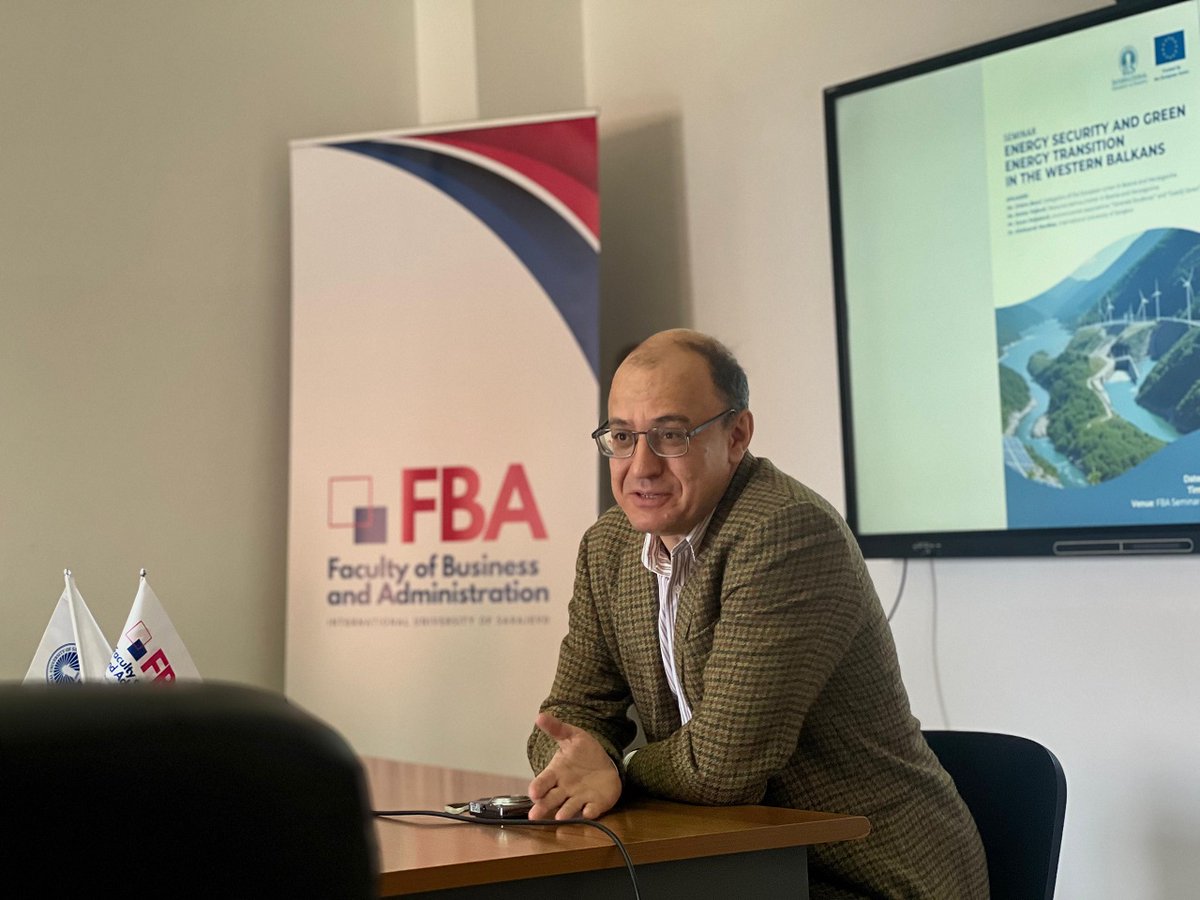
Associate Professor Dr. Aliaksandr Novikau from the Political Science and International Relations (PSIR) study program at the IUS Faculty of Business and Administration (FBA) leads the Jean Monnet Module – European Energy Security, a project funded by the European Union.
In a recent feature, he highlights the importance of aligning BiH with EU energy policies, strengthening regional cooperation, and ensuring a just transition towards renewable energy while protecting jobs in the coal sector.
👉 Read more here: https://t.co/Y1JnHTgocs
#iussarajevo #jeanmonnet #energysecurity #eufunded #sustainability #regionalcooperation