W związku z tragicznym atakiem na Rynku Głównym w Krakowie 8 i 9 listopada 2026 r. ogłoszono dniami żałoby narodowej.
Myślami jesteśmy z ofiarami, poszkodowanymi i ich bliskimi. Wszystkim dotkniętym tragedią wyrażamy głębokie współczucie i solidarność.
Kraków od stuleci jest jednym z najważniejszych ośrodków polskiej nauki. ��ączymy się w smutku z jego mieszkańcami oraz z całą krakowską społecznością akademicką: studentami, naukowcami i pracownikami uczelni.
Dziękujemy policjantom, ratownikom medycznym i wszystkim służbom, które niosły pomoc. Rannym życzymy powrotu do zdrowia.
Minister Nauki i Szkolnictwa Wyższego wraz z pracownikami resortu
@GallinPeter@sonukg4india Dear Professor. Excellent work! For better clarity, I think it's worth adding a reference to the golden ratio identity Φ²=Φ+1 and the inscribed angle theorem. What do you think?
@chris_juravich@USDescartes Elegant solution. 'Big O' notation. Do you think we could use Big O in some areas of law? Someone said math is always precise and definitive :)
@chris_juravich@CPierre67@USDescartes Cauchy's product theorem states that if at least one of the series is absolutely convergent, then their product converges to the expected value
Yeah, instead of 'alternative methods', I should've said what @CPierre67 suggested 😉
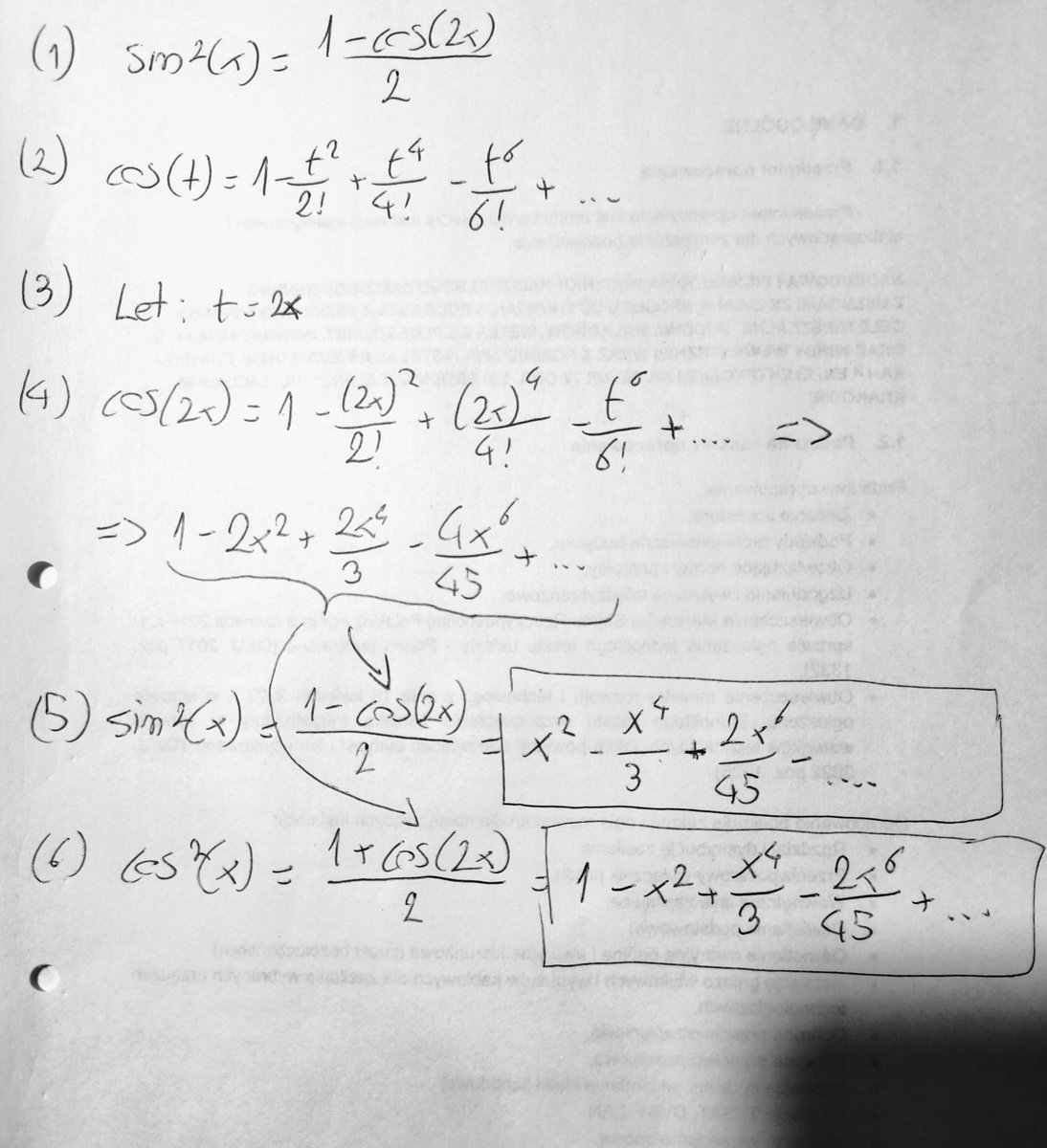
@chris_juravich@CPierre67@USDescartes Your method of multiplying the Maclaurin series for the functions sin(x) & cos(x) is completely valid. The power series of the functions sin(x) & cos(x) are absolutely convergent for every x={R}.
I've noticed something puzzling and exciting when I work with abstract algebra and models.
In physics, we have the notion of supercriticality, i.e., when you follow the liquid-gas coexistence curve as temperature and pressure increase, you reach a critical point beyond which matter enters this weird state where it is neither a gas nor a liquid. The distinction between the phases disappears, and it's hard to tell what you're looking at.
I want to say that I've recently experienced this phenomenon a lot in the AIxMaths space, in the region where we consider highly abstract notions from universal algebra. At some point, the level of abstraction becomes so high that you end up talking about objects that are not intuitive to people at all. Every insight in this space comes basically from text, and no human can claim to be superior to LLMs in terms of originality, creativity, etc. Because everything at this level of abstraction is based on text. The new notions, ideas, and progress basically come from text processing, and to admire new theorems, you have to get used to them.
This is something I see personally when I work with semigroups, loops, and other arcane objects using models. One can prompt agents to make synthetic discoveries, and they are capable of original ideas, new insights, etc., because all of this is based on pure text. Even the legendary Irving Kaplansky, when asked what he pictured when thinking about algebraic rings, reportedly said, "I see the letter R." And I think this is much deeper than one might think. Because at some level of abstraction, we enter a supercritical zone of symbolic thinking, and at this level none of our intuitions has a natural background. Every insight is superhuman, alien, and artificial. It's a no-man's land, and everything there is hard-earned. And LLMs are fast and capable. I'm learning now that, once guided well, they can make artificial discoveries. More to report soon. Stay tuned!
@jacekdziwisz@WilczeE Od razu skojarzyłem pewną analogię w do pewnych rozwiązań równań Einsteina. Wyobraźnia zaczęła szaleć gdyż korespondencja plyn-grawitacja (Fluid/Gravity Duality) występuje w teorii strun.Dynamikę płynów można matematycznie opisać językiem geometrii czasoprzestrzeni czarnych dziur
Dotarliśmy do miejsca, gdzie realnie, w prawdziwej matematyce mamy już narzędzie, które potrafi rozwiązywać najtrudniejsze problemy. To absolutny przełom - ocenił dr Bartosz Naskręcki @nasqret rozwiązanie problemu Naviera-Stokesa przez #AI@OpenAI
https://t.co/2hD8AZjCAR
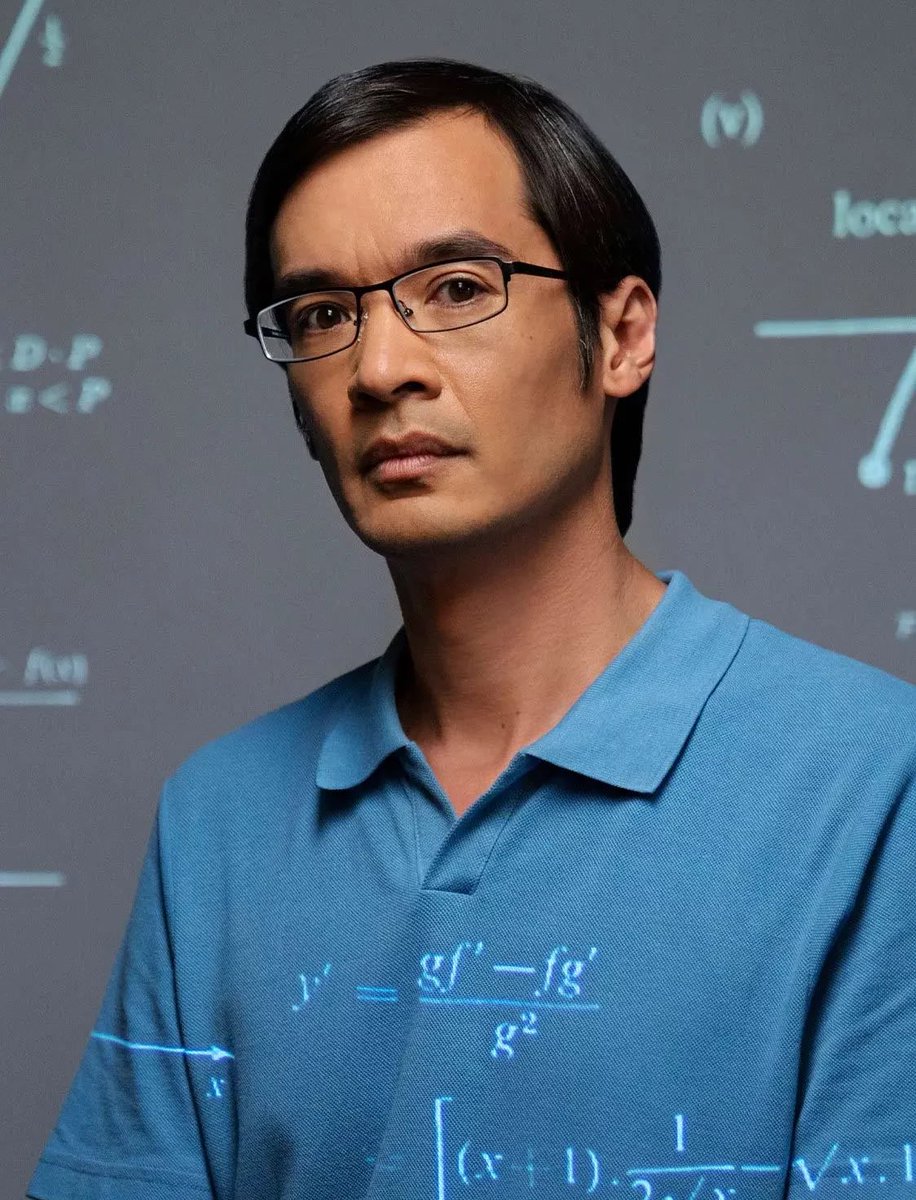
Terence Tao made a very powerful point:
“In most cases in pure mathematics, the problems are posed not because we desperately want the solution to these problems in and of themselves, but because we have seen from past experience that human-directed efforts to solve these problems tend to spur further development of the field through the efforts to solve such problems, and then to digest any partial or complete solutions that emerge for further insights.
Prematurely solving the problem by purely AI-powered methods—particularly without full transparency into the solution process—can contaminate this process to the point where it actually becomes a net negative for the progress of mathematics as a whole.”
I’ve been following Terence Tao for like 20 years, and I have always been impressed by the clarity of his thinking.
This clarity stands out even more in this difficult moment, as AI labs turn mathematics into a battleground in their race for supremacy.
In this race, they risk damaging one of humanity’s highest intellectual endeavours.
Max Born was a brilliant physicist, but he sometimes made small mistakes in long calculations. His students often checked his work.
In 1926, Born asked 22-year-old graduate student Robert Oppenheimer to check the calculations in his paper on quantum mechanics. After several days, Oppenheimer said he could not find any mistakes and asked, “Did you really do it all by yourself?”
Born was 43 at the time. He respected Oppenheimer’s honesty.
During Born’s seminars, Oppenheimer often interrupted speakers, including Born, to correct their calculations. His comments impressed some students but annoyed others.
The students complained to Born, but Born found it difficult to confront Oppenheimer directly. Eventually, the students, led by Maria Goeppert-Mayer, threatened to boycott the lectures if the interruptions continued.
Born then left a fake parchment on his desk, written as a student warning against Oppenheimer’s behavior. When Oppenheimer saw it, he became quiet and stopped interrupting the seminars.
Born later wrote that the plan had worked.
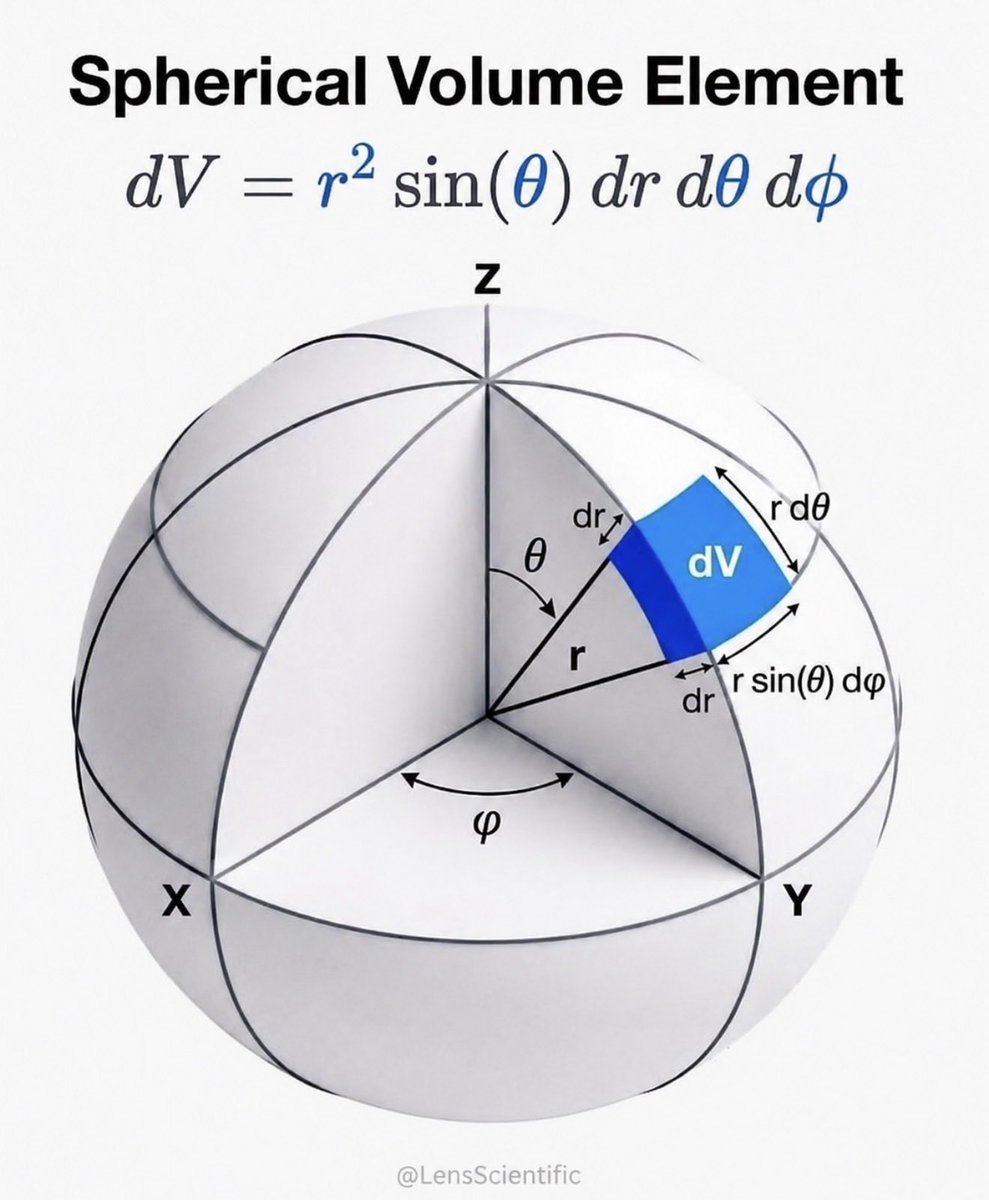
Ever wondered why the spherical volume element contains a sin(θ)?
The answer lies in geometry.
As you move away from the poles, circles of latitude get larger, introducing the r sin(θ) factor that appears in:
dV = r²sin(θ) dr dθ dφ
A beautiful example of mathematics describing 3D space.
@NihzaBG Jeśli celem jest rozwój nauki np. matematyki czy fizyki to widzę to mniej więcej tak. Jednym słowem współpraca i uczciwość (no dobra to były 2 slowa 🤪)
@NihzaBG Naprawdę nie musisz za nic przepraszać. Nie czuję żadnej urazy 😊
AI to potężne narzędzie i nigdy nie powinno byc wstydem dla naukowca, że z niego korzysta, jeśli wykazuje uczciwość i publicznie to przyznaje. Oszust ryzykuje i wcześniej czy później prawda się odsłoni. 👇
@Ricardo92057972 @NihzaBG Oczywiście nie powinnyśmy ograniczać stosowanie AI. Ale nieuczciwych należy filtrować. Z drugiej strony jeśli AI wykona całą pracę od A do Z i będzie ona oznaczona że stworzona przez AI to nie widzę przeszkód by nie dać jej szansy również na takich serwisach jak Mathoverflow.
@NihzaBG Dlatego w czasach AI słowo uczciwość nabiera jakiegoś magicznego znaczenia i wielkiej mocy. Przez AI jest coraz mniej ludzi uczciwych. Problem napędza system gdzie o wartości jakiejś pracy nie stanowi jej treść, ale ilość cytowań
@NihzaBG Pozwoli Pani, że odpowiem w swoim ojczystym języku. Interesujący wątek. To faktycznie może stanowić problem i nie tylko w matematyce kiedy pod wynikami prac, analiz i rozwiązań wykonanych stricte przez AI podpisuje się człowiek przypisując sobie ich wartość.