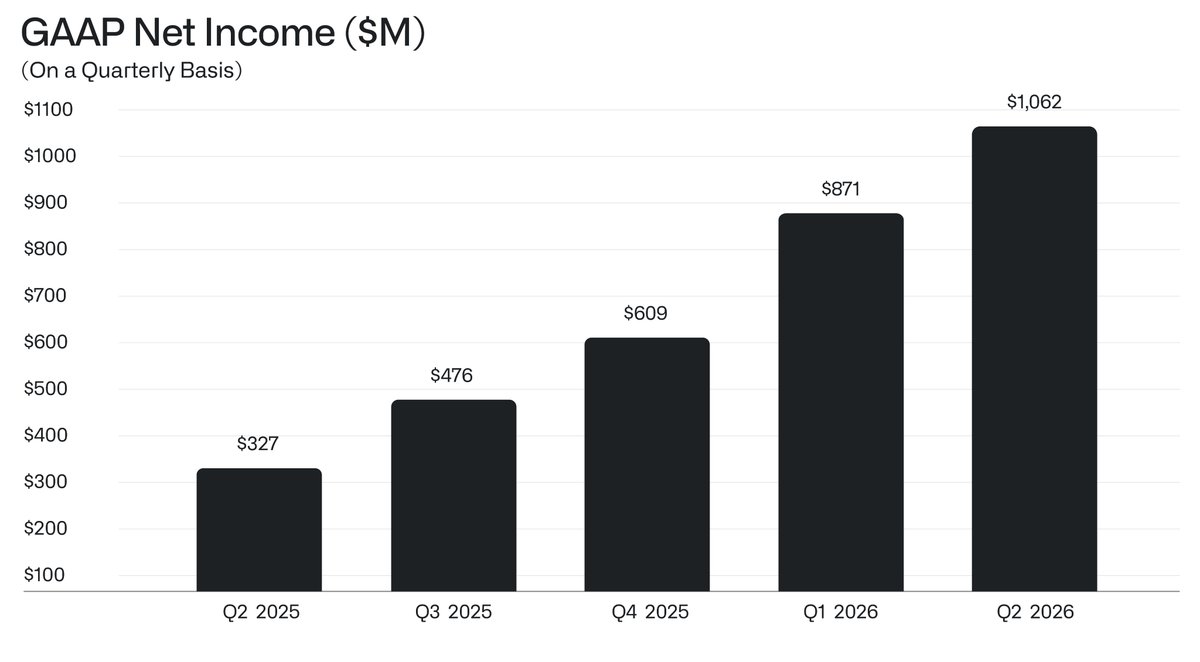
Palantir reports Q2 ‘26 U.S. comm revenue growth of 149% Y/Y and revenue growth of 93% Y/Y; raises FY ’26 revenue guidance to 82% Y/Y growth and U.S. comm revenue guidance to 134% Y/Y, crushing consensus expectations.
Q2 U.S. revenue grew 115% y/y and adjusted operating margin was 62%.
We also generated $1.062 billion in Q2 2026 GAAP net income, representing 55% margin and 225% Y/Y growth.
BREAKING: Palantir $PLTR and Nvidia $NVDA expand their partnership to deliver sovereign AI for the US government and critical infrastructure agencies.
- The Partnership enables agencies to deploy, customize, and post-train NVIDIA Nemotron models on proprietary data.
- Combines NVIDIA AI infrastructure with Palantir platforms for sovereign, mission-critical AI.
- Gives customers control over data, IP, model weights, auditability, authorization, and post-training.
Once again, no matter what the model is…Palantir provides the infrastructure that makes any model operational to enable transformation within an enterprise.
Alex Karp: “Combining Palantir infrastructure with NVIDIA’s AI and Nemotron models will allow the U.S. government to unleash the full power of LLMs while removing the underlying security risks and rational concerns around proprietary insights migrating into the weights of closed models. Moreover, many of our US clients are already using these models, including multiple supporting critical US infrastructure — both private and public — and this will facilitate their radical expansion.”
Jensen Huang: “Open source AI is foundational to national security, public safety and U.S. technology leadership. Palantir’s Nemotron-powered intelligent engine shows how open models can strengthen America’s leadership in AI — giving U.S. government agencies a secure, customizable and fully controlled foundation to build mission-critical AI systems in support of national security.”
$PLTR Japan looking at U.S. AI military system for SDF decision-making 👀🇯🇵
According to multiple government sources, the ministry is looking at Palantir Technologies Inc.’s “Maven Smart System.” 🛡️🔮
June 26, 2026
The Defense Ministry is considering adopting a U.S. military artificial-intelligence system for the Self-Defense Forces’ command-and-control, prompting calls from within the Japanese government for domestic production of such AI programs.
According to multiple government sources, the ministry is looking at Palantir Technologies Inc.’s “Maven Smart System.”
Palantir provides data integration and operational-planning systems, as well as automatic target detection and analysis, for the U.S. Department of Defense.
Palantir’s systems were reportedly used in the U.S.-Israeli airstrikes against Iran in February.
The Takaichi administration plans to revise three key security-related documents in 2026 to include AI in the SDF’s command-and-control decision-support system.
It also plans to reflect part of the related costs in the fiscal 2027 budget request.
Despite the apparent interest in Palantir’s Maven Smart System, the Japanese government has emphasized “AI sovereignty” concerning the autonomous managing of its data and systems.
The AI system provider and the supplying country can determine usability, raising concerns in Japan about dependence on foreign firms and potential information leaks through shared confidential data.
For this reason, calls are rising within the government and the ruling coalition to develop domestic AI command-and-control systems in the mid- to long term.
Some officials have proposed initially combining Japanese and foreign systems for the SDF and eventually switching to an all-Japanese version.
Until now, the SDF has not used AI at the core of command-and-control.
From late January to February, Palantir’s AI system was used during the joint command-post exercise Keen Edge between the SDF and the U.S. Indo-Pacific Command. 🌟
🇯🇵🛡️🦾🔮💥
https://t.co/X90pOSowsk🔮