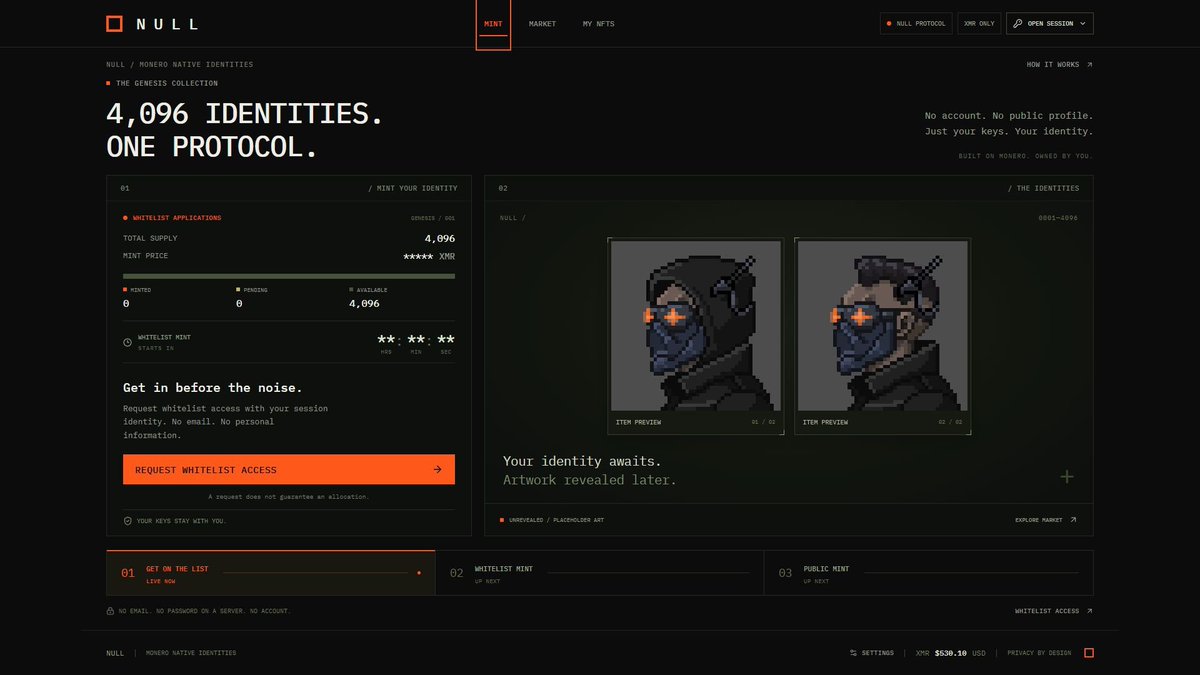
We have finally settled on the data packaging scheme for our protocol - @nullonxmr
The indexer comes first, followed by the minting service. Our immediate priority is to test the entire workflow on the testnet; stay tuned for announcements so you’re ready to help us debug the test version of our protocol.
We publish a link between the NFT output and its key image, backed by a DLEQ proof. That lets the indexer identify which NFT output was spent when that key image appears in a confirmed transaction. It then checks the new ownership output, authorization and payment proofs before accepting the transfer. The proofs are recorded in tx_extra, so others can repeat those checks/
The trade-off is that these NFT outputs become traceable. The published link also lets observers rule out that output as the real input in other rings with a different key image. So the privacy impact extends beyond the NFT’s own history, although the proof doesn’t reveal the private key or automatically expose the owner’s full wallet balance
https://t.co/fqvx4QNubL
As mentioned, we’ve started moving the protocol logic into the indexer. Development will be shared in this repository, so anyone can follow the progress
Each indexer will act as a node that reads the Monero blockchain, checks protocol operations and reconstructs collection and NFT ownership history. Independent indexers following the same rules should reach the same state from the same chain
The repository is open to contributions, comments and suggestions. Feel free to look through the code, ask questions or help with development as it takes shape
https://t.co/fqvx4QNubL
As mentioned, we’ve started moving the protocol logic into the indexer. Development will be shared in this repository, so anyone can follow the progress
Each indexer will act as a node that reads the Monero blockchain, checks protocol operations and reconstructs collection and NFT ownership history. Independent indexers following the same rules should reach the same state from the same chain
The repository is open to contributions, comments and suggestions. Feel free to look through the code, ask questions or help with development as it takes shape
On NFTs, Monero, and what can be verified
@nullonxmr@monero
There have been questions about what NULL is building and whether NFTs on Monero can be technically meaningful. Here is how the protocol approaches ownership, what is recorded on-chain, and which questions still need further testing and independent review.
NULL is being developed as an overlay protocol on Monero. Monero validates the underlying transactions, while NULL clients and indexers interpret the NFT operations and enforce the protocol’s rules
The artwork and descriptive metadata remain off-chain. Collection terms, content references, ownership operations and their proofs are recorded in transaction extra data. This provides a history that independent indexers can read and verify from the chain
Each NFT is bound to a specific transaction output. A purchase spends the seller’s NFT output and the buyer’s payment inputs in the same native transaction, creating the outputs required for the agreed ownership change and payments. Clients must verify both the transaction and the NFT’s history before signing
The intended result is ownership that can be reconstructed without trusting any website’s database. So, in any case, the on-chain records remain available for another implementation to interpret.
Collection creation and primary purchases have been demonstrated in a controlled development chain. An open-source release and a public testnet version are planned so the implementation, its assumptions and its limitations can be examined directly
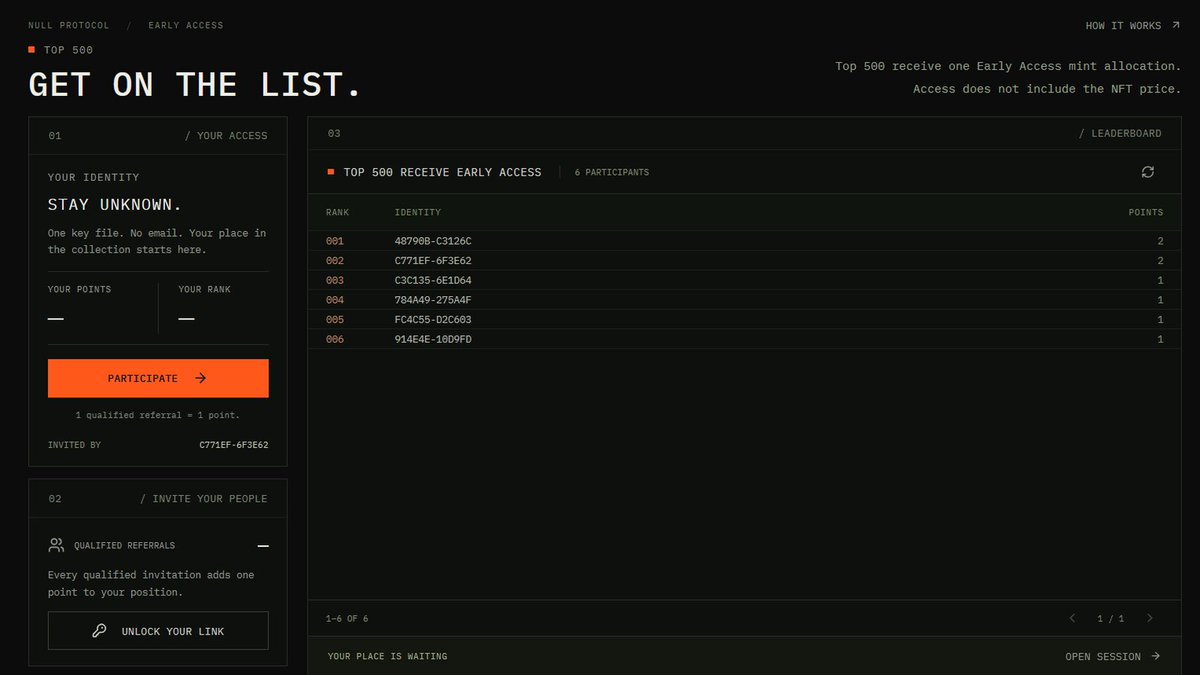
NULL ACCESS // OPEN
Top 500 receive Early Access.
1 qualified referral = 1 point.
No wallet connect. No email.
Create your identity. Climb the board.
https://t.co/3aolwikcbD
The protocol uses a shared-transaction approach: the buyer’s payment and the seller’s NFT output are spent in the same native Monero transaction. Both clients verify and sign it before broadcast
Minting follows the same flow, with the collection creator acting as the seller. Transaction coordination and signing are handled automatically within the seller’s configured terms
Local tests have covered collection creation and purchases of up to five NFTs in one transaction. Indexers will reconstruct ownership from the chain and validate the protocol rules
An open-source release and a public testnet version of the platform are planned, so anyone can try the full flow, inspect how it works, and help identify issues
Building a token layer on @monero.
We've tested collection creation and NFT purchases in native transactions. Indexers will reconstruct the state from the chain.
We plan to open-source the code and share devlogs here as we go.