Huge. British Govt announces:
• £165m: National AI Biosecurity Initiative: Includes £100m for a new AI Biosecurity Lab, using AI to detect emerging biological threats.
• £120m: AI Security Institute (AISI): Additional funding to strengthen AI risk research and evaluation.
• £70m: National Exposure and Real-Time Vulnerability (NERV) Centre: Identifying vulnerabilities in critical infrastructure.
• £60m: National Cyber Shield: Strengthening Britain’s cyber defences.
• £60m: UK Sovereign AI: Expanding investment into physical and industrial AI.
• £60m: R&D Procurement Scheme: Supporting companies developing AI security and NHS innovations.
• £30m: Mayoral AI Partnerships: Helping local businesses adopt AI, create jobs and improve public services.
• £23m : AI Economics Institute: Research into AI’s effects on productivity, employment and living standards.
• £18m: UK Advanced Chip Design Academy: Developing domestic semiconductor design expertise and reducing overseas dependencies.
I have just been looking at the 5-year performance records of all the Vanguard funds and ETF's available to UK investors, and I was quite surprised to learn that the S&P 500 ETF is only the 2nd best performer on this list.
Here are the top 25:
1. FTSE UK Equity Income Index Fund - 106.45%
2. S&P 500 UCITS ETF - 88.20%
3. Global Equity Income Fund - 87.03%
4. FTSE North America UCITS ETF - 85.00%
5. FTSE Developed Asia Pacific ex Japan UCITS ETF - 84.27%
6. US Equity Index Fund - 81.00%
7. FTSE Developed World ex-UK Equity Index Fund - 80.65%
8. FTSE Developed World UCITS ETF - 78.21%
9. FTSE 100 Index Unit Trust - 78.11%
10. FTSE 100 UCITS ETF - 77.79%
11. FTSE All-World High Dividend Yield UCITS ETF - 73.99%
12. LifeStrategy 100% Equity - 73.63%
13. FTSE All-World UCITS ETF - 72.83%
14. ESG Screened Developed World All Cap Equity Index Fund (UK) - 71.47%
15. FTSE Global All Cap Index Fund - 70.88%
16. ESG Developed World All Cap Equity Index Fund - 70.33%
17. FTSE UK All Share Index Unit Trust - 67.66%
18. ESG Global All Cap UCITS ETF - 65.34%
19. FTSE Developed Europe UCITS ETF - 62.36%
20. Japan Stock Index Fund - 60.79%
21. FTSE Japan UCITS ETF - 57.16%
22. FTSE Developed Europe ex UK UCITS ETF - 56.99%
23. Global Emerging Markets Fund - 56.48%
24. FTSE Developed Europe ex-UK Equity Index Fund - 55.68%
25. Emerging Markets Stock Index Fund - 55.01%
As you can see, the S&P 500 ETF is surprisingly eclipsed by the FTSE UK Equity Income Index Fund, which is focused on large-cap UK-listed dividend stocks, and therefore has a high weighting to energy, financial and healthcare stocks.
Indeed two of the top three are income funds, which shows how important dividends (and the reinvesting of dividends) can be in terms of long term performance.
However I will finish by repeating the famous saying, past performance is not indicative of future performance, because it's very true.
The biggest winners of the past five years may not necessarily be the biggest winners in the next five years, so this is something to bear in mind when deciding which ETFs or funds to invest in.
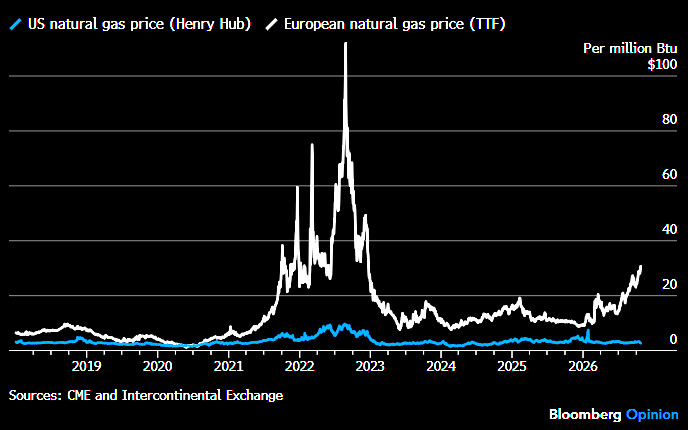
CHART OF THE DAY: The price of natural gas in the US 🇺🇸 and Europe 🇪🇺. Now, imagine running a gas-intensive company (say, a fertilizer plant) in either region. Europe >$30; US <$3
The EU's role in the collapse of the UK car industry
"Output peaked at 1.92 m vehicles during 1972, our last year before entering the EEC. During our first decade in the EEC and its Customs Union output slumped to 868,000 by 1982"
@johnredwood explains: https://t.co/xPoNqKnBlN
Median annual pay for full-time employees has passed £40,000 for the first time (£40,911, up 4.5%).
I think many people's mental benchmark for the “average salary” is still stuck at around £30k. Just over a third of full-time employees now earn above the higher-rate threshold!
@andyburnham@JohnHealey_MP Pls consider confidence boosting & growth initiatives in the budget:
-increase supply of energy (incl oil & gas, solar, wind, SMR)
-remove hurdles for construction of homes (planning, gateway 2&3)
-Track progress, & help infra projects worth £100M+
Very striking plunge in UK consumer confidence: biggest single-month drop since Covid April 2020. Usually a drop this steep is event-driven (saw a similar slump around Brexit) whereas it's harder to pin this on anything more specific than rising costs. https://t.co/iD892PrQXm
Australian pension fund investor IFM Investors has taken a 64% stake in Associated British Ports, in one of the biggest UK deals of the year https://t.co/YCvCMYpOwr
This is not correct. You shouldn’t reduce the rent that was agreed between the two parties. Pls take a note, this rule will hurt future supply of rental properties if you don’t correct it. This is back door for rental controls which have never worked. @KemiBadenoch@Nigel_Farage
This Labour government’s transformative Renters’ Rights Act empowers private renters to challenge unreasonable rent increases.
If a tenant believes a proposed rent increase is above the open-market rent, they can refer the matter to the First-tier Tribunal.
In a recent case in Manchester where the Landlord proposed an increase in rent from £1,650 per calendar month to £1,700, the Tribunal determined the open market rent was actually £1,450 per calendar month.
We’re standing up for renters and our reforms are working.
https://t.co/wX1g3r33mV
Regular wage growth in the three months to August 2026 rose to 3.7% excluding bonuses.
Including bonuses, the rate was 3.7%, down from the previous period.
Read the release ➡ https://t.co/kjHLiJwsV1
Sheer stupidity, if u really meant it! These are golden weeks in investing that offers a lot of learning to any investor, and more so for young ones. Reminds me of Munger’s quote that the most important organ in investing is not brain but stomach.
Watch out what u teach them!
about to speak to a group of 150 high school seniors about the importance of investing
given the state of the equity markets today, gonna tell them all that its just a scam
Great comments, Stephen! Cant agree more. 👏👏
@MartinSLewis What you do to UK is great but pls help people to invest in equities as well and not just find ways to save or cut costs. People can’t generate wealth just by investing everything in cash ISAs and premium bonds.
I hate the @MartinSLewis approach to financial life it’s thinking small saving tiny amounts - save a little money every week and you’ll have…not much money, it’s a take no risk don’t invest approach to life, be timorous - I can’t stand it as it reflects a narrowness and is now what Britain is.
I am surrounded by friends who keep money in cash who are afraid - I see this behaviour as no better than buying huge amounts of groceries and then dumping them unused at the end of every week. The nation’s potential is going to waste.
Financial regulation adds to the problem: be afraid, risk, risk, don’t do it, you may lose money, past performance doesn’t guarantee future performance, stocks can go down. Where is the requirement to say to people: don’t open a bank account, inflation will destroy you?
The fundamental issue is that it confuses financial triage with wealth creation.
Martin Lewis acts as an ombudsman running damage control for households on the margins. But damage control is not an investment strategy, and you cannot coupon-clip your way to financial independence:
• The upside of cutting back is hard-capped; the upside of growth is asymmetrical. The absolute most you can save is whatever you currently spend. By contrast, investing in productive assets and scaling earning power has no mathematical ceiling. Obsessing over a 0.2% edge on an easy-access cash ISA burns enormous mental bandwidth for trivial absolute returns.
• It institutionalises a scarcity mindset. Spending three hours hunting a £25 cashback loophole trains people to view life through a lens of defensive survival rather than offensive acquisition. That energy is far better spent building high-value skills or understanding long-term equity compounding.
• It reinforces a cultural allergy to risk. The UK personal finance mainstream remains attached to Premium Bonds, cash ISAs, and capital preservation over owning productive businesses. It is a posture of managed decline: avoid mistakes, don't stand out, mend and make do.
Penny-pinching can keep you from going broke, but it will never build financial freedom. Real upside requires risk and an open mindset.
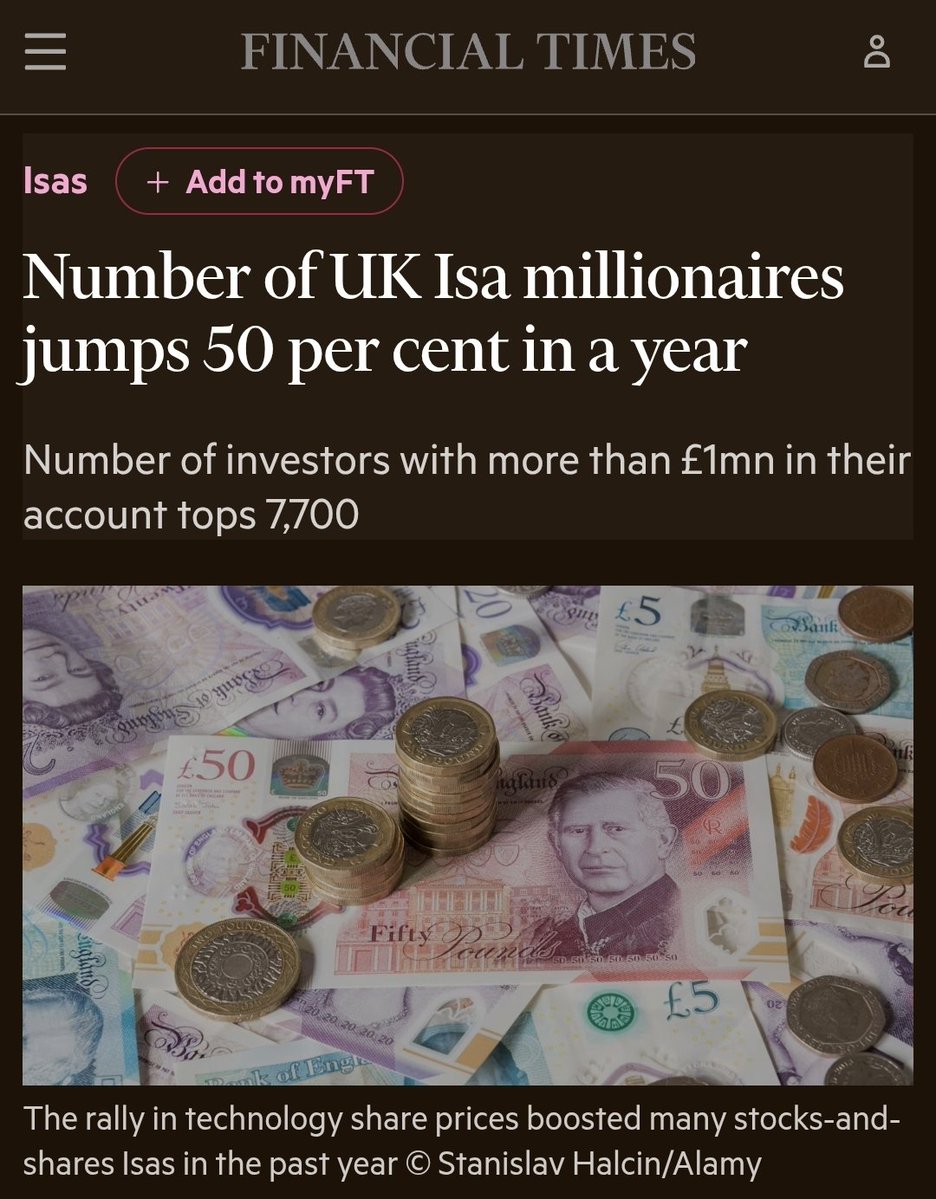
Honestly, the only thing I like about the UK is the Stocks and Shares ISA account.
The number of ISA millionaires rose from 5,070 in April 2023 to 7,730 in April 2024. That’s a 52% increase in just one year.
For those of you who don’t know what an ISA is, it’s a tax-free account where you can invest up to £20,000 each tax year, and any gains you make are free from UK capital gains tax.
One day, I hope to reach this milestone.
There’s a lot of self-serving spin emanating from the UK government about how virtuous it is re fiscal consolidation.
Here are the facts.
Labour inherited an OBR budget deficit forecast of £87bn (3.1% GDP) for FY2024/25. After R Reeves’ 1st disastrous budget the actual deficit was £153bn (5.2%). Massive jump.
Labour inherited OBR budget deficit of £77bn (2.7%) for FY2025/26. After RR’s disastrous 2nd budget that turned out to be £133bn (4.3%).
So in its first two years it added over £120bn to borrowing/deficit (despite huge increase in taxes).
The OBR forecast it inherited for this FY2026/27 was £69bn (2.3%). It is now forecast to be £116bn (3.3%). That looks like an underestimate. More likely to be closer to £130bn again.
Inherited budget forecast for 2027/28: £51bn (1.6%). Latest forecast: £97bn (2.9%).
Inherited budget forecast for 2028/29: £39bn (1.2%). Latest forecast: £86bn (2.5%).
Far from fiscal consolidation Labour is forecast to borrow an incredible £260bn more over the 5 years from 2024/25 than the forecasts it inherited. Despite the tax rises.
Which will continue. Alone among G7 countries the IMF projects the UK tax burden to rise by 3.7% of GDP 2025-31. The only other country with a rising tax burden is France (0.8%). Italy is static. Rest of G7 have falling tax burden.
And let’s not forget Labour’s so-called ‘fiscal consolidation’ is all backloaded to end-decade. Unlikely to happen. So taxes will have to rise by even more.
Can’t agree more with you!
@JohnHealey_MP - time to deliver a growth boosting budget? Pls think deeply why construction is bringing gdp figures down for last 2 yrs. Isn’t it time to fix it?
Boosting energy production at home is a no brainer - gives immediate results.
ONS: UK GDP grows at its fastest annual rate in 4 years.
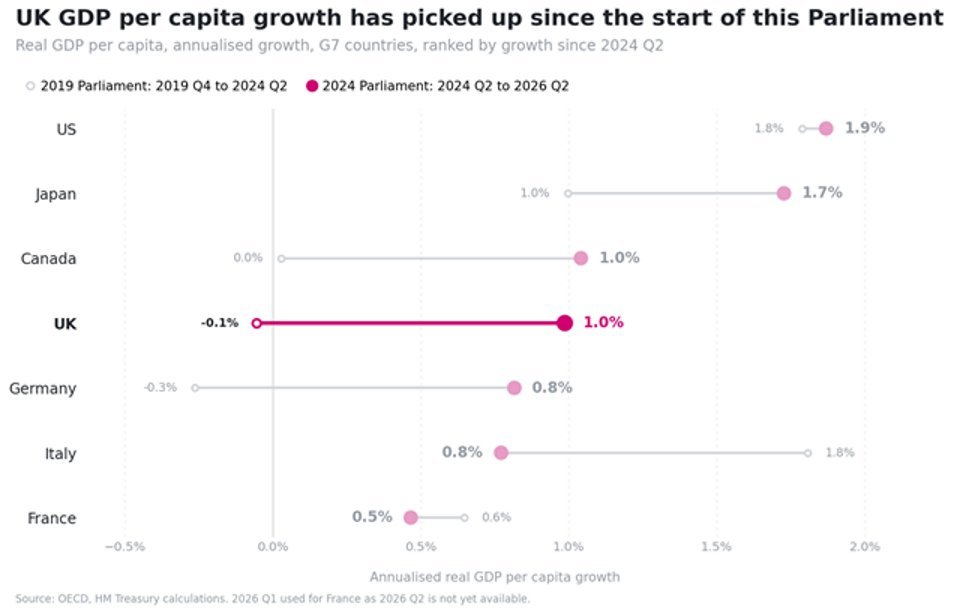
We had the fastest rate of GDP growth in the G7 in first half of 2026.
How about GDP per person? After a totally miserable performance under the anti-growth Conservaties, we're now on the up again since the election.
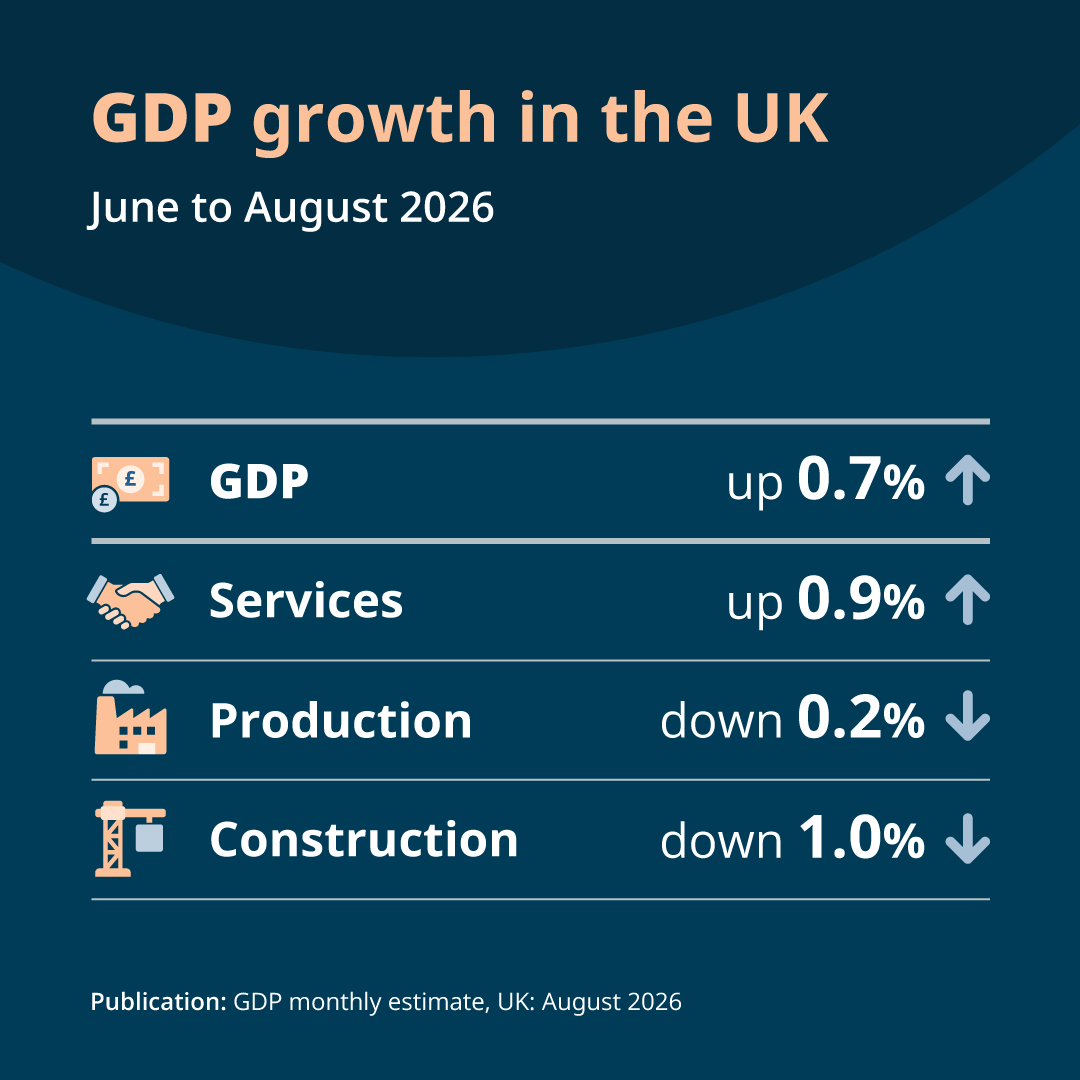
GDP grew 0.7% in the three months to August 2026, following revised growth of 0.5% in the three months to July.
Services grew (+0.9%) while production (-0.2%) and construction (-1.0%) both fell.
Read the full article ➡️ https://t.co/Cx45uRuVoN